Text to imageProductStyle guide
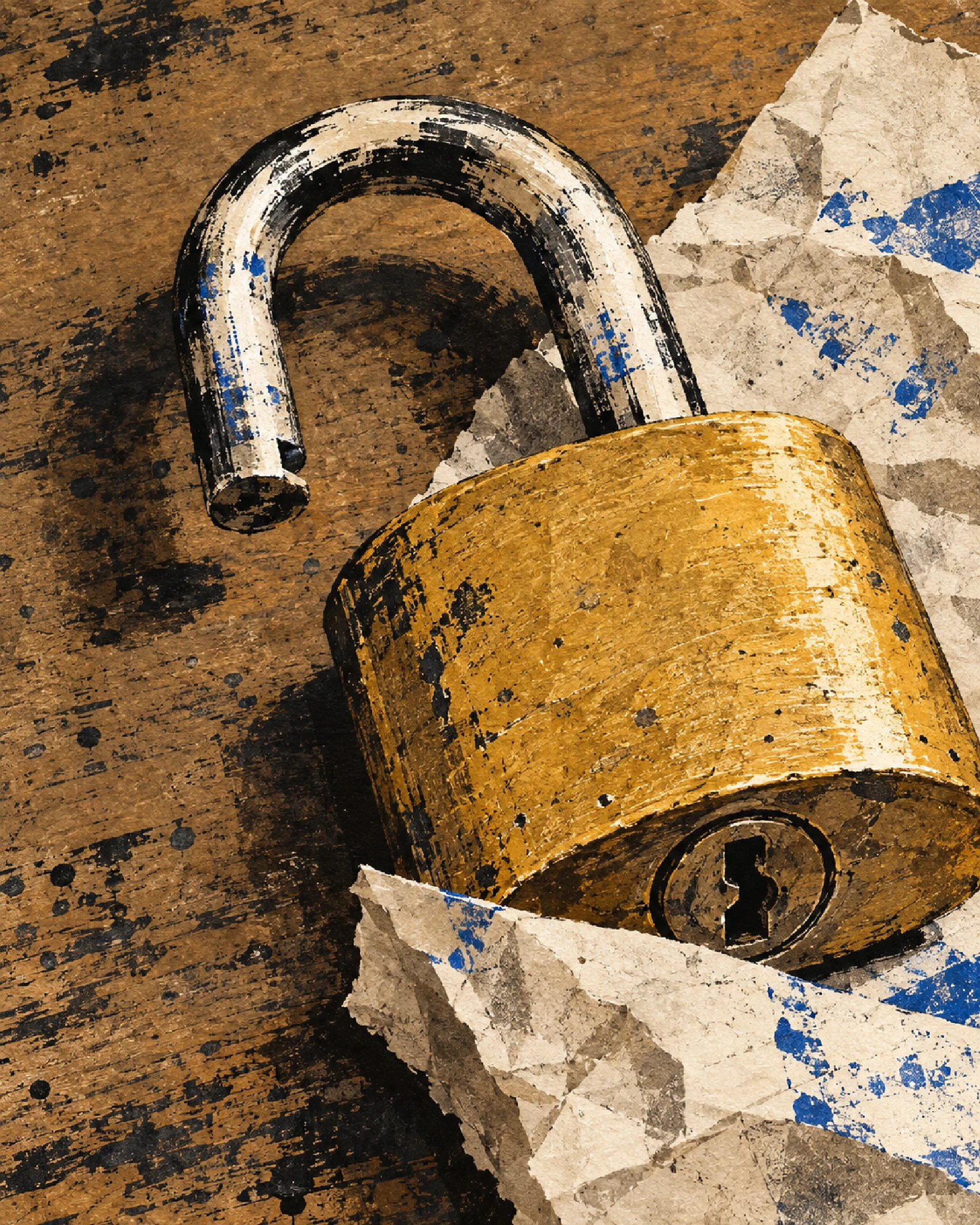
Open Padlock in Creased Paper
An intimately cropped product poster of a substantial padlock emerging from creased wrapping, built from bleeding ink and displaced print impressions.
Remix this referenceOpen Padlock in Creased Paper
- Form language
- Reduce volumes to weighty, slightly skewed cut shapes; preserve structural gaps while allowing irregular silhouettes.
- Contour
- Alternate swollen brush edges with dry, abruptly broken strokes; let selected contours disappear into printed masses.
- Mark-making
- Combine dragged ink streaks with displaced duplicate impressions; let accidental blots punctuate otherwise economical marks.
- Surface rendering
- Build tone through translucent overprints, broken roller deposits and occasional ink pools, with exposed paper between passes.
Priority
Maintain the visibly experimental combination of expressive ink drawing and imperfect print impressions.
What to avoid & what to check
Exact prompt for this example
MODULE OWNERSHIP
subject: Subject count, type, stable proportions and landmarks, resting face geometry, hair shape, physical materials, garment construction and permanent marks. No emotion, movement, color assignment or rendering recipe.
expression: Facial soft-tissue displacement and pupil direction, muscle coordination, regional intensity, asymmetry and onset/peak/release. No head/body pose, stable appearance, skin color or rendering.
gesture: Head/neck/body/limb orientation, joint movement, support, contact and pose-caused occlusion using existing anatomy. No eye/pupil movement, emotion, identity, props inventory or camera.
props: Prop count, type, construction, physical material and scale relative to the subject. Holding/contact belongs to gesture, position to composition, color to palette.
scene: Environment elements, terrain, backdrop/floor presence and structural detail. No canvas positions, camera, lighting, assigned colors or render texture.
camera: Projection, focal-length impression, camera elevation/yaw/roll, viewing distance and crop. No actor pose, world placement, lighting or canvas aspect ratio.
composition: Normalized 0-100% canvas positions, scale in frame, depth/overlap, focal hierarchy and margins. No joint pose, camera projection, rendering, subject/prop inventory or emotion.
palette: Color anchors, hue/saturation/value ranges, colors assigned to parts and approximate color coverage. No illumination direction, shading algorithm, physical material or layout.
lighting: Light-source direction/softness/intensity, ambient illumination, physical shadow direction/length and highlight position. Absence of directional illumination is allowed. No shading technique, palette or material changes.
style: Reusable form abstraction, contour weight/taper/edge quality, medium and mark scale/density/direction, surface rendering and tonal transition technique. No fixed subject proportions, anatomy, identity, expression, pose, palette, light-source direction, camera or layout.
output: Image count, aspect ratio, size, file/alpha requirements and global lettering/logo/watermark restrictions. No background scenery, crop, style, identity or pose.

SUBJECT
inventory: One original, unbranded padlock is the sole product; no people or animals.
geometry: A broad flattened body has rounded shoulders, an offset U-shaped shackle with one free tip and a recessed round keyway.
resting-face: No facial anatomy applies.
appearance: The body is cast brass and the shackle is steel; minor casting pits and handling scuffs may vary naturally.

PRIORITY


AVOID


CHECK


PROPS
inventory: One sheet of wrapping paper, several times wider than the padlock.
construction: Thin fibrous paper has an irregular torn edge, deep creases and a loosely folded pocket.

PRIORITY


AVOID


CHECK


SCENE
inventory: A plain packing-table surface provides the entire environment; no horizon or room architecture is visible.
structure: The tabletop is continuous and subtly worn, without decorative pattern or additional fixtures.

PRIORITY


AVOID


CHECK


CAMERA
projection: Use perspective with a short-telephoto impression and restrained depth distortion.
viewpoint: View closely from above and slightly to one side, revealing both the broad face and one thick sidewall.
crop: Use an intimate detail crop that cuts through the lower body while retaining the whole open shackle.

PRIORITY


AVOID


CHECK


COMPOSITION
placement: Let the product fill the lower-right area; its open arc reaches toward the upper-left third.
depth: Paper overlaps the bottom corner of the body and recedes behind it; the shackle opening remains unobstructed.
spacing: Make the open shackle the first read, the keyway second; leave an irregular quiet field along the left edge.

PRIORITY


AVOID


CHECK


PALETTE
colors: Use carbon black, mustard ochre, chalk cream and a small electric-blue accent.
assignment: Assign ochre to the body, black and cream to the shackle, cream to paper, and blue to selected printed echoes.
balance: Cream and ochre occupy the broad areas; dense black anchors the image and blue stays sharply limited.

PRIORITY


AVOID


CHECK


LIGHTING
sources: A broad window source from the upper right provides soft directional illumination with modest ambient fill.
shadows: A short shadow falls toward the lower left, tightening beneath the body and softening across paper folds.
highlights: Broad highlights catch the upper-right shoulder and the outer bend of the shackle.

PRIORITY


AVOID


CHECK


STYLE GUIDE
form-language: Reduce volumes to weighty, slightly skewed cut shapes; preserve structural gaps while allowing irregular silhouettes.
contour: Alternate swollen brush edges with dry, abruptly broken strokes; let selected contours disappear into printed masses.
mark-making: Combine dragged ink streaks with displaced duplicate impressions; let accidental blots punctuate otherwise economical marks.
surface-rendering: Build tone through translucent overprints, broken roller deposits and occasional ink pools, with exposed paper between passes.

PRIORITY
Maintain the visibly experimental combination of expressive ink drawing and imperfect print impressions.

AVOID


CHECK


OUTPUT
format: One finished image, portrait 4:5, 1600 × 2000 pixels, opaque PNG.
restrictions: Deliver one opaque PNG at 1600 × 2000 pixels, portrait 4:5; no lettering, logos or watermarks.

PRIORITY


AVOID


CHECK
Model information comes from image provenance. The same prompt may produce a different result.