Text to imageAnimationStyle guide
Wringing Rain from Her Braid
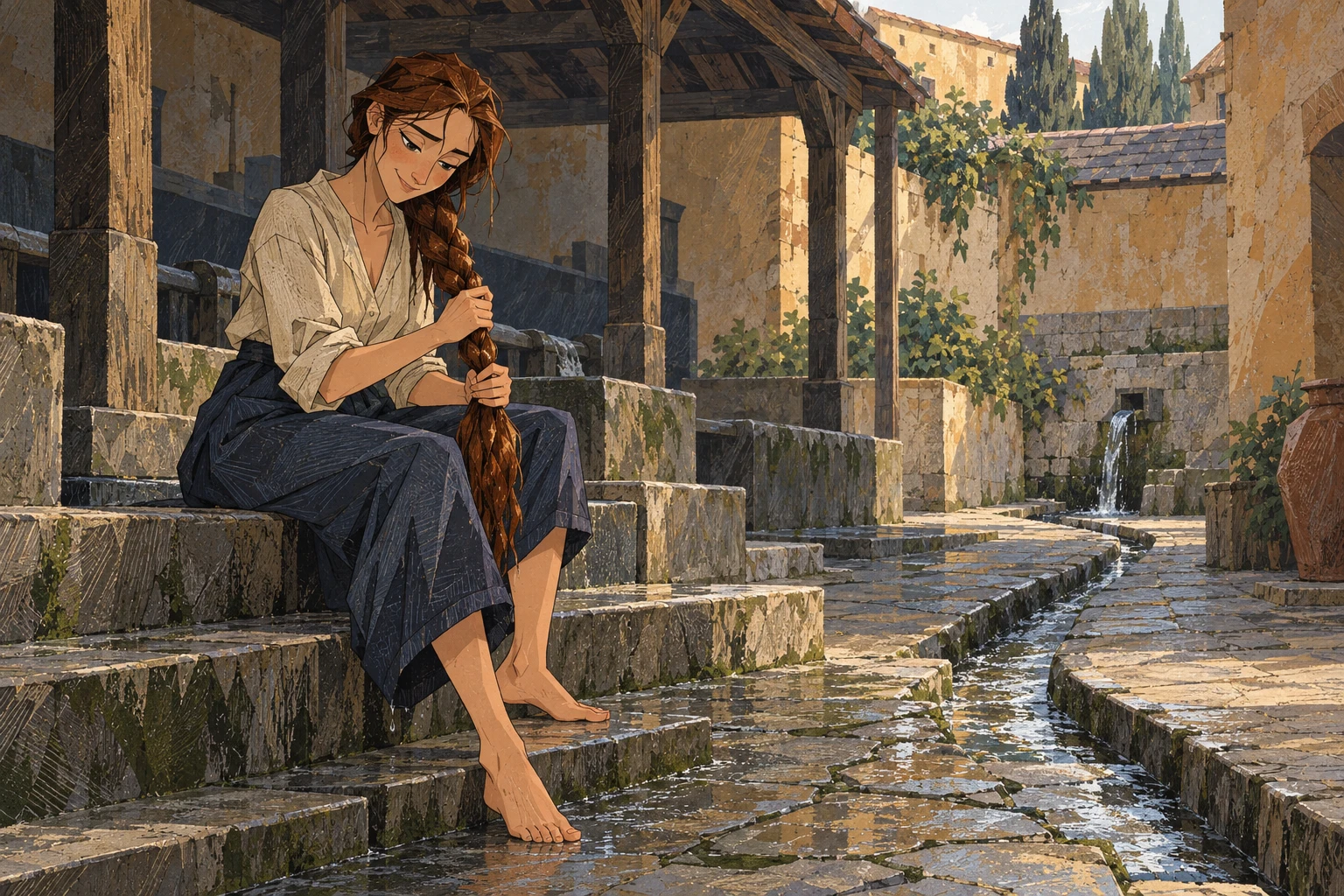
After the rain, a woman sits on a communal washhouse step, wringing her braid with a small amused smile. An empty courtyard and winding drain open around her through carved lines and angular planes.
Remix this referenceWringing Rain from Her Braid
- Form language
- Translate forms into interlocking angular planes, allowing slight skew and unequal facets within a coherent graphic vocabulary.
- Contour
- Use slightly irregular straight and angular contours like carved cuts, with broken joins and occasional tapered endings.
- Mark-making
- Group short parallel hatches into selective passages; let restrained scratches vary naturally in length and spacing.
- Surface rendering
- Build flat printed planes with limited paper grain and discrete hatched tonal regions; replace continuous modeling with stepped value changes.
Priority
Rendering medium: 2D woodcut-print animated-film illustration; formal rendering reference: Cartoon Saloon · 2020s · Wolfwalkers (2020), town sequences
What to avoid & what to check
Exact prompt for this example
MODULE OWNERSHIP
subject: Subject count, type, stable proportions and landmarks, resting face geometry, hair shape, physical materials, garment construction and permanent marks. No emotion, movement, color assignment or rendering recipe.
expression: Facial soft-tissue displacement and pupil direction, muscle coordination, regional intensity, asymmetry and onset/peak/release. No head/body pose, stable appearance, skin color or rendering.
gesture: Head/neck/body/limb orientation, joint movement, support, contact and pose-caused occlusion using existing anatomy. No eye/pupil movement, emotion, identity, props inventory or camera.
props: Prop count, type, construction, physical material and scale relative to the subject. Holding/contact belongs to gesture, position to composition, color to palette.
scene: Environment elements, terrain, backdrop/floor presence and structural detail. No canvas positions, camera, lighting, assigned colors or render texture.
camera: Projection, focal-length impression, camera elevation/yaw/roll, viewing distance and crop. No actor pose, world placement, lighting or canvas aspect ratio.
composition: Normalized 0-100% canvas positions, scale in frame, depth/overlap, focal hierarchy and margins. No joint pose, camera projection, rendering, subject/prop inventory or emotion.
palette: Color anchors, hue/saturation/value ranges, colors assigned to parts and approximate color coverage. No illumination direction, shading algorithm, physical material or layout.
lighting: Light-source direction/softness/intensity, ambient illumination, physical shadow direction/length and highlight position. Absence of directional illumination is allowed. No shading technique, palette or material changes.
style: Reusable form abstraction, contour weight/taper/edge quality, medium and mark scale/density/direction, surface rendering and tonal transition technique. No fixed subject proportions, anatomy, identity, expression, pose, palette, light-source direction, camera or layout.
output: Image count, aspect ratio, size, file/alpha requirements and global lettering/logo/watermark restrictions. No background scenery, crop, style, identity or pose.

SUBJECT
inventory: One adult human woman, actor A; no other figures or animals.
geometry: A long-limbed adult with broad palms, a narrow chin and a substantial braid reaching her waist.
resting-face: A long nose, shallow-set almond eyes, straight brows and a broad mouth with a fuller lower lip.
appearance: Heavy damp hair, a linen shirt with turned-back cuffs, loose calf-length trousers and bare feet.

PRIORITY


AVOID


CHECK


EXPRESSION — ACTOR A
brows: Brows settle low and loose, with one outer end slightly raised.
lids: Upper lids soften downward; lower lids lift slightly.
cheeks: A small uneven cheek lift follows the smile.
nose: Nostrils remain relaxed without a nose wrinkle.
mouth: Closed lips curl into a small smile, stronger at the left corner.
jaw: The jaw releases without opening the mouth.
gaze: Pupils turn down toward her braid.
coordination: The cheek lift supports the uneven mouth corners while the upper face stays quiet.
timing: Catch the release of a private chuckle, with the smile still lingering.

PRIORITY


AVOID


CHECK


GESTURE
head: Her neck bends gently sideways, bringing the braid forward beside her shoulder.
torso: She sits sideways on a step, torso inclined slightly toward her working hands.
limbs: Both elbows bend loosely; one foot rests on the lower step while the other reaches the courtyard floor.
contact: One hand grips the braid above the other; the hands counterturn and compress its lower length.

PRIORITY


AVOID


CHECK


PROPS
inventory: No separate props.
construction: No prop construction applies.

PRIORITY


AVOID


CHECK


SCENE
inventory: An open communal washhouse courtyard with stone steps, a shallow drain, plaster walls and a timber canopy.
structure: The drain bends through worn paving toward a wall outlet; rain beads and a thin falling rivulet suggest the recent shower.

PRIORITY


AVOID


CHECK


CAMERA
projection: Perspective with a moderate normal-lens impression and restrained depth exaggeration.
viewpoint: View obliquely into the courtyard from just above her eye level, with a level horizon.
crop: A medium-wide view includes her whole figure and enough courtyard to establish the washhouse.

PRIORITY


AVOID


CHECK


COMPOSITION
placement: A occupies the left third, about half the frame height; her face and hands form the primary focal cluster.
depth: A foreground paving edge overlaps the steps; the drain leads past A into the quieter rear courtyard.
spacing: Leave a spacious open interval across the right half, with irregular architectural gaps and generous clearance above her head.

PRIORITY


AVOID


CHECK


PALETTE
colors: Use chalk ochre, subdued indigo, copper brown and pale stone, with a narrow range of muted greens.
assignment: Ochre plaster, indigo clothing, copper-brown hair, warm beige skin and pale stone paving with muted green damp patches.
balance: Pale mineral colors dominate; indigo supplies the largest dark accent and copper remains a small warm note.

PRIORITY


AVOID


CHECK


LIGHTING
sources: Broad soft daylight enters from the upper right through the open courtyard, with gentle ambient fill.
shadows: Short diffuse shadows fall left beneath the canopy, steps and figure.
highlights: Small highlights touch the upper-right edges of wet hair and the water, without a glowing rim.

PRIORITY


AVOID


CHECK


STYLE GUIDE
form-language: Translate forms into interlocking angular planes, allowing slight skew and unequal facets within a coherent graphic vocabulary.
contour: Use slightly irregular straight and angular contours like carved cuts, with broken joins and occasional tapered endings.
mark-making: Group short parallel hatches into selective passages; let restrained scratches vary naturally in length and spacing.
surface-rendering: Build flat printed planes with limited paper grain and discrete hatched tonal regions; replace continuous modeling with stepped value changes.

PRIORITY
Rendering medium: 2D woodcut-print animated-film illustration; formal rendering reference: Cartoon Saloon · 2020s · Wolfwalkers (2020), town sequences

AVOID


CHECK


OUTPUT
format: One finished image, 3:2 landscape, 1536 × 1024 pixels, opaque PNG.
restrictions: No lettering, logos, signatures or watermarks.

PRIORITY


AVOID


CHECK


FINAL INTEGRATION
subject + gesture + expression: Keep the braid's identity clear through the hand contact while the facial performance remains readable.
style + lighting + palette: Translate the illumination into the chosen tonal vocabulary while preserving the assigned color relationships.
Art direction
카툰 살롱 / Cartoon Saloon · 2020s · 울프워커스(2020)의 도시 장면 / Wolfwalkers (2020), town sequences ↗- Transfer the angular planar abstraction of the town sequences to generic form surfaces
- Slightly irregular straight and angular contours resembling carved lines
- Short parallel hatch groups and restrained scratched marks
- Flat planes with limited paper texture and hatched tonal regions, without continuous modeling
Model information comes from image provenance. The same prompt may produce a different result.