Text to imageArt stylesStyle guide
Sow at the Garden Gate
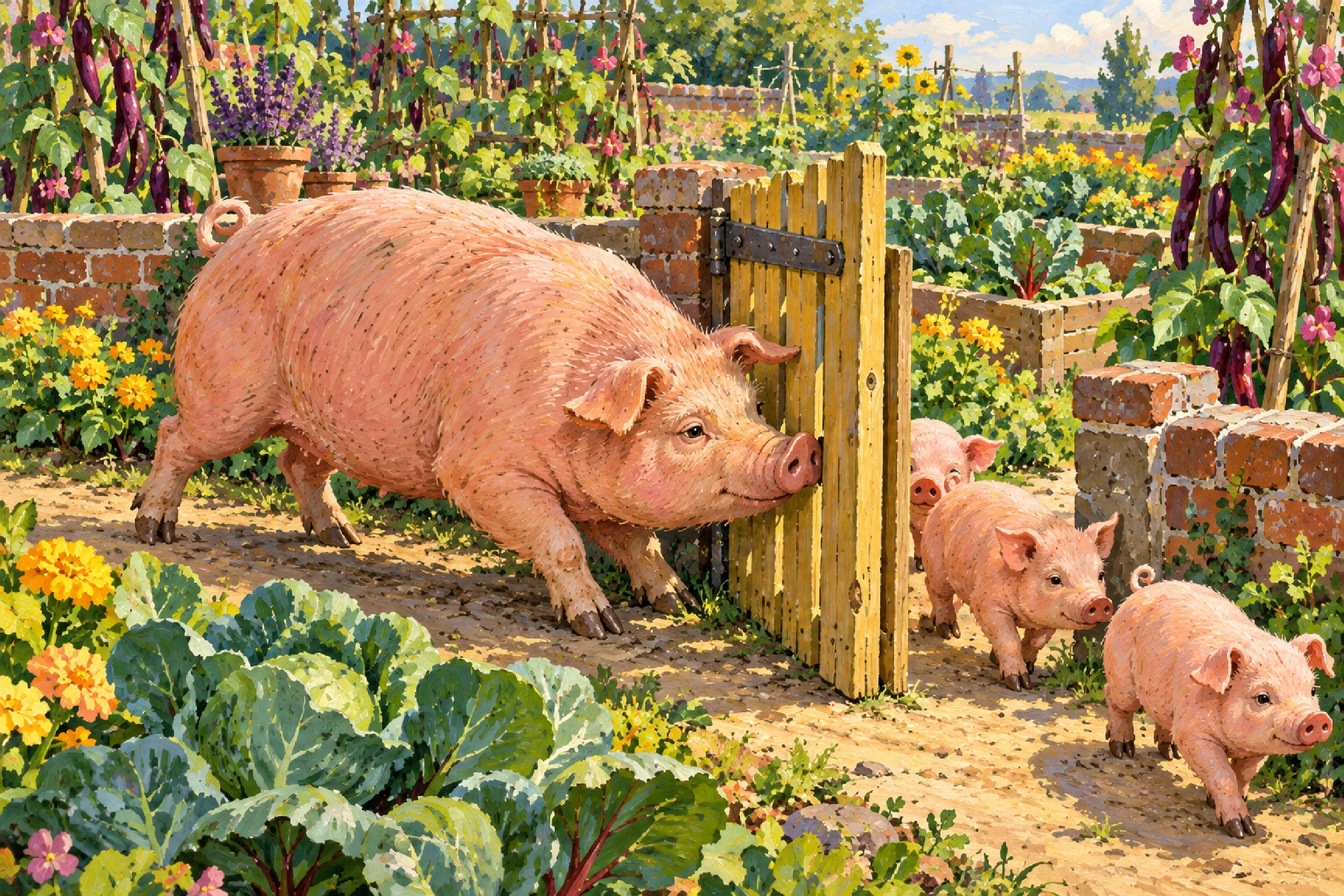
A folk painting of a sow pushing a garden gate as piglets slip through. Overlapping animals and vegetable beds mingle through lively brushwork and simple decoration.
Remix this referenceSow at the Garden Gate
- Form language
- Reduce forms to buoyant interlocking silhouettes and repeated decorative units; allow charming inconsistencies in descriptive detail.
- Contour
- Use wandering brush outlines with blunt turns, uneven thickness and occasional gaps instead of mechanically uniform edging.
- Mark-making
- Make rounded dabs, hooked strokes and short hatch clusters with a springy brush; vary their rhythm rather than stamping repeats.
- Surface rendering
- Layer opaque folk-painting patches with visible drag and small underpaint glimpses; use stepped tonal changes and decorative accents.
Priority
Keep naive folk painting visible through lively simplification and individually brushed decoration.
What to avoid & what to check
Exact prompt for this example
MODULE OWNERSHIP
subject: Subject count, type, stable proportions and landmarks, resting face geometry, hair shape, physical materials, garment construction and permanent marks. No emotion, movement, color assignment or rendering recipe.
expression: Facial soft-tissue displacement and pupil direction, muscle coordination, regional intensity, asymmetry and onset/peak/release. No head/body pose, stable appearance, skin color or rendering.
gesture: Head/neck/body/limb orientation, joint movement, support, contact and pose-caused occlusion using existing anatomy. No eye/pupil movement, emotion, identity, props inventory or camera.
props: Prop count, type, construction, physical material and scale relative to the subject. Holding/contact belongs to gesture, position to composition, color to palette.
scene: Environment elements, terrain, backdrop/floor presence and structural detail. No canvas positions, camera, lighting, assigned colors or render texture.
camera: Projection, focal-length impression, camera elevation/yaw/roll, viewing distance and crop. No actor pose, world placement, lighting or canvas aspect ratio.
composition: Normalized 0-100% canvas positions, scale in frame, depth/overlap, focal hierarchy and margins. No joint pose, camera projection, rendering, subject/prop inventory or emotion.
palette: Color anchors, hue/saturation/value ranges, colors assigned to parts and approximate color coverage. No illumination direction, shading algorithm, physical material or layout.
lighting: Light-source direction/softness/intensity, ambient illumination, physical shadow direction/length and highlight position. Absence of directional illumination is allowed. No shading technique, palette or material changes.
style: Reusable form abstraction, contour weight/taper/edge quality, medium and mark scale/density/direction, surface rendering and tonal transition technique. No fixed subject proportions, anatomy, identity, expression, pose, palette, light-source direction, camera or layout.
output: Image count, aspect ratio, size, file/alpha requirements and global lettering/logo/watermark restrictions. No background scenery, crop, style, identity or pose.

SUBJECT
inventory: One adult sow, actor A, and three small piglets; no human figures.
geometry: The sow has a long barrel body, wedge-shaped head and short sturdy legs; piglets have compact matching construction.
resting-face: Small inset eyes, a broad snout disk and a low mouth line define the pigs' resting faces.
appearance: Sparse bristles, folded ear tips and cloven hooves; no clothing. Minor bristle shapes may vary.

PRIORITY


AVOID


CHECK


EXPRESSION — ACTOR A
brows: Brow tissue gathers faintly above the inner eye corners.
lids: Upper lids lower slightly; lower lids tighten gently.
cheeks: The cheek on the contact side bunches slightly more than the other.
nose: Nostrils widen gently without a wrinkled snarl.
mouth: The mouth stays closed, with the contact-side corner compressed.
jaw: The jaw stays closed with mild tension beneath the muzzle.
gaze: The visible pupil turns toward the gate beside the snout.
coordination: Keep upper-face effort mild while cheek and mouth compression carry the strain.
timing: Hold the apex of steady effort before the muzzle relaxes.

PRIORITY


AVOID


CHECK


GESTURE
head: A lowers the head and presses the side of the snout against the gate.
torso: A leans forward into the push while the hindquarters remain firmly supported.
limbs: A braces the forelegs unevenly; the piglets take short steps through the opening.
contact: A's snout meets a gate slat and all visible hooves meet the path.

PRIORITY


AVOID


CHECK


PROPS
inventory: No separate props; the gate belongs to the garden structure.
construction: No prop construction applies.

PRIORITY


AVOID


CHECK


SCENE
inventory: A kitchen garden contains a hinged wooden gate, low masonry walls, vegetable beds and tall flowering bean poles.
structure: An earth path threads between raised beds; uneven gate slats and climbing bean stems give the enclosure character.

PRIORITY


AVOID


CHECK


CAMERA
projection: Use shallow illustrative perspective with a mild wide-lens impression.
viewpoint: Look slightly downward and diagonally across the gate, with a level horizon.
crop: Include the pigs and the surrounding garden; crop a few outer plants at the picture edges.

PRIORITY


AVOID


CHECK


COMPOSITION
placement: Set the sow left of center and let the gate opening lead toward the piglet group on the right.
depth: Overlap sow, gate and piglets in a readable chain; partly hide one piglet behind the gate and stack beds beyond.
spacing: The gate encounter is the main focus; leave small breathing gaps between the dense garden clusters.

PRIORITY


AVOID


CHECK


PALETTE
colors: Choose coral pink, cabbage green, butter yellow, brick red and deep plum.
assignment: Coral belongs to the pigs, greens to planting, yellow to gate and path, brick red to walls, plum to accents.
balance: Let greens and warm yellows carry broad areas; keep coral distinct and plum sparse.

PRIORITY


AVOID


CHECK


LIGHTING
sources: Soft afternoon daylight comes broadly from the upper right with ample ambient fill.
shadows: Short soft shadows fall toward the lower left beneath pigs, gate and planting.
highlights: Gentle highlights touch the pigs' upper backs and the upper edges of leaves.

PRIORITY


AVOID


CHECK


STYLE GUIDE
form-language: Reduce forms to buoyant interlocking silhouettes and repeated decorative units; allow charming inconsistencies in descriptive detail.
contour: Use wandering brush outlines with blunt turns, uneven thickness and occasional gaps instead of mechanically uniform edging.
mark-making: Make rounded dabs, hooked strokes and short hatch clusters with a springy brush; vary their rhythm rather than stamping repeats.
surface-rendering: Layer opaque folk-painting patches with visible drag and small underpaint glimpses; use stepped tonal changes and decorative accents.

PRIORITY
Keep naive folk painting visible through lively simplification and individually brushed decoration.

AVOID


CHECK


OUTPUT
format: One finished image, landscape 3:2, 2400 × 1600 pixels, opaque PNG.
restrictions: No lettering, logos or watermarks.

PRIORITY


AVOID


CHECK


FINAL INTEGRATION
expression + gesture + scene: Coordinate facial compression with the physical contact so the sow's effort feels coherent.
gesture + scene + composition: Coordinate the gate's structure with the animal action so the overlapping encounter reads immediately.
palette + style: Let the color roles remain recognizable through freely varied decorative brushwork.
Model information comes from image provenance. The same prompt may produce a different result.