Text to imageProductStyle guide
Watering Can with a Detachable Rose
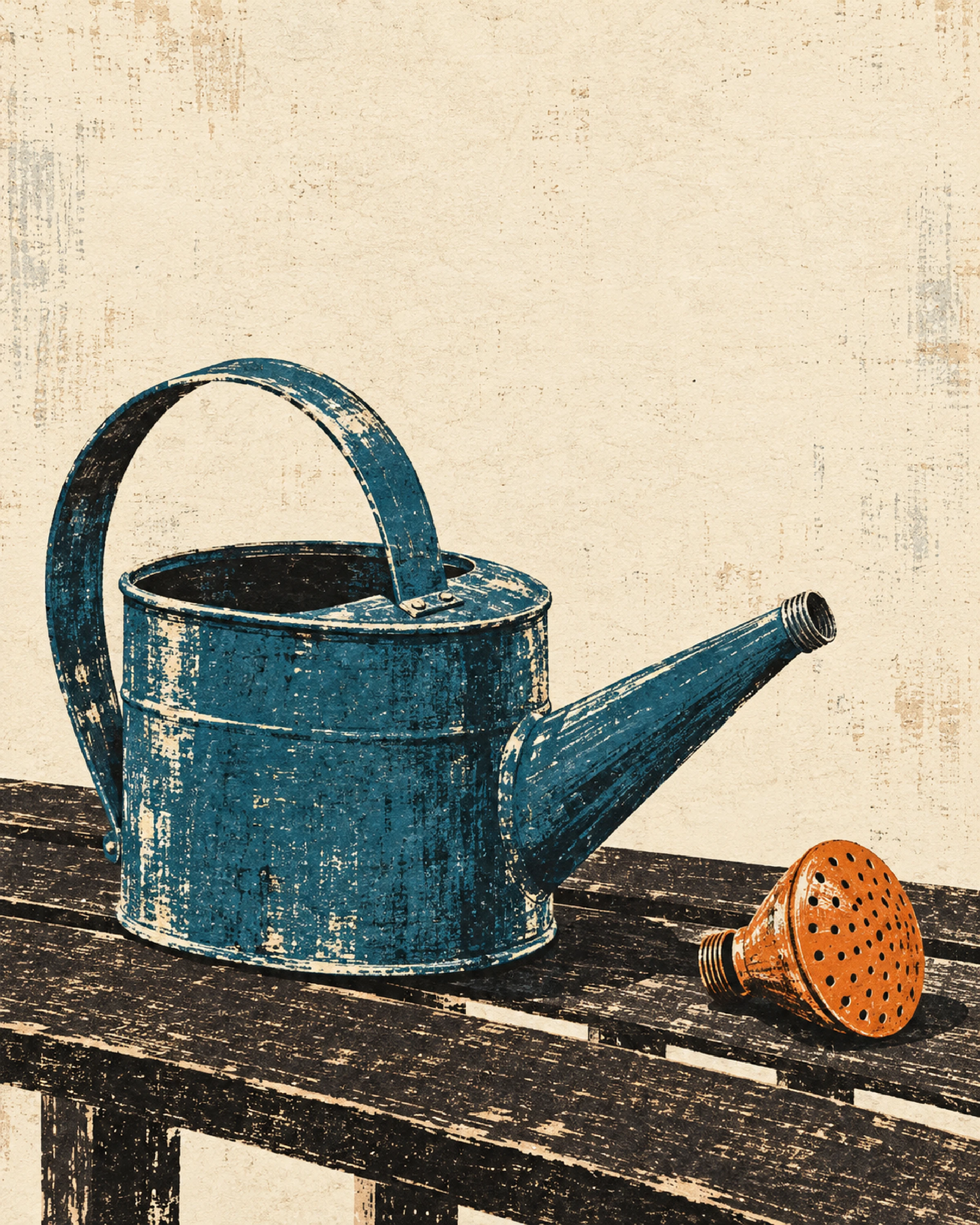
An experimental ink-print product poster built around an open strap handle and a detached sprinkler rose.
Remix this referenceWatering Can with a Detachable Rose
- Form language
- Reduce volumes to interlocking cut shapes, retaining useful openings and connections while simplifying minor detail.
- Contour
- Use blunt relief-print edges with occasional chipped interruptions; let selected silhouettes exist without an outline.
- Mark-making
- Drag broad ink strokes across the shapes and add sparse scraped cuts; pressure and mark spacing vary naturally.
- Surface rendering
- Build tones through uneven ink transfer and translucent overprints, with small registration slips and exposed paper.
Priority
Make experimental ink-and-print processes visibly shape the image.
What to avoid & what to check
Exact prompt for this example
MODULE OWNERSHIP
subject: Subject count, type, stable proportions and landmarks, resting face geometry, hair shape, physical materials, garment construction and permanent marks. No emotion, movement, color assignment or rendering recipe.
expression: Facial soft-tissue displacement and pupil direction, muscle coordination, regional intensity, asymmetry and onset/peak/release. No head/body pose, stable appearance, skin color or rendering.
gesture: Head/neck/body/limb orientation, joint movement, support, contact and pose-caused occlusion using existing anatomy. No eye/pupil movement, emotion, identity, props inventory or camera.
props: Prop count, type, construction, physical material and scale relative to the subject. Holding/contact belongs to gesture, position to composition, color to palette.
scene: Environment elements, terrain, backdrop/floor presence and structural detail. No canvas positions, camera, lighting, assigned colors or render texture.
camera: Projection, focal-length impression, camera elevation/yaw/roll, viewing distance and crop. No actor pose, world placement, lighting or canvas aspect ratio.
composition: Normalized 0-100% canvas positions, scale in frame, depth/overlap, focal hierarchy and margins. No joint pose, camera projection, rendering, subject/prop inventory or emotion.
palette: Color anchors, hue/saturation/value ranges, colors assigned to parts and approximate color coverage. No illumination direction, shading algorithm, physical material or layout.
lighting: Light-source direction/softness/intensity, ambient illumination, physical shadow direction/length and highlight position. Absence of directional illumination is allowed. No shading technique, palette or material changes.
style: Reusable form abstraction, contour weight/taper/edge quality, medium and mark scale/density/direction, surface rendering and tonal transition technique. No fixed subject proportions, anatomy, identity, expression, pose, palette, light-source direction, camera or layout.
output: Image count, aspect ratio, size, file/alpha requirements and global lettering/logo/watermark restrictions. No background scenery, crop, style, identity or pose.

SUBJECT
inventory: One original metal watering can with a removable sprinkler attachment system.
geometry: A flattened kidney-shaped reservoir, broad arched strap handle, and long tapered spout with an exposed threaded tip.
resting-face: No face or anthropomorphic features.
appearance: Folded galvanized steel with rolled rims and a riveted handle; minor dents and fabrication details may vary.

PRIORITY


AVOID


CHECK


GESTURE
head: No head or neck control targets apply.
torso: Keep the can upright with its rigid spout pointing right.
limbs: No limb-joint control targets apply.
contact: Rest the can and rose on the bench, with the rose disconnected from the spout.

PRIORITY


AVOID


CHECK


PROPS
inventory: One sprinkler rose, small enough to fit the watering can's spout.
construction: A shallow metal dome with a perforated face and a short threaded socket.

PRIORITY


AVOID


CHECK


SCENE
inventory: A potting bench against a plain workshop wall.
structure: The bench has widely spaced timber slats; the wall has no fixtures or decorative objects.

PRIORITY


AVOID


CHECK


CAMERA
projection: A restrained perspective with a long-normal focal-length impression.
viewpoint: Look slightly downward from a three-quarter side view, revealing the reservoir opening and spout connection.
crop: Keep the entire watering can and rose visible while cropping the bench to a fragment.

PRIORITY


AVOID


CHECK


COMPOSITION
placement: Anchor the can low and left; leave a generous uninterrupted field above.
depth: The rose sits in the near foreground; the can overlaps the bench's receding slat rhythm.
spacing: Make the handle opening the primary visual pause, with a clear gap separating the rose from the spout.

PRIORITY


AVOID


CHECK


PALETTE
colors: Use petrol blue, oxidized orange, warm paper ivory, and a little near-black.
assignment: Give the can petrol blue, its rose orange, the bench near-black, and the wall and open intervals ivory.
balance: Let ivory occupy the largest area, blue form the main color mass, and orange provide a compact accent.

PRIORITY


AVOID


CHECK


LIGHTING
sources: Broad soft daylight enters from the upper left with modest ambient fill.
shadows: Short soft shadows fall toward the lower right beneath the reservoir and rose.
highlights: Keep broad highlights on the upper handle edge and the shoulder of the reservoir.

PRIORITY


AVOID


CHECK


STYLE GUIDE
form-language: Reduce volumes to interlocking cut shapes, retaining useful openings and connections while simplifying minor detail.
contour: Use blunt relief-print edges with occasional chipped interruptions; let selected silhouettes exist without an outline.
mark-making: Drag broad ink strokes across the shapes and add sparse scraped cuts; pressure and mark spacing vary naturally.
surface-rendering: Build tones through uneven ink transfer and translucent overprints, with small registration slips and exposed paper.

PRIORITY
Make experimental ink-and-print processes visibly shape the image.

AVOID


CHECK


OUTPUT
format: One finished image, portrait 4:5, 2400 × 3000 pixels, opaque PNG.
restrictions: No lettering, logos, watermarks, labels, or diagram annotations.

PRIORITY


AVOID


CHECK


FINAL INTEGRATION
subject + style: Simplification should preserve the product's functional readability while allowing handmade print variation.
Model information comes from image provenance. The same prompt may produce a different result.