Text to imageComicsStyle guide
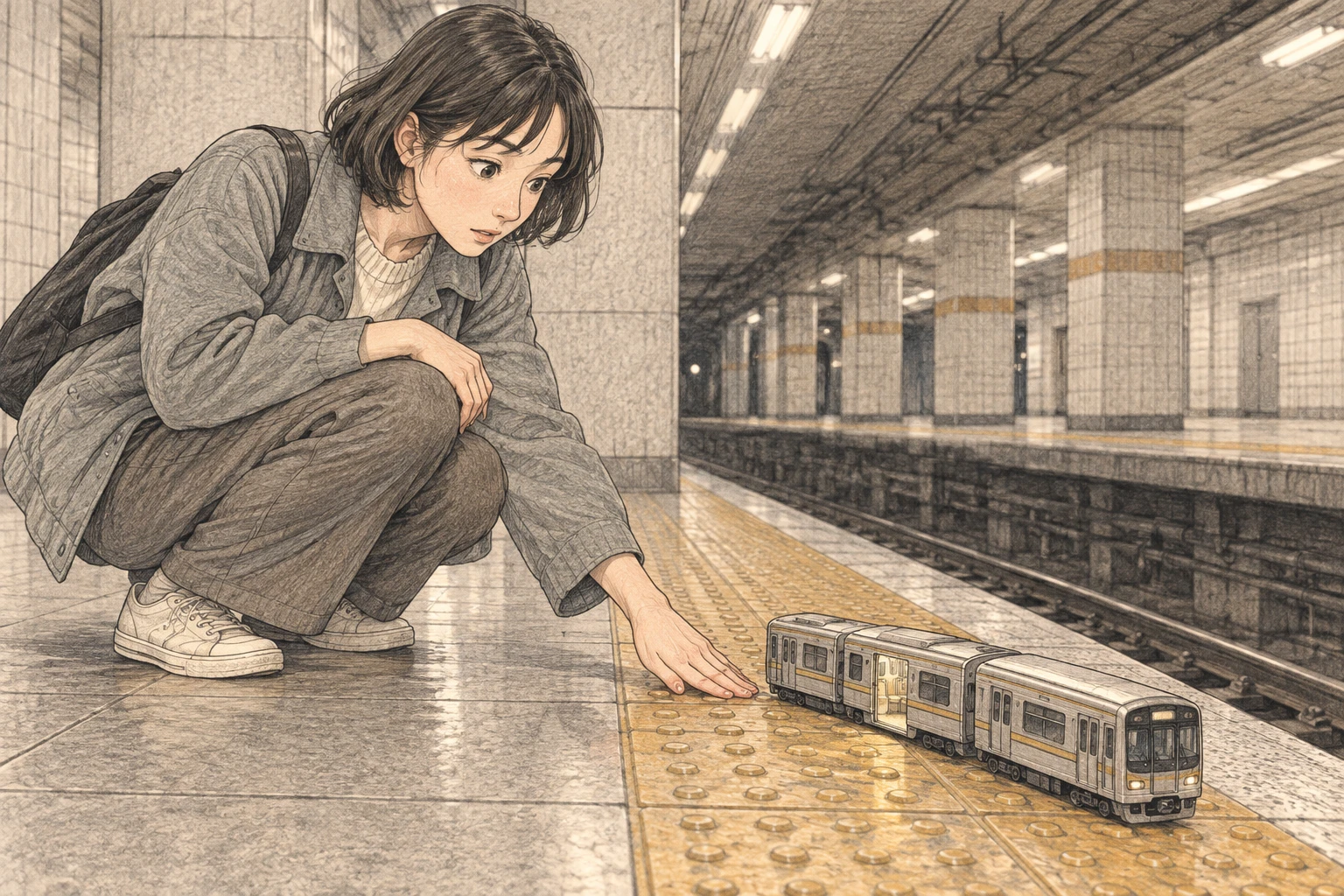
A Commuter Meets a Palm-Sized Train
A palm-sized train arrives along a subway platform’s tactile paving. A commuter lowers her hand beside its little doorway in a slice-of-life comic illustration shaped by searching pencil lines and soft graphite tones.
Remix this referenceA Commuter Meets a Palm-Sized Train
- Form language
- Use observational manga simplification: broad readable masses, selectively described fittings, and small irregularities that retain a drawn-from-life feeling.
- Contour
- Build contours from tapered graphite passes, allowing broken edges and occasional searching doubles; press harder only at decisive overlaps.
- Mark-making
- Let loose pencil hatching follow surface turns, with rubbed passages beside crisp strokes; vary marks naturally without filling every opening.
- Surface rendering
- Layer soft graphite veils over visible paper tooth, lift small accents with an eraser, and let sparse colored-pencil passages share the grain.
Priority
Rendering medium: pencil-led slice-of-life manga illustration in graphite with restrained colored pencil.
What to avoid & what to check
Exact prompt for this example
MODULE OWNERSHIP
subject: Subject count, type, stable proportions and landmarks, resting face geometry, hair shape, physical materials, garment construction and permanent marks. No emotion, movement, color assignment or rendering recipe.
expression: Facial soft-tissue displacement and pupil direction, muscle coordination, regional intensity, asymmetry and onset/peak/release. No head/body pose, stable appearance, skin color or rendering.
gesture: Head/neck/body/limb orientation, joint movement, support, contact and pose-caused occlusion using existing anatomy. No eye/pupil movement, emotion, identity, props inventory or camera.
props: Prop count, type, construction, physical material and scale relative to the subject. Holding/contact belongs to gesture, position to composition, color to palette.
scene: Environment elements, terrain, backdrop/floor presence and structural detail. No canvas positions, camera, lighting, assigned colors or render texture.
camera: Projection, focal-length impression, camera elevation/yaw/roll, viewing distance and crop. No actor pose, world placement, lighting or canvas aspect ratio.
composition: Normalized 0-100% canvas positions, scale in frame, depth/overlap, focal hierarchy and margins. No joint pose, camera projection, rendering, subject/prop inventory or emotion.
palette: Color anchors, hue/saturation/value ranges, colors assigned to parts and approximate color coverage. No illumination direction, shading algorithm, physical material or layout.
lighting: Light-source direction/softness/intensity, ambient illumination, physical shadow direction/length and highlight position. Absence of directional illumination is allowed. No shading technique, palette or material changes.
style: Reusable form abstraction, contour weight/taper/edge quality, medium and mark scale/density/direction, surface rendering and tonal transition technique. No fixed subject proportions, anatomy, identity, expression, pose, palette, light-source direction, camera or layout.
output: Image count, aspect ratio, size, file/alpha requirements and global lettering/logo/watermark restrictions. No background scenery, crop, style, identity or pose.

SUBJECT
inventory: A is one adult human commuter; no other people are visible, and the train has no visible occupants.
geometry: Ordinary adult proportions, an oval face, broad rounded nose, and slightly prominent ears.
resting-face: Her resting features have straight brows, shallow upper-lid folds, and a small mouth with a full lower lip.
appearance: An ear-length bob curls inward; she wears a cotton work jacket, knitted crewneck, trousers, and plain sneakers.

PRIORITY


AVOID


CHECK


EXPRESSION — ACTOR A
brows: One brow rises slightly while the other remains relaxed.
lids: Upper lids lift with interest; lower lids remain loose.
cheeks: Cheeks remain relaxed, without a smile-driven lift.
nose: The nose remains relaxed, without nostril flare or bridge wrinkling.
mouth: Lips separate into a small gap with nearly level corners.
jaw: The jaw releases slightly without dropping into an exaggerated gape.
gaze: Both pupils look down toward the miniature train’s open doorway.
coordination: Uneven brow activity carries the curiosity while the lower face stays quiet.
timing: Catch the onset of recognition, before curiosity develops into a smile.

PRIORITY


AVOID


CHECK


GESTURE
head: A lowers her chin and extends her neck slightly toward her offered hand.
torso: She crouches with her torso leaning forward, balanced over her planted feet.
limbs: One arm reaches low with its palm upward; the other forearm rests across a raised knee.
contact: Her offered fingertips touch the paving beside the train door; neither hand grips the train.

PRIORITY


AVOID


CHECK


PROPS
inventory: One palm-length, three-car subway train with one open passenger doorway.
construction: Metal car bodies, inset glass windows, articulated connections, and small wheels suggest a shrunken working train.

PRIORITY


AVOID


CHECK


SCENE
inventory: An underground subway platform with tactile paving, a platform edge, tiled columns, and a recessed track bed.
structure: The tactile paving has raised dots; the station remains at ordinary human scale.

PRIORITY


AVOID


CHECK


CAMERA
projection: Use natural perspective with a moderately wide lens impression and restrained near-field enlargement.
viewpoint: View obliquely along the platform from a low seated height, with a slight downward pitch and level roll.
crop: A medium-wide view includes the full figure and enough station architecture to establish scale.

PRIORITY


AVOID


CHECK


COMPOSITION
placement: A occupies the left half; her hand and the train form the primary focus below and right of her face.
depth: The train is directly over the raised tactile dots. The strip leads from the foreground train toward receding columns; keep the doorway clear of finger overlap.
spacing: Give the hand–train encounter open floor around it, with generous platform depth extending to the right.

PRIORITY


AVOID


CHECK


PALETTE
colors: Warm paper ivory, graphite gray, charcoal, and a restrained muted ochre form the small color family.
assignment: Use charcoal for hair and train windows, graphite for clothing and architecture, and ochre for tactile paving.
balance: Ivory and pale grays dominate; deep darks are sparse, and ochre remains a minor accent.

PRIORITY


AVOID


CHECK


LIGHTING
sources: Broad overhead station fixtures provide soft, moderate illumination with ample ambient fill.
shadows: Short soft shadows settle beneath the shoes, offered hand, and train.
highlights: Small overhead reflections touch the train roof and upper window edges.

PRIORITY


AVOID


CHECK


STYLE GUIDE
form-language: Use observational manga simplification: broad readable masses, selectively described fittings, and small irregularities that retain a drawn-from-life feeling.
contour: Build contours from tapered graphite passes, allowing broken edges and occasional searching doubles; press harder only at decisive overlaps.
mark-making: Let loose pencil hatching follow surface turns, with rubbed passages beside crisp strokes; vary marks naturally without filling every opening.
surface-rendering: Layer soft graphite veils over visible paper tooth, lift small accents with an eraser, and let sparse colored-pencil passages share the grain.

PRIORITY
Rendering medium: pencil-led slice-of-life manga illustration in graphite with restrained colored pencil.

AVOID


CHECK


OUTPUT
format: Not applicable.
restrictions: One finished single-panel image, landscape 3:2, 1800 × 1200 pixels, opaque PNG; no lettering, logos, or watermarks.

PRIORITY


AVOID


CHECK


FINAL INTEGRATION
subject + props + scene + composition: Let the familiar human and station dimensions make the train’s impossible scale immediately legible.
expression + gesture + style: Combine understated facial acting and a considerate gesture with lively pencil marks for quiet visual comedy.
Model information comes from image provenance. The same prompt may produce a different result.