Text to imageCharacterStyle guide
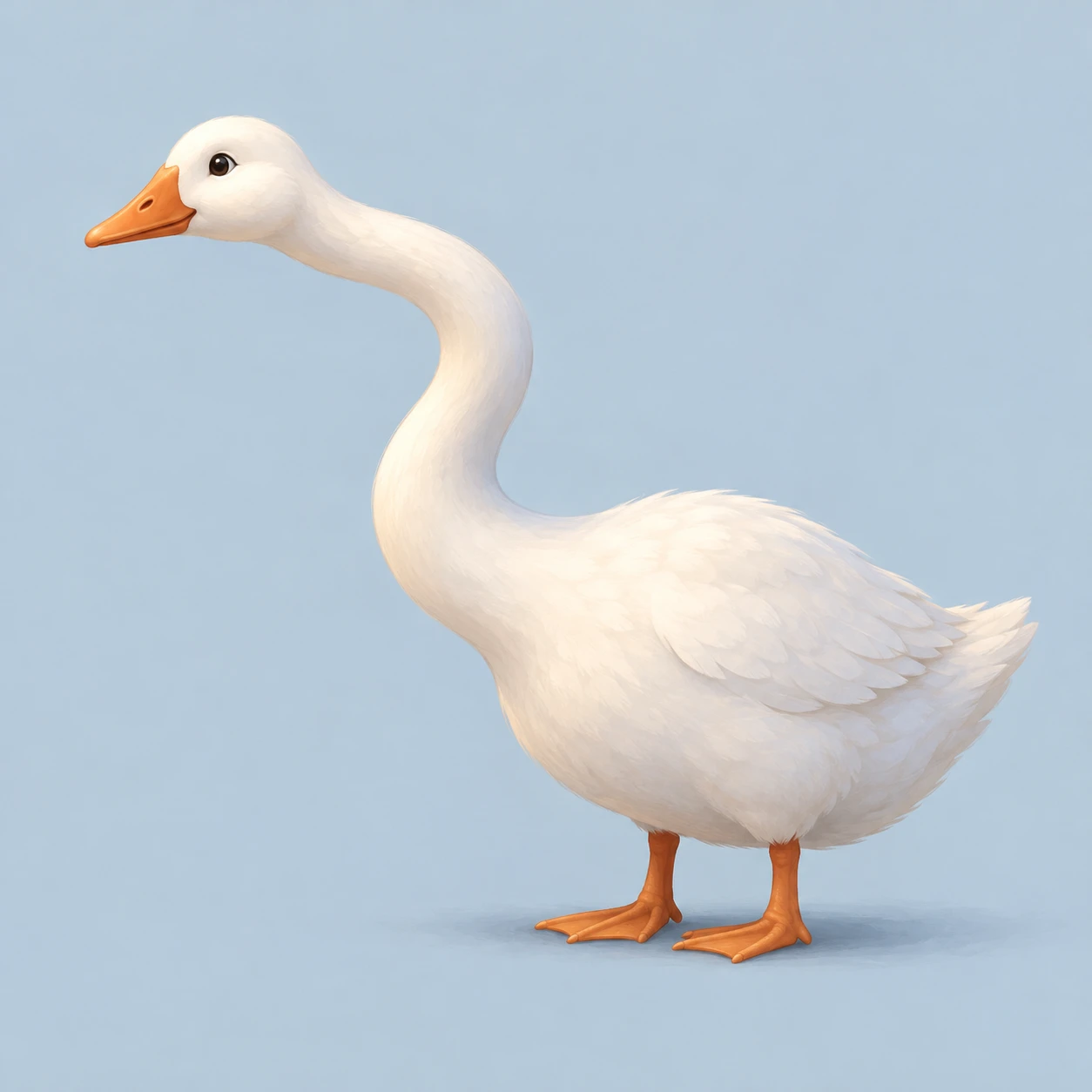
Little Goose Friend · S-Curve Neck
Connect opposing neck curves to give a little goose a flexible pose and continuous volume.
Little Goose Friend · S-Curve Neck
- Shape & line
- Build the neck as a continuous curved tube: from the chest on image-right, sweep toward image-left, curve back toward image-right at mid-neck, then turn toward the head on image-left. Echo these bends with the opposite contour while preserving a substantial neck width through both turns.
- Color & light
- Use warm white plumage and muted orange for the bill and feet. Light from the upper image-left, carrying a soft cream highlight along the neck's upper-left-facing surface and a pale blue-gray shadow along its lower-right-facing surface so the curved tube retains volume.
- Texture & material
- Paint the plumage as soft matte masses with a few short feather strokes on the body. Keep the neck surface mostly smooth so texture does not interrupt its curves, and give the bill and feet firmer edges with restrained, broad highlights.
- Composition
- Separate the forward-reaching neck from the belly with a broad, readable pocket of background. Place the two feet beneath the body on one ground line and add a small soft contact shadow there, keeping the S-shaped neck unobstructed against the plain background.
Priority
Prioritize the continuous S-shaped neck and its readable thickness.
What to avoid & what to check
Avoid sharp neck corners, pinched bends, and feather marks that obscure the silhouette.
Check that both neck contours flow smoothly from chest to head and that background remains visible between neck and belly.
Exact prompt for this example
SUBJECT
One original little goose character with a rounded white body, a long gently bent neck, a small head, an orange bill, and two orange feet. Its body sits toward image-right while its head reaches toward image-left; the neck connects them through a clearly readable S-shaped bend.

COMPOSITION
Show the entire goose in a near-profile view facing image-left, centered on a pale blue-gray background. Keep the head, neck, belly, and both feet inside the frame, with generous empty space around the neck silhouette.

STYLE GUIDE
1. Shape & line
Build the neck as a continuous curved tube: from the chest on image-right, sweep toward image-left, curve back toward image-right at mid-neck, then turn toward the head on image-left. Echo these bends with the opposite contour while preserving a substantial neck width through both turns.

2. Color & light
Use warm white plumage and muted orange for the bill and feet. Light from the upper image-left, carrying a soft cream highlight along the neck's upper-left-facing surface and a pale blue-gray shadow along its lower-right-facing surface so the curved tube retains volume.

3. Texture & material
Paint the plumage as soft matte masses with a few short feather strokes on the body. Keep the neck surface mostly smooth so texture does not interrupt its curves, and give the bill and feet firmer edges with restrained, broad highlights.

4. Composition
Separate the forward-reaching neck from the belly with a broad, readable pocket of background. Place the two feet beneath the body on one ground line and add a small soft contact shadow there, keeping the S-shaped neck unobstructed against the plain background.

PRIORITY
Preserve the requested identity, count, action, composition and output settings. Apply the style rules within those constraints; a style reference must not replace the subject or layout. Within the style: Prioritize the continuous S-shaped neck and its readable thickness.

AVOID
Avoid sharp neck corners, pinched bends, and feather marks that obscure the silhouette.

OUTPUT
Create one square image as a clean, softly painted character illustration, without text, labels, borders, or watermarks.

SELF-CHECK
Check that both neck contours flow smoothly from chest to head and that background remains visible between neck and belly.
Model information comes from image provenance. The same prompt may produce a different result.