Text to imageAnimationStyle guide
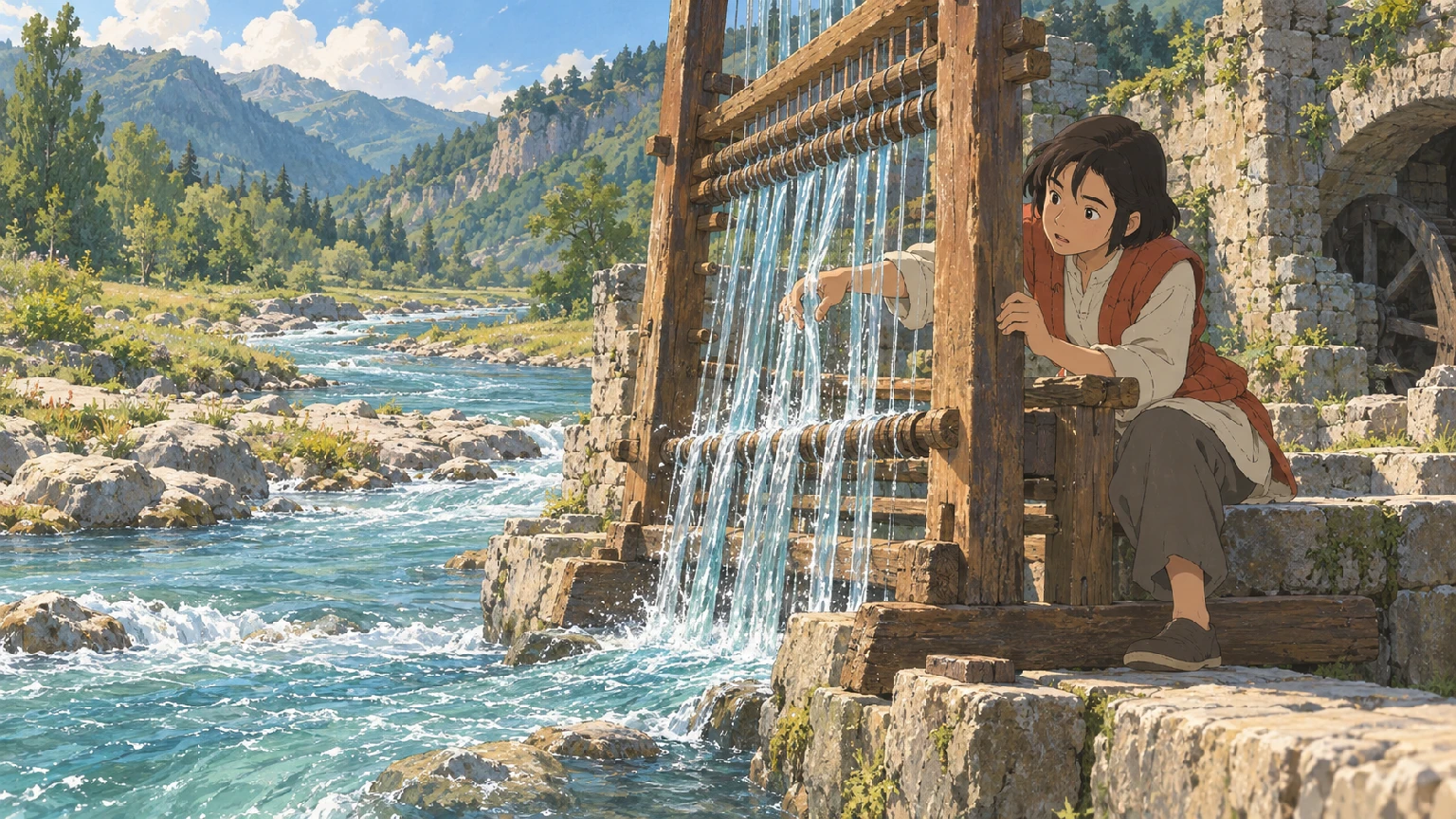
River Strands Through a Loom
Beside an old stone mill, a woman separates river strands passing through a great loom. The open valley makes this impossible task feel like an ordinary morning.
Remix this referenceRiver Strands Through a Loom
- Form language
- Establish broad interlocking form planes before adding small painted variations; simplify secondary detail while allowing irregular shapes to vary naturally.
- Contour
- Build contours from alternating firm and softened painted boundaries, using occasional tapered accents instead of continuous enclosing outlines.
- Mark-making
- Layer overlapping brush traces along each plane's direction, with sparse dry-brush skips and naturally varied stroke lengths.
- Surface rendering
- Retain shallow paper-and-pigment grain, uneven opaque patches and softly blended tonal joins; let translucent passages keep their broken underpainting.
Priority
Rendering medium: 2D hand-painted animated-film background illustration; formal rendering reference: Studio Ghibli · 2020s · The Boy and the Heron (2023), background art
What to avoid & what to check
Exact prompt for this example
MODULE OWNERSHIP
subject: Subject count, type, stable proportions and landmarks, resting face geometry, hair shape, physical materials, garment construction and permanent marks. No emotion, movement, color assignment or rendering recipe.
expression: Facial soft-tissue displacement and pupil direction, muscle coordination, regional intensity, asymmetry and onset/peak/release. No head/body pose, stable appearance, skin color or rendering.
gesture: Head/neck/body/limb orientation, joint movement, support, contact and pose-caused occlusion using existing anatomy. No eye/pupil movement, emotion, identity, props inventory or camera.
props: Prop count, type, construction, physical material and scale relative to the subject. Holding/contact belongs to gesture, position to composition, color to palette.
scene: Environment elements, terrain, backdrop/floor presence and structural detail. No canvas positions, camera, lighting, assigned colors or render texture.
camera: Projection, focal-length impression, camera elevation/yaw/roll, viewing distance and crop. No actor pose, world placement, lighting or canvas aspect ratio.
composition: Normalized 0-100% canvas positions, scale in frame, depth/overlap, focal hierarchy and margins. No joint pose, camera projection, rendering, subject/prop inventory or emotion.
palette: Color anchors, hue/saturation/value ranges, colors assigned to parts and approximate color coverage. No illumination direction, shading algorithm, physical material or layout.
lighting: Light-source direction/softness/intensity, ambient illumination, physical shadow direction/length and highlight position. Absence of directional illumination is allowed. No shading technique, palette or material changes.
style: Reusable form abstraction, contour weight/taper/edge quality, medium and mark scale/density/direction, surface rendering and tonal transition technique. No fixed subject proportions, anatomy, identity, expression, pose, palette, light-source direction, camera or layout.
output: Image count, aspect ratio, size, file/alpha requirements and global lettering/logo/watermark restrictions. No background scenery, crop, style, identity or pose.

SUBJECT
inventory: A is one adult human woman, the river mill's weaver; no other characters.
geometry: A has a compact, sturdy build, broad palms and a square face with prominent cheekbones and a short nose.
resting-face: Straight brows, shallow upper-lid folds and a wide mouth with a fuller lower lip define her resting face.
appearance: Her blunt bob tucks behind her ears; a quilted vest covers a cotton tunic, with loose trousers and cloth shoes.

PRIORITY


AVOID


CHECK


EXPRESSION — ACTOR A
brows: The left brow rises slightly while the right remains relaxed.
lids: Upper lids lift modestly; lower lids remain loose.
cheeks: Cheeks remain soft, without a smile-driven lift.
nose: Nostrils remain relaxed and the bridge stays unwrinkled.
mouth: Lips part narrowly, with one corner raised almost imperceptibly.
jaw: The jaw releases just enough to sustain the small lip opening.
gaze: Both pupils track a water strand.
coordination: Keep the questioning brow more active than the quiet mouth.
timing: Hold the apex of a small discovery, before a broader reaction develops.

PRIORITY


AVOID


CHECK


GESTURE
head: A inclines her head toward her extended hand, with her neck comfortably following the lean.
torso: Seated on the stone ledge, she leans forward from the hips while keeping her weight settled.
limbs: Her left arm reaches through the loom with fingers spread; her right elbow bends, and both feet rest on the ledge.
contact: Left fingertips separate two water strands while her right palm braces the frame; the frame partly hides her lap.

PRIORITY


AVOID


CHECK


PROPS
inventory: One freestanding wooden loom, slightly taller than A standing; no separate tools.
construction: Heavy timber uprights support open crossbars and rounded spacing pegs, with worn joints and uneven hand-cut edges.

PRIORITY


AVOID


CHECK


SCENE
inventory: An open river valley contains a roofless stone mill, a broad working ledge, gravel shallows, meadow banks and distant wooded slopes.
structure: The river rises into narrow continuous ribbons through the loom, then rejoins its channel; broken mill walls retain an empty wheel recess.

PRIORITY


AVOID


CHECK


CAMERA
projection: Use natural perspective with a moderate wide-lens impression and restrained edge distortion.
viewpoint: View diagonally across the mill ledge from seated eye height, with a level horizon.
crop: A wide environmental full-figure view includes the entire loom and enough valley to establish the river's course.

PRIORITY


AVOID


CHECK


COMPOSITION
placement: A occupies the right third; the loom reaches into the middle, while the river opens across the spacious left half.
depth: Near stonework overlaps the loom's base; the hand-and-water encounter leads into the receding river and distant slopes.
spacing: Make the hand-and-water encounter primary, A's face secondary; preserve open intervals between strands and generous valley breathing room.

PRIORITY


AVOID


CHECK


PALETTE
colors: Anchor the image in mineral turquoise, muted olive, warm limestone and a small persimmon accent.
assignment: Give water turquoise, vegetation olive, masonry limestone, timber umber, A's vest persimmon, tunic ivory and skin warm beige.
balance: Let subdued landscape hues dominate, with the vest as a small saturated accent and pale water notes interrupting deeper values.

PRIORITY


AVOID


CHECK


LIGHTING
sources: Broad morning light enters from the upper left, supported by soft open-sky ambient illumination.
shadows: Frame and wall shadows fall gently toward the lower right; the empty wheel recess holds deeper shade.
highlights: Broken highlights follow the upper-left edges of the water ribbons and the exposed knuckles.

PRIORITY


AVOID


CHECK


STYLE GUIDE
form-language: Establish broad interlocking form planes before adding small painted variations; simplify secondary detail while allowing irregular shapes to vary naturally.
contour: Build contours from alternating firm and softened painted boundaries, using occasional tapered accents instead of continuous enclosing outlines.
mark-making: Layer overlapping brush traces along each plane's direction, with sparse dry-brush skips and naturally varied stroke lengths.
surface-rendering: Retain shallow paper-and-pigment grain, uneven opaque patches and softly blended tonal joins; let translucent passages keep their broken underpainting.

PRIORITY
Rendering medium: 2D hand-painted animated-film background illustration; formal rendering reference: Studio Ghibli · 2020s · The Boy and the Heron (2023), background art

AVOID


CHECK


OUTPUT
format: One finished image, 16:9 landscape, 1536 × 864 pixels, opaque PNG.
restrictions: No lettering, logos, captions or watermarks.

PRIORITY


AVOID


CHECK


FINAL INTEGRATION
gesture + scene + props: Coordinate the hand contact, water continuity and frame openings so the impossible craft reads as a coherent task.
style + lighting + palette: Let painted variation carry the selected hues and physical illumination without replacing either module's decisions.
Art direction
스튜디오 지브리 / Studio Ghibli · 2020s · 그대들은 어떻게 살 것인가(2023)의 배경 미술 / The Boy and the Heron (2023), background art ↗- Establish broad form planes before describing smaller surface variations with painted patches
- Use hard and soft painted boundaries rather than strong continuous outlines
- Overlapping brush traces following the plane direction with sparse dry-brush marks
- Shallow paper-and-pigment texture, uneven painted planes and blended tonal transitions
Model information comes from image provenance. The same prompt may produce a different result.