Text to imageAnimationStyle guide
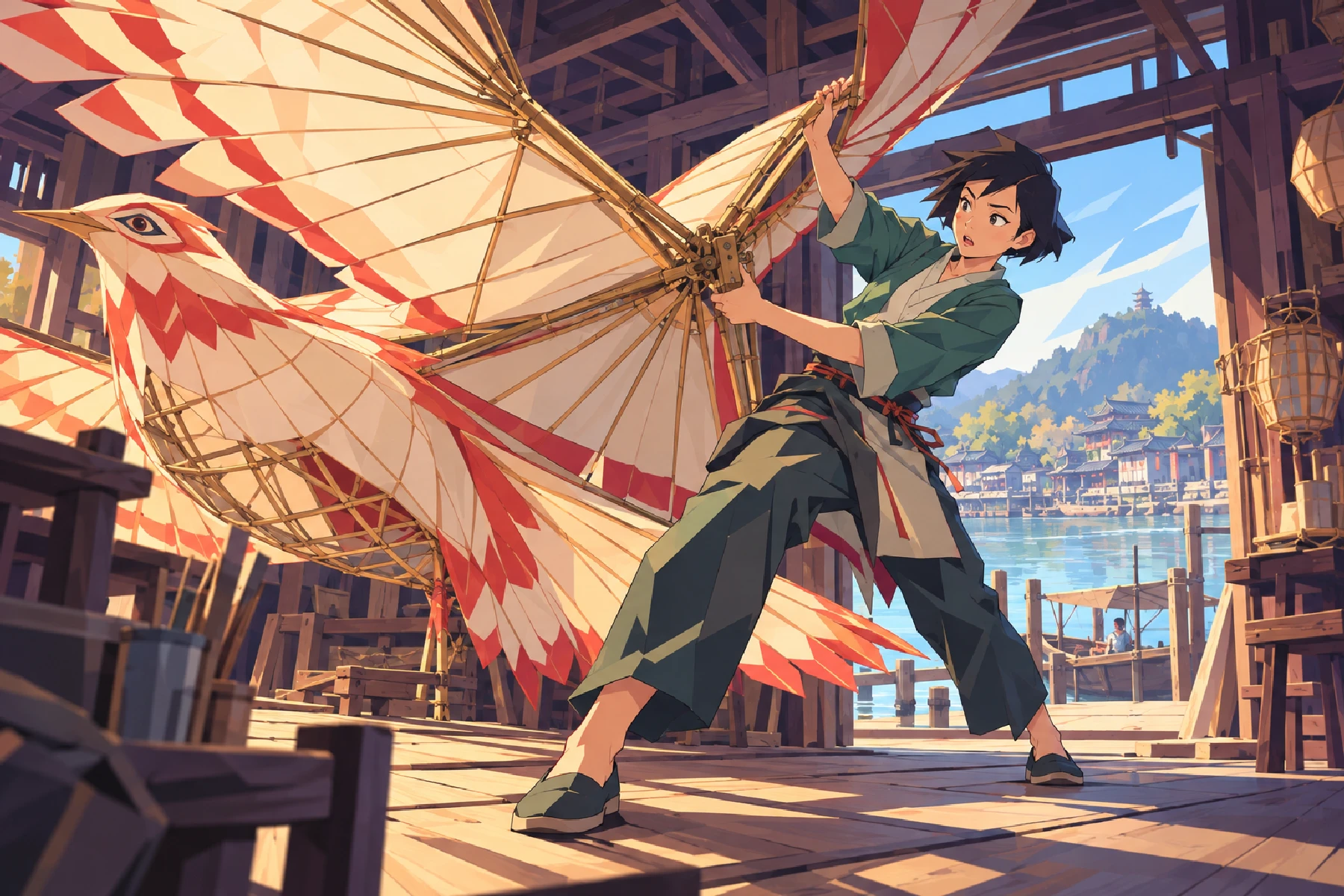
Lantern Maker Opening a Giant Bird
Inside a riverside workshop, a maker leans back as a giant folding bird lantern suddenly opens its wing. Overlapping paper planes and an asymmetric flicker of surprise meet sharp contours and separated tonal shapes.
Remix this referenceLantern Maker Opening a Giant Bird
- Form language
- Abstract surfaces into wedges, triangles and angular facets; alternate broad unbroken planes with abrupt directional changes.
- Contour
- Use strong exterior weight contrast, tapered sharp corners and short interior cuts; let selected edges disappear into adjoining planes.
- Mark-making
- Place sparse angular chips and decisive sharp strokes at transitions, leaving clean planes unmarked; vary their lengths naturally.
- Surface rendering
- Build volume from a small set of sharply separated tonal planes instead of gradients, with occasional offset slivers at abrupt transitions.
Priority
Rendering medium: 2D angular Japanese anime graphic illustration; formal rendering reference: TRIGGER · 2010s · Promare (2019)
What to avoid & what to check
Exact prompt for this example
MODULE OWNERSHIP
subject: Subject count, type, stable proportions and landmarks, resting face geometry, hair shape, physical materials, garment construction and permanent marks. No emotion, movement, color assignment or rendering recipe.
expression: Facial soft-tissue displacement and pupil direction, muscle coordination, regional intensity, asymmetry and onset/peak/release. No head/body pose, stable appearance, skin color or rendering.
gesture: Head/neck/body/limb orientation, joint movement, support, contact and pose-caused occlusion using existing anatomy. No eye/pupil movement, emotion, identity, props inventory or camera.
props: Prop count, type, construction, physical material and scale relative to the subject. Holding/contact belongs to gesture, position to composition, color to palette.
scene: Environment elements, terrain, backdrop/floor presence and structural detail. No canvas positions, camera, lighting, assigned colors or render texture.
camera: Projection, focal-length impression, camera elevation/yaw/roll, viewing distance and crop. No actor pose, world placement, lighting or canvas aspect ratio.
composition: Normalized 0-100% canvas positions, scale in frame, depth/overlap, focal hierarchy and margins. No joint pose, camera projection, rendering, subject/prop inventory or emotion.
palette: Color anchors, hue/saturation/value ranges, colors assigned to parts and approximate color coverage. No illumination direction, shading algorithm, physical material or layout.
lighting: Light-source direction/softness/intensity, ambient illumination, physical shadow direction/length and highlight position. Absence of directional illumination is allowed. No shading technique, palette or material changes.
style: Reusable form abstraction, contour weight/taper/edge quality, medium and mark scale/density/direction, surface rendering and tonal transition technique. No fixed subject proportions, anatomy, identity, expression, pose, palette, light-source direction, camera or layout.
output: Image count, aspect ratio, size, file/alpha requirements and global lettering/logo/watermark restrictions. No background scenery, crop, style, identity or pose.

SUBJECT
inventory: One original adult human woman, a lantern maker designated A.
geometry: A has a lean frame, long forearms, broad palms and a compact, square-chinned face.
resting-face: Her resting features are straight brows, almond-shaped eyes, a short narrow nose and a broad mouth.
appearance: Blunt cropped hair exposes her ears; a canvas wrap jacket, straight trousers and soft work shoes complete her clothing.

PRIORITY


AVOID


CHECK


EXPRESSION — ACTOR A
brows: Both brows rise, with the left slightly higher.
lids: Upper lids lift sharply; lower lids remain comparatively relaxed.
cheeks: Cheeks remain loose, without a smile-driven lift.
nose: The nose bridge stays relaxed, with only a slight nostril opening.
mouth: Lips separate into a small uneven breath gap.
jaw: The jaw has just begun to drop.
gaze: Pupils look down-left toward the lantern hinge.
coordination: Link the raised brows with widened lids while keeping the lower face relatively soft.
timing: Catch the onset: the eyes have opened before the mouth fully reacts.

PRIORITY


AVOID


CHECK


GESTURE
head: A turns her neck toward the lower hinge with her chin slightly lowered.
torso: A twists left and leans back to clear the wing springing past her chest.
limbs: Her right arm reaches upward, left elbow stays tucked, and staggered feet brace beneath a bent front knee.
contact: Her left hand anchors the central hinge while her right palm checks an opening rib; both soles stay planted.

PRIORITY


AVOID


CHECK


PROPS
inventory: One folding bird lantern, its body about A's torso length and its open wings wider than her arm span.
construction: Thin translucent paper stretches over bamboo ribs; a wooden central hinge joins broad pleated wings to a hollow bird body.

PRIORITY


AVOID


CHECK


SCENE
inventory: A riverside lantern shed with a plank floor, exposed roof beams and an open sliding doorway overlooking the river.
structure: Low rafters and a broad door lintel give the modest workshop a close, usable interior.

PRIORITY


AVOID


CHECK


CAMERA
projection: Perspective with a moderately wide lens impression and restrained near-field enlargement.
viewpoint: View from just below standing eye level, obliquely across the workshop, with no camera roll.
crop: Show A's full figure and most of the lantern, allowing the nearest wing tip to leave the frame.

PRIORITY


AVOID


CHECK


COMPOSITION
placement: Place A near 65% canvas width; the bird spreads across the left two-thirds, with its upper wing reaching the top edge.
depth: Overlap the near wing across A's lower torso; retain a clear face silhouette against the distant doorway.
spacing: Make the face and hinge the primary and secondary focal points; leave a spacious river opening beneath the rising diagonal.

PRIORITY


AVOID


CHECK


PALETTE
colors: Use warm ivory, vermilion, deep plum, jade and pale apricot, with saturation concentrated in the middle values.
assignment: Give the lantern ivory paper and vermilion bands, A jade clothing and apricot skin, and the shed plum structural masses.
balance: Let ivory occupy the largest area, plum anchor the darker areas, and vermilion provide sparse emphatic accents.

PRIORITY


AVOID


CHECK


LIGHTING
sources: Broad daylight enters from the upper left, supported by gentle ambient light throughout the shed.
shadows: Cast moderately soft shadows down-right, with deeper occlusion beneath overlapping wings and roof beams.
highlights: Keep the brightest highlights on upper-left-facing ridges and the exposed side of A's face.

PRIORITY


AVOID


CHECK


STYLE GUIDE
form-language: Abstract surfaces into wedges, triangles and angular facets; alternate broad unbroken planes with abrupt directional changes.
contour: Use strong exterior weight contrast, tapered sharp corners and short interior cuts; let selected edges disappear into adjoining planes.
mark-making: Place sparse angular chips and decisive sharp strokes at transitions, leaving clean planes unmarked; vary their lengths naturally.
surface-rendering: Build volume from a small set of sharply separated tonal planes instead of gradients, with occasional offset slivers at abrupt transitions.

PRIORITY
Rendering medium: 2D angular Japanese anime graphic illustration; formal rendering reference: TRIGGER · 2010s · Promare (2019)

AVOID


CHECK


OUTPUT
format: Deliver one finished 3:2 landscape image, 1800 × 1200 pixels, as an opaque PNG.
restrictions: No lettering, logos or watermarks.

PRIORITY


AVOID


CHECK


FINAL INTEGRATION
gesture + props: Keep the hand contacts consistent with the lantern's folding mechanism while allowing incidental fold details to vary.
Art direction
트리거 / TRIGGER · 2010s · 프로메어(2019) / Promare (2019) ↗- Abstract form surfaces into wedges, triangles and angular facets
- Strong exterior weight contrast with short sharp interior cuts
- Small angular facets and sharp marks, with no marks in clean planes
- A small set of sharply separated tonal planes in place of gradients
Model information comes from image provenance. The same prompt may produce a different result.