Text to imageSpace & architectureStyle guide
Ramp Around a Rehearsal Floor
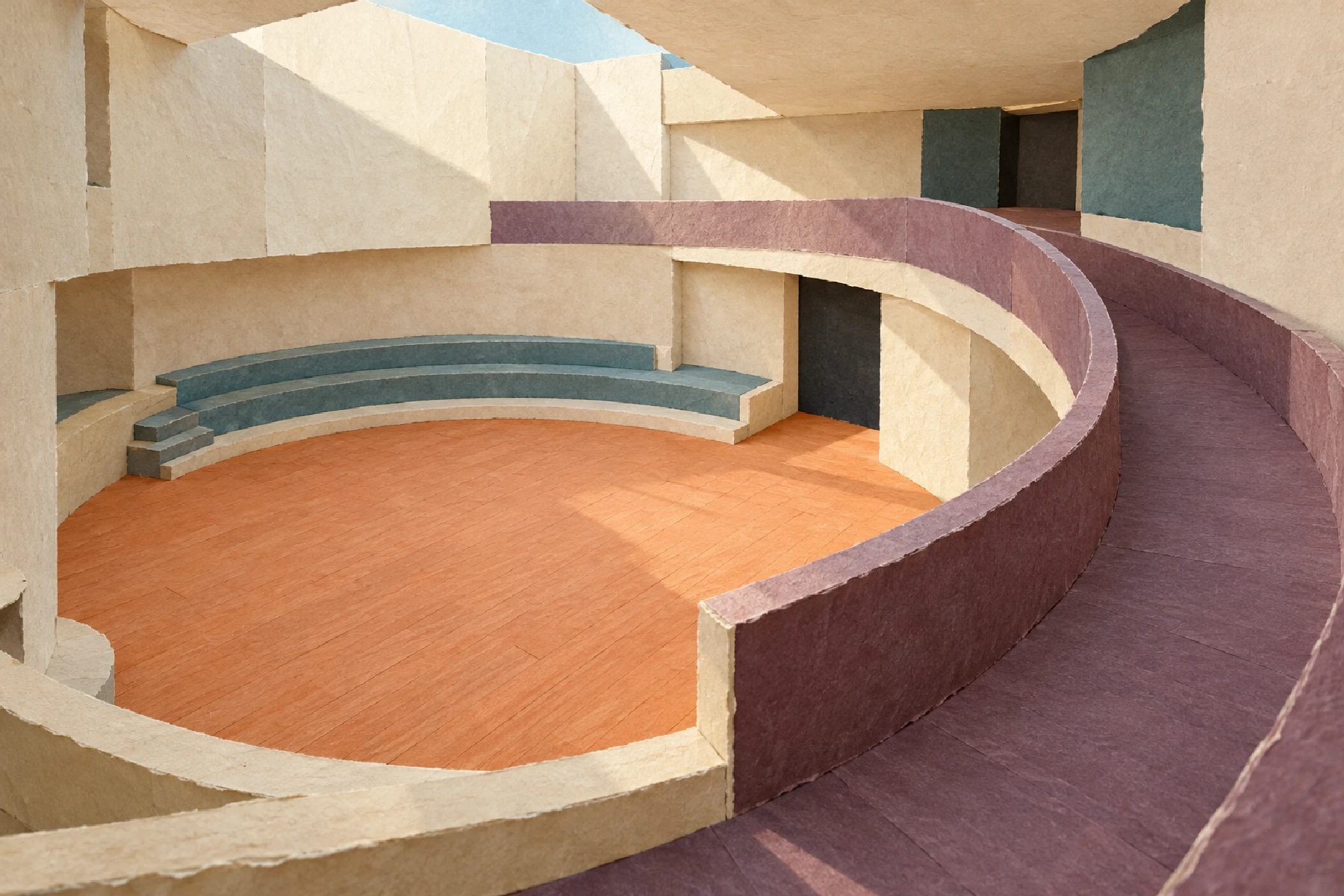
A public interior where a ramp rises around a recessed rehearsal floor. Layered paper thickness and exposed cut edges make the walls and circulation feel tangible.
Remix this referenceRamp Around a Rehearsal Floor
- Form language
- Reduce volumes to folded bands and generous interlocking planes, allowing slight handmade irregularity in otherwise coherent forms.
- Contour
- Use clean scissor-cut curves beside occasional torn edges; exposed paper thickness supplies a fine uneven rim without ink outlines.
- Mark-making
- Combine broad cut shapes with sparse rubbed-pencil traces and faint paste marks; vary their pressure and let some pieces remain quiet.
- Surface rendering
- Build tactile cut-paper layers with visible overlaps and shallow relief; use translucent paper veils for selective tonal transitions.
Priority
Make layered cut-paper construction and tactile overlaps unmistakable.
What to avoid & what to check
Exact prompt for this example
MODULE OWNERSHIP
subject: Subject count, type, stable proportions and landmarks, resting face geometry, hair shape, physical materials, garment construction and permanent marks. No emotion, movement, color assignment or rendering recipe.
expression: Facial soft-tissue displacement and pupil direction, muscle coordination, regional intensity, asymmetry and onset/peak/release. No head/body pose, stable appearance, skin color or rendering.
gesture: Head/neck/body/limb orientation, joint movement, support, contact and pose-caused occlusion using existing anatomy. No eye/pupil movement, emotion, identity, props inventory or camera.
props: Prop count, type, construction, physical material and scale relative to the subject. Holding/contact belongs to gesture, position to composition, color to palette.
scene: Environment elements, terrain, backdrop/floor presence and structural detail. No canvas positions, camera, lighting, assigned colors or render texture.
camera: Projection, focal-length impression, camera elevation/yaw/roll, viewing distance and crop. No actor pose, world placement, lighting or canvas aspect ratio.
composition: Normalized 0-100% canvas positions, scale in frame, depth/overlap, focal hierarchy and margins. No joint pose, camera projection, rendering, subject/prop inventory or emotion.
palette: Color anchors, hue/saturation/value ranges, colors assigned to parts and approximate color coverage. No illumination direction, shading algorithm, physical material or layout.
lighting: Light-source direction/softness/intensity, ambient illumination, physical shadow direction/length and highlight position. Absence of directional illumination is allowed. No shading technique, palette or material changes.
style: Reusable form abstraction, contour weight/taper/edge quality, medium and mark scale/density/direction, surface rendering and tonal transition technique. No fixed subject proportions, anatomy, identity, expression, pose, palette, light-source direction, camera or layout.
output: Image count, aspect ratio, size, file/alpha requirements and global lettering/logo/watermark restrictions. No background scenery, crop, style, identity or pose.

SUBJECT
inventory: No figures, animals or independent object subjects.
geometry: No independent body or object proportions apply.
resting-face: No faces are present.
appearance: No independent character appearance or garment construction applies.

PRIORITY


AVOID


CHECK


PROPS
inventory: No separate props.
construction: No prop construction applies.

PRIORITY


AVOID


CHECK


SCENE
inventory: A recessed timber rehearsal floor, curved ramp, solid parapet, built-in seating, upper landing and roof slot.
structure: The ramp wraps partway around the floor and joins an upper landing; plaster walls enclose the open interior.

PRIORITY


AVOID


CHECK


CAMERA
projection: Use architectural perspective with a moderate wide-angle impression and upright verticals.
viewpoint: Look diagonally downward from the entrance landing across the lower floor toward the rising route.
crop: Frame a broad interior view, cropping the near threshold and part of the overhead enclosure.

PRIORITY


AVOID


CHECK


COMPOSITION
placement: Set the recessed floor left of center; let the ramp sweep through the right side toward the upper background.
depth: Overlap the near parapet, lower floor and distant landing to make the connected levels immediately legible.
spacing: Give the empty floor generous breathing room and balance the ramp's busy arc with a broad quiet wall.

PRIORITY


AVOID


CHECK


PALETTE
colors: Chalk cream, burnt apricot, dusty aubergine and muted teal, with a small charcoal anchor.
assignment: Assign cream to walls, apricot to the floor, aubergine to the ramp, teal to seating and charcoal to deep openings.
balance: Keep cream dominant, with broad muted accents and only small areas of the darkest value.

PRIORITY


AVOID


CHECK


LIGHTING
sources: Soft daylight enters through the roof slot from the upper left, with gentle ambient fill.
shadows: The ramp and parapet cast broad soft shadows toward the lower right; recesses remain gently shaded.
highlights: Upper-left wall edges and exposed landing tops receive the clearest highlights.

PRIORITY


AVOID


CHECK


STYLE GUIDE
form-language: Reduce volumes to folded bands and generous interlocking planes, allowing slight handmade irregularity in otherwise coherent forms.
contour: Use clean scissor-cut curves beside occasional torn edges; exposed paper thickness supplies a fine uneven rim without ink outlines.
mark-making: Combine broad cut shapes with sparse rubbed-pencil traces and faint paste marks; vary their pressure and let some pieces remain quiet.
surface-rendering: Build tactile cut-paper layers with visible overlaps and shallow relief; use translucent paper veils for selective tonal transitions.

PRIORITY
Make layered cut-paper construction and tactile overlaps unmistakable.

AVOID


CHECK


OUTPUT
format: Deliver one finished image at 1800 × 1200 pixels, 3:2 aspect ratio, as an opaque PNG.
restrictions: No lettering, logos, signatures or watermarks.

PRIORITY


AVOID


CHECK
Model information comes from image provenance. The same prompt may produce a different result.