Text to imageArt stylesStyle guide
A Giant Paper Crane Through the Door
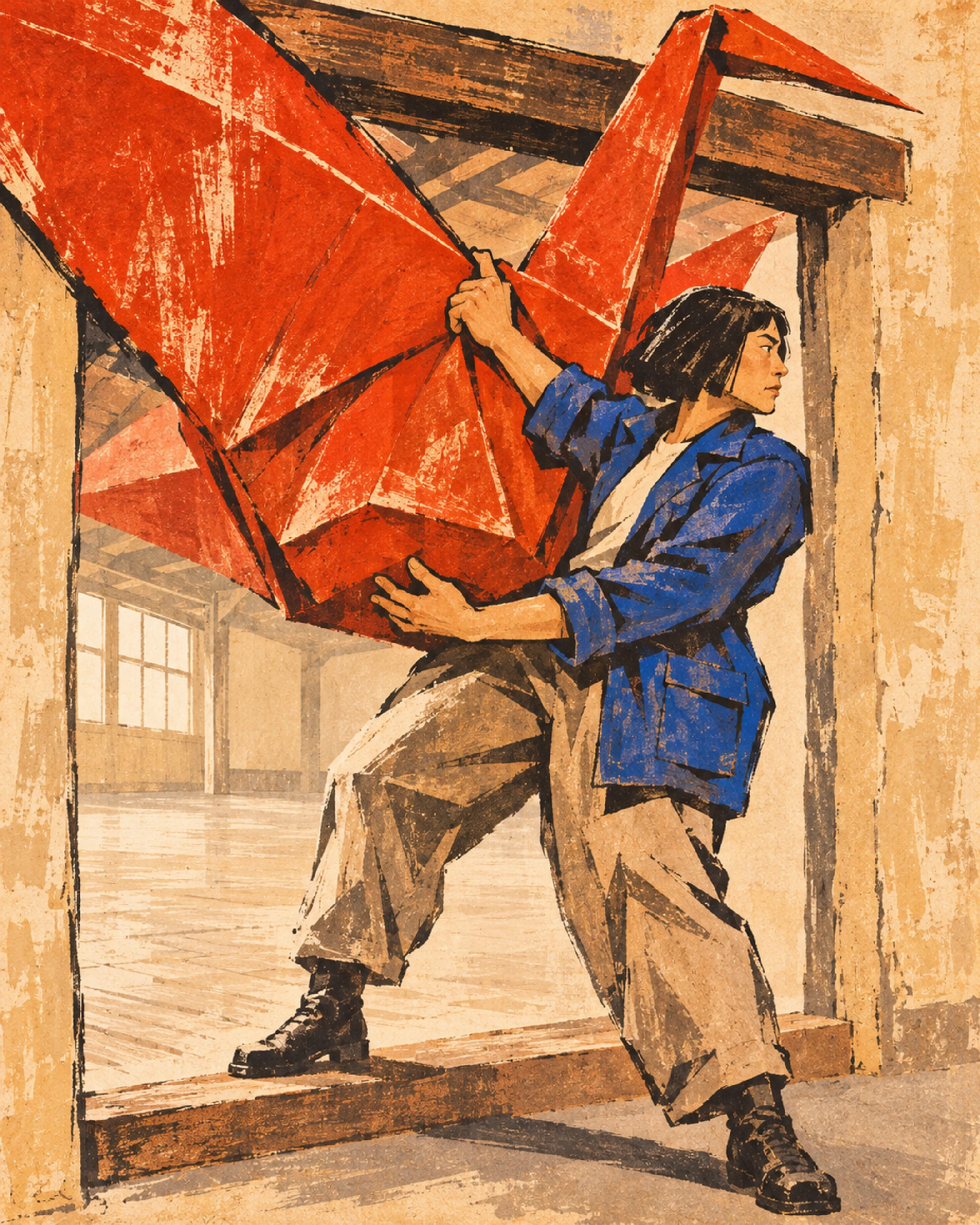
A woman turns an enormous folded paper crane sideways through a narrow doorway. Ragged ink strokes and displaced print layers animate the overlapping wings and figure.
Remix this referenceA Giant Paper Crane Through the Door
- Form language
- Abstract forms into interlocking wedges and swelling curves; concentrate descriptive detail at junctions and allow minor shapes to vary.
- Contour
- Use forceful brush-ink contours that swell, split and abruptly break; let adjacent printed masses complete selected edges.
- Mark-making
- Combine dragged dry-brush streaks with blunt stencil cuts and occasional scraped lines; vary pressure and mark length naturally.
- Surface rendering
- Build tone through uneven ink deposits and translucent print overlaps, with slight registration drift and paper exposed in worn passages.
Priority
Define the experimental poster treatment through forceful brush ink meeting imperfect stencil printing.
What to avoid & what to check
Exact prompt for this example
MODULE OWNERSHIP
subject: Subject count, type, stable proportions and landmarks, resting face geometry, hair shape, physical materials, garment construction and permanent marks. No emotion, movement, color assignment or rendering recipe.
expression: Facial soft-tissue displacement and pupil direction, muscle coordination, regional intensity, asymmetry and onset/peak/release. No head/body pose, stable appearance, skin color or rendering.
gesture: Head/neck/body/limb orientation, joint movement, support, contact and pose-caused occlusion using existing anatomy. No eye/pupil movement, emotion, identity, props inventory or camera.
props: Prop count, type, construction, physical material and scale relative to the subject. Holding/contact belongs to gesture, position to composition, color to palette.
scene: Environment elements, terrain, backdrop/floor presence and structural detail. No canvas positions, camera, lighting, assigned colors or render texture.
camera: Projection, focal-length impression, camera elevation/yaw/roll, viewing distance and crop. No actor pose, world placement, lighting or canvas aspect ratio.
composition: Normalized 0-100% canvas positions, scale in frame, depth/overlap, focal hierarchy and margins. No joint pose, camera projection, rendering, subject/prop inventory or emotion.
palette: Color anchors, hue/saturation/value ranges, colors assigned to parts and approximate color coverage. No illumination direction, shading algorithm, physical material or layout.
lighting: Light-source direction/softness/intensity, ambient illumination, physical shadow direction/length and highlight position. Absence of directional illumination is allowed. No shading technique, palette or material changes.
style: Reusable form abstraction, contour weight/taper/edge quality, medium and mark scale/density/direction, surface rendering and tonal transition technique. No fixed subject proportions, anatomy, identity, expression, pose, palette, light-source direction, camera or layout.
output: Image count, aspect ratio, size, file/alpha requirements and global lettering/logo/watermark restrictions. No background scenery, crop, style, identity or pose.

SUBJECT
inventory: One adult woman, actor A.
geometry: Ordinary adult proportions, with a sturdy torso and broad hands.
resting-face: A straight nose, shallow brow ridge and rounded chin give the resting profile a simple, recognizable structure.
appearance: A blunt bob, cotton work jacket, plain shirt, loose canvas trousers and ankle boots.

PRIORITY


AVOID


CHECK


EXPRESSION — ACTOR A
brows: The visible brow draws slightly inward and down.
lids: The visible lids narrow slightly; the far eye remains unprescribed.
cheeks: The visible cheek stays mostly relaxed, without a smile lift.
nose: The visible nostril remains relaxed, without flaring.
mouth: The lips meet with a light, even press.
jaw: The jaw settles closed without a hard clench.
gaze: The visible pupil aims into the hall toward the passage ahead.
coordination: A slight brow contraction leads the quieter tension of the closed lips.
timing: Catch the onset of concentration, before stronger facial tension develops.

PRIORITY


AVOID


CHECK


GESTURE
head: A turns her head toward the hall while keeping a readable side profile.
torso: She twists sideways through the opening, leaning back slightly beneath the load.
limbs: One foot steps over the sill while the trailing leg braces; both elbows bend around the load.
contact: Her left forearm supports the crane's belly; her right hand grips a wing root as its tip brushes the lintel.

PRIORITY


AVOID


CHECK


PROPS
inventory: One folded paper crane, with a wingspan substantially greater than A's height.
construction: Heavy paper forms a hollow folded body, pointed beak, long neck, tail and broad creased wings.

PRIORITY


AVOID


CHECK


SCENE
inventory: A narrow doorway connects a corridor to an otherwise empty community hall; a continuous floor is visible.
structure: Thick plaster reveals, a timber lintel and a raised sill give the opening a substantial frame.

PRIORITY


AVOID


CHECK


CAMERA
projection: Moderate wide-angle perspective with gentle spatial expansion.
viewpoint: View obliquely from the corridor at waist height, with a level camera.
crop: Show the full figure and doorway threshold; let a peripheral wing extend beyond the upper crop.

PRIORITY


AVOID


CHECK


COMPOSITION
placement: The crane dominates the upper left; A occupies the lower right, with the doorway spanning their intersection.
depth: A near wing overlaps the lintel and part of A, leaving her profile clear; the far wing recedes into the hall.
spacing: Make the supporting hands and folded belly the focal knot; leave a generous open wedge inside the doorway.

PRIORITY


AVOID


CHECK


PALETTE
colors: Use vermilion, cobalt, warm straw and near-black, with restrained saturation outside the two strong hues.
assignment: Vermilion belongs to the crane, cobalt to the jacket, straw to the architecture, and near-black to hair and boots.
balance: Let broad pale fields carry the image, interrupted by the large vermilion mass and smaller cobalt accent.

PRIORITY


AVOID


CHECK


LIGHTING
sources: Broad, soft daylight enters from the hall on the left, with gentle corridor ambient light.
shadows: Soft shadows fall rightward across the sill; contact shadows gather beneath the supported paper body.
highlights: Broad highlights favor the left-facing paper planes and the jacket's upper shoulder.

PRIORITY


AVOID


CHECK


STYLE GUIDE
form-language: Abstract forms into interlocking wedges and swelling curves; concentrate descriptive detail at junctions and allow minor shapes to vary.
contour: Use forceful brush-ink contours that swell, split and abruptly break; let adjacent printed masses complete selected edges.
mark-making: Combine dragged dry-brush streaks with blunt stencil cuts and occasional scraped lines; vary pressure and mark length naturally.
surface-rendering: Build tone through uneven ink deposits and translucent print overlaps, with slight registration drift and paper exposed in worn passages.

PRIORITY
Define the experimental poster treatment through forceful brush ink meeting imperfect stencil printing.

AVOID


CHECK


OUTPUT
format: One finished portrait-format image, 4:5 aspect ratio, 2048 × 2560 pixels, opaque PNG.
restrictions: No lettering, logos or watermarks.

PRIORITY


AVOID


CHECK


FINAL INTEGRATION
gesture + composition + style: Keep the carrying action legible through the overlaps while allowing irregular printed edges.
Model information comes from image provenance. The same prompt may produce a different result.