Text to imageArt stylesStyle guide
A Canal Path Through an Abandoned Brickworks
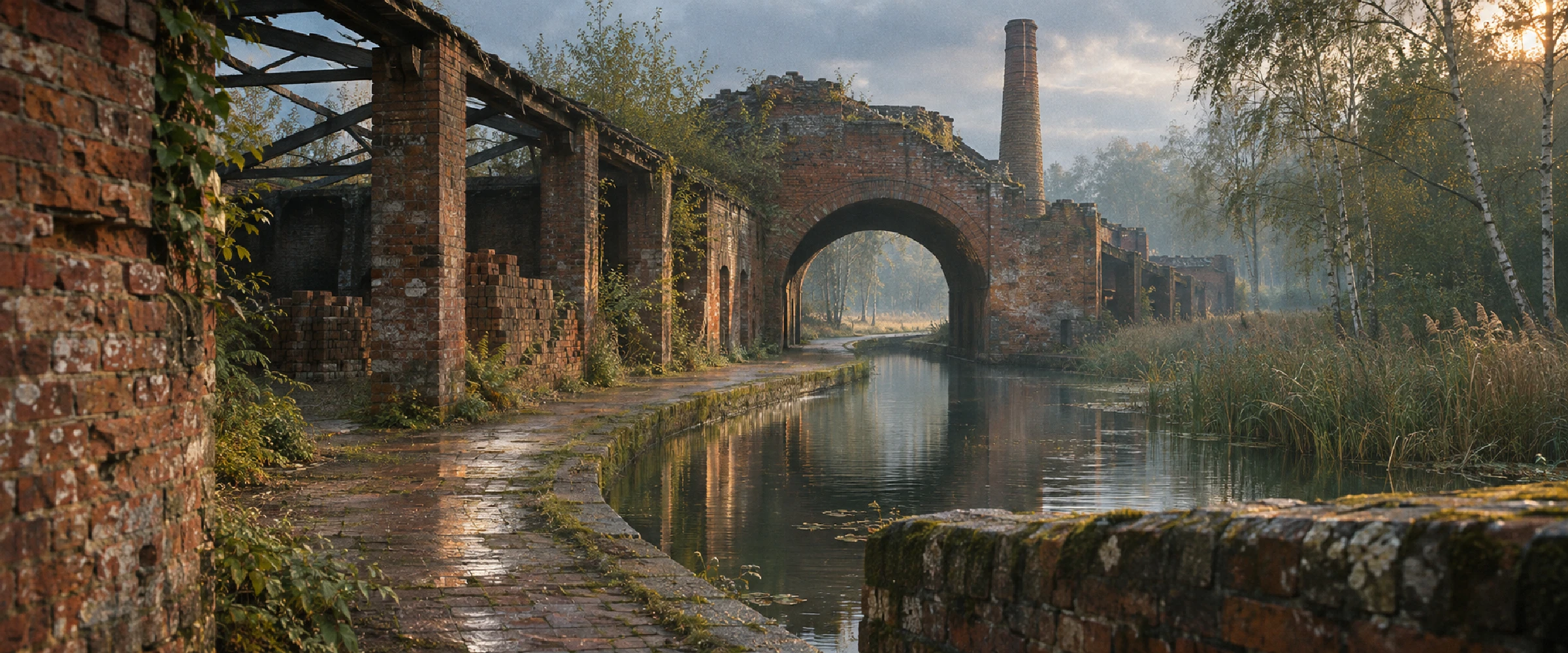
A wet towpath passes roofless brickworks and a kiln arch toward distant birches. Analog grain, blooming bright edges, and deep shadows give the panoramic journey expressive depth.
Remix this referenceA Canal Path Through an Abandoned Brickworks
- Form language
- Preserve photographic irregularity while grouping repeated forms into larger readable masses; small shape variations may occur naturally.
- Contour
- Use optically resolved edges without drawn outlines; let crisp nearby edges gradually soften with distance.
- Mark-making
- Fine irregular film grain remains visible in middle tones, with occasional softer grain clumps rather than uniform digital noise.
- Surface rendering
- Use continuous photographic tones, gently compressed light values, deep dark values retaining detail, and slight halation at bright tonal boundaries.
Priority
Make the analog photographic treatment visible through optical depth, grain, and the gentle response of bright edges.
What to avoid & what to check
Exact prompt for this example
MODULE OWNERSHIP
subject: Subject count, type, stable proportions and landmarks, resting face geometry, hair shape, physical materials, garment construction and permanent marks. No emotion, movement, color assignment or rendering recipe.
expression: Facial soft-tissue displacement and pupil direction, muscle coordination, regional intensity, asymmetry and onset/peak/release. No head/body pose, stable appearance, skin color or rendering.
gesture: Head/neck/body/limb orientation, joint movement, support, contact and pose-caused occlusion using existing anatomy. No eye/pupil movement, emotion, identity, props inventory or camera.
props: Prop count, type, construction, physical material and scale relative to the subject. Holding/contact belongs to gesture, position to composition, color to palette.
scene: Environment elements, terrain, backdrop/floor presence and structural detail. No canvas positions, camera, lighting, assigned colors or render texture.
camera: Projection, focal-length impression, camera elevation/yaw/roll, viewing distance and crop. No actor pose, world placement, lighting or canvas aspect ratio.
composition: Normalized 0-100% canvas positions, scale in frame, depth/overlap, focal hierarchy and margins. No joint pose, camera projection, rendering, subject/prop inventory or emotion.
palette: Color anchors, hue/saturation/value ranges, colors assigned to parts and approximate color coverage. No illumination direction, shading algorithm, physical material or layout.
lighting: Light-source direction/softness/intensity, ambient illumination, physical shadow direction/length and highlight position. Absence of directional illumination is allowed. No shading technique, palette or material changes.
style: Reusable form abstraction, contour weight/taper/edge quality, medium and mark scale/density/direction, surface rendering and tonal transition technique. No fixed subject proportions, anatomy, identity, expression, pose, palette, light-source direction, camera or layout.
output: Image count, aspect ratio, size, file/alpha requirements and global lettering/logo/watermark restrictions. No background scenery, crop, style, identity or pose.

SUBJECT
inventory: No people or animals.
geometry: No discrete character proportions or anatomical landmarks apply.
resting-face: No faces are present.
appearance: No character hair, garments, or permanent marks apply.

PRIORITY


AVOID


CHECK


PROPS
inventory: No separate props.
construction: No prop construction applies.

PRIORITY


AVOID


CHECK


SCENE
inventory: An abandoned brickworks canal with a towpath, roofless firing sheds, a kiln arch, reed beds, birches, and haze.
structure: The canal bends through connected brick yards; the wet path passes beneath a surviving kiln arch toward open woodland. Minor masonry damage may vary naturally.

PRIORITY


AVOID


CHECK


CAMERA
projection: Use photographic perspective with a moderate wide-angle impression and restrained edge stretching.
viewpoint: Look along the canal from slightly above standing eye level, obliquely across its first bend, with a level horizon.
crop: Take a distant panoramic view that includes nearby paving and the full progression into woodland.

PRIORITY


AVOID


CHECK


COMPOSITION
placement: The path enters near 15% width at the bottom, turns through the middle, and reaches the woodland near 80% width.
depth: A cropped foreground wall overlaps the canal; successive openings reveal the arch, then the distant clearing and birches in haze.
spacing: Make the arch the main pause along the route; balance dense near structures with generous open water and distant air.

PRIORITY


AVOID


CHECK


PALETTE
colors: Use weathered russet, muted olive, blue-gray, and pale straw, with restrained overall saturation.
assignment: Russet belongs to brickwork, olive to vegetation, blue-gray to water and sky, and straw to the distant clearing.
balance: Earth colors occupy most surfaces; cooler passages connect them, while the palest values remain a small accent.

PRIORITY


AVOID


CHECK


LIGHTING
sources: Soft late-afternoon sun enters from the upper right through thin cloud, supported by broad skylight.
shadows: Long softened wall shadows extend toward the lower left; covered recesses retain deep ambient shade.
highlights: Broken highlights catch wet paving and water; upper-right-facing masonry edges receive a quiet rim.

PRIORITY


AVOID


CHECK


STYLE GUIDE
form-language: Preserve photographic irregularity while grouping repeated forms into larger readable masses; small shape variations may occur naturally.
contour: Use optically resolved edges without drawn outlines; let crisp nearby edges gradually soften with distance.
mark-making: Fine irregular film grain remains visible in middle tones, with occasional softer grain clumps rather than uniform digital noise.
surface-rendering: Use continuous photographic tones, gently compressed light values, deep dark values retaining detail, and slight halation at bright tonal boundaries.

PRIORITY
Make the analog photographic treatment visible through optical depth, grain, and the gentle response of bright edges.

AVOID


CHECK


OUTPUT
format: One finished image, panoramic 12:5, 2400 × 1000 pixels, opaque PNG; no lettering, logos, or watermarks.
restrictions: One finished image, panoramic 12:5, 2400 × 1000 pixels, opaque PNG; no lettering, logos, or watermarks.

PRIORITY


AVOID


CHECK


FINAL INTEGRATION
scene + composition + style: Let the setting's connected spaces support the visual journey, with photographic edge behavior reinforcing its depth.
lighting + style: Apply the restrained halation to bright wet-surface reflections while retaining detail within the deep physical shadows.
Model information comes from image provenance. The same prompt may produce a different result.