Text to imageProductStyle guide
Opening the Tiered Sewing Box
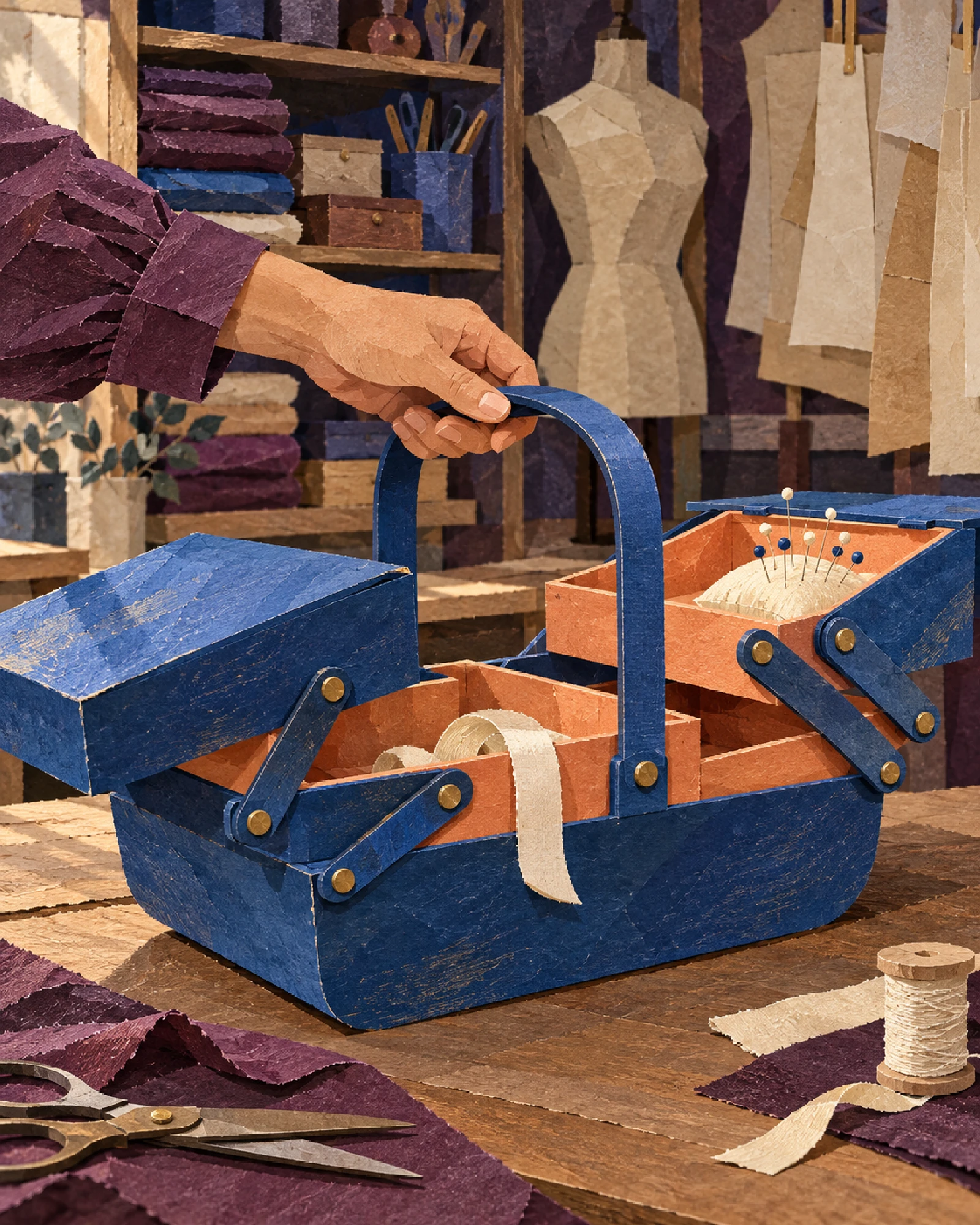
A hand opens a tiered sewing box within a layered workroom. Lifted compartments and tactile paper overlaps make its function vivid.
Remix this referenceOpening the Tiered Sewing Box
- Form language
- Translate forms into nested cut-paper planes with gently exaggerated interlocks; let small shape irregularities remain.
- Contour
- Use blade-cut curves beside occasional softly torn edges, with no drawn outline and slight handmade wavering.
- Mark-making
- Apply sparse scumbled pigment and broad rubbed streaks to the paper pieces, varying their direction naturally.
- Surface rendering
- Show matte paper tooth, raised cut edges and tactile overlaps; build tonal changes from layered pieces and rubbed pigment.
Priority
The finished image must visibly read as layered cut-paper collage with tactile overlaps.
What to avoid & what to check
Exact prompt for this example
MODULE OWNERSHIP
subject: Subject count, type, stable proportions and landmarks, resting face geometry, hair shape, physical materials, garment construction and permanent marks. No emotion, movement, color assignment or rendering recipe.
expression: Facial soft-tissue displacement and pupil direction, muscle coordination, regional intensity, asymmetry and onset/peak/release. No head/body pose, stable appearance, skin color or rendering.
gesture: Head/neck/body/limb orientation, joint movement, support, contact and pose-caused occlusion using existing anatomy. No eye/pupil movement, emotion, identity, props inventory or camera.
props: Prop count, type, construction, physical material and scale relative to the subject. Holding/contact belongs to gesture, position to composition, color to palette.
scene: Environment elements, terrain, backdrop/floor presence and structural detail. No canvas positions, camera, lighting, assigned colors or render texture.
camera: Projection, focal-length impression, camera elevation/yaw/roll, viewing distance and crop. No actor pose, world placement, lighting or canvas aspect ratio.
composition: Normalized 0-100% canvas positions, scale in frame, depth/overlap, focal hierarchy and margins. No joint pose, camera projection, rendering, subject/prop inventory or emotion.
palette: Color anchors, hue/saturation/value ranges, colors assigned to parts and approximate color coverage. No illumination direction, shading algorithm, physical material or layout.
lighting: Light-source direction/softness/intensity, ambient illumination, physical shadow direction/length and highlight position. Absence of directional illumination is allowed. No shading technique, palette or material changes.
style: Reusable form abstraction, contour weight/taper/edge quality, medium and mark scale/density/direction, surface rendering and tonal transition technique. No fixed subject proportions, anatomy, identity, expression, pose, palette, light-source direction, camera or layout.
output: Image count, aspect ratio, size, file/alpha requirements and global lettering/logo/watermark restrictions. No background scenery, crop, style, identity or pose.

SUBJECT
inventory: One original cantilever sewing box, accompanied by one visible adult hand and a sleeved forearm.
geometry: The box has a deep rounded base, stepped shallow trays, slender pivot arms and a crescent lifting grip.
resting-face: No face is visible; facial controls do not apply.
appearance: Bent-plywood shells and metal pivots; a typical adult hand and a loose woven sleeve with a plain cuff.

PRIORITY


AVOID


CHECK


GESTURE
head: No head or neck gesture controls apply.
torso: No torso gesture controls apply.
limbs: The forearm draws back while the gently bent wrist lifts the hand.
contact: The thumb opposes curled fingers around the raised grip; the partly opened box rests on the workbench.

PRIORITY


AVOID


CHECK


PROPS
inventory: One fabric pincushion and one narrow cotton ribbon, each small enough to fit inside a tray.
construction: The pincushion is a softly stuffed cloth pad; the ribbon is a flexible woven strip.

PRIORITY


AVOID


CHECK


SCENE
inventory: A dressmaker's workroom with a broad workbench, fabric-storage shelves and hanging pattern sheets.
structure: Open shelving and suspended sheets divide the room into successive recesses around the working surface.

PRIORITY


AVOID


CHECK


CAMERA
projection: Moderate perspective with a normal-lens impression and little optical distortion.
viewpoint: View obliquely from slightly above workbench height, with no camera roll.
crop: Frame the whole box, hand and forearm closely within the room; exclude the head, neck and torso and crop peripheral pattern sheets.

PRIORITY


AVOID


CHECK


COMPOSITION
placement: The box occupies the lower-right half; its grip reaches near 55% width, with the hand entering from the left.
depth: The box leads the hierarchy; overlapping trays reveal the pincushion and ribbon against receding workshop layers.
spacing: Leave an irregular pocket of space around the grip and uneven intervals between the surrounding room layers.

PRIORITY


AVOID


CHECK


PALETTE
colors: Cobalt, apricot, aubergine and warm cream, with a muted brown for the hand.
assignment: Cobalt covers the box exterior; apricot fills tray interiors; aubergine belongs to the room and sleeve; cream marks props.
balance: Muted aubergine dominates, cobalt and apricot form the main accents, and cream appears sparingly.

PRIORITY


AVOID


CHECK


LIGHTING
sources: A broad soft source from the upper left provides gentle directional light with moderate ambient fill.
shadows: Short shadows fall to the lower right, with narrow contact shadows beneath overlapping trays.
highlights: Soft highlights touch upper-left rims and the upper surface of the hand.

PRIORITY


AVOID


CHECK


STYLE GUIDE
form-language: Translate forms into nested cut-paper planes with gently exaggerated interlocks; let small shape irregularities remain.
contour: Use blade-cut curves beside occasional softly torn edges, with no drawn outline and slight handmade wavering.
mark-making: Apply sparse scumbled pigment and broad rubbed streaks to the paper pieces, varying their direction naturally.
surface-rendering: Show matte paper tooth, raised cut edges and tactile overlaps; build tonal changes from layered pieces and rubbed pigment.

PRIORITY
The finished image must visibly read as layered cut-paper collage with tactile overlaps.

AVOID


CHECK


OUTPUT
format: One finished image, 4:5 aspect ratio, 1600 × 2000 pixels, opaque PNG.
restrictions: No lettering, logos or watermarks.

PRIORITY


AVOID


CHECK


FINAL INTEGRATION
subject + gesture + composition + style: Coordinate product construction, visible hand contact and paper abstraction so the functional moment remains recognizable.
Model information comes from image provenance. The same prompt may produce a different result.