Text to imageArt stylesStyle guide
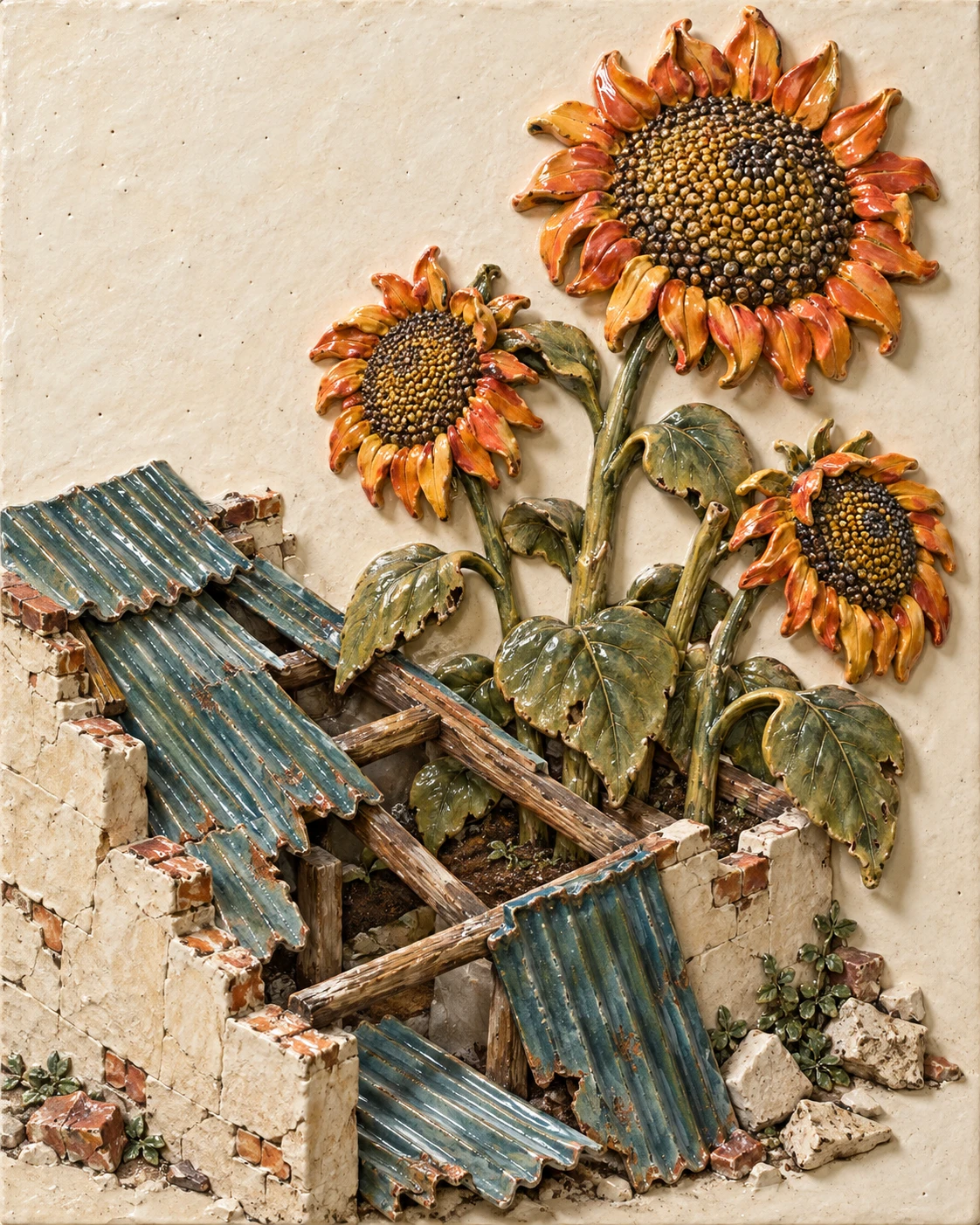
Sunflowers Through a Fallen Roof
Sunflowers rise through a collapsed shed roof in a ceramic relief illustration. Glaze gathers across rounded flower forms and folded roof planes, while generous empty space gives the small ruin a quiet vitality.
Remix this referenceSunflowers Through a Fallen Roof
- Form language
- Build a ceramic relief illustration from broad hand-modeled slabs and rounded mounds; compress minor detail into shallow grooves and allow slight unevenness.
- Contour
- Use softly rolled perimeter lips with occasional chipped interruptions; vary edge thickness naturally and let adjacent relief levels define interior boundaries.
- Mark-making
- Group small pressed dimples into rhythmic patches and use sparse curved incisions; let hand-dragged marks vary in length and pressure across otherwise quiet areas.
- Surface rendering
- Model translucent glaze pooling in recesses and thinning over crests, with rounded tonal transitions, occasional kiln freckles and small satin-to-gloss shifts.
Priority
Make the hand-modeled ceramic relief and the depth of its glaze visibly convincing.
What to avoid & what to check
Exact prompt for this example
MODULE OWNERSHIP
subject: Subject count, type, stable proportions and landmarks, resting face geometry, hair shape, physical materials, garment construction and permanent marks. No emotion, movement, color assignment or rendering recipe.
expression: Facial soft-tissue displacement and pupil direction, muscle coordination, regional intensity, asymmetry and onset/peak/release. No head/body pose, stable appearance, skin color or rendering.
gesture: Head/neck/body/limb orientation, joint movement, support, contact and pose-caused occlusion using existing anatomy. No eye/pupil movement, emotion, identity, props inventory or camera.
props: Prop count, type, construction, physical material and scale relative to the subject. Holding/contact belongs to gesture, position to composition, color to palette.
scene: Environment elements, terrain, backdrop/floor presence and structural detail. No canvas positions, camera, lighting, assigned colors or render texture.
camera: Projection, focal-length impression, camera elevation/yaw/roll, viewing distance and crop. No actor pose, world placement, lighting or canvas aspect ratio.
composition: Normalized 0-100% canvas positions, scale in frame, depth/overlap, focal hierarchy and margins. No joint pose, camera projection, rendering, subject/prop inventory or emotion.
palette: Color anchors, hue/saturation/value ranges, colors assigned to parts and approximate color coverage. No illumination direction, shading algorithm, physical material or layout.
lighting: Light-source direction/softness/intensity, ambient illumination, physical shadow direction/length and highlight position. Absence of directional illumination is allowed. No shading technique, palette or material changes.
style: Reusable form abstraction, contour weight/taper/edge quality, medium and mark scale/density/direction, surface rendering and tonal transition technique. No fixed subject proportions, anatomy, identity, expression, pose, palette, light-source direction, camera or layout.
output: Image count, aspect ratio, size, file/alpha requirements and global lettering/logo/watermark restrictions. No background scenery, crop, style, identity or pose.

SUBJECT
inventory: Three mature sunflower plants, each with one seed head, a substantial stem and a few broad leaves.
geometry: Broad, shallow seed disks have irregular petal crowns; stout stems carry heart-shaped leaves of naturally varied sizes.
resting-face: No facial anatomy applies.
appearance: Fibrous stems, papery petals and densely packed seeds; leaf edges may show a few natural tears.

PRIORITY


AVOID


CHECK


PROPS
inventory: No separate props.
construction: No prop construction applies.

PRIORITY


AVOID


CHECK


SCENE
inventory: A small roofless garden shed, collapsed roof sections, exposed rafters and a narrow patch of earth against a blank backdrop.
structure: Broken corrugated roof sheets rest across a low masonry wall; gaps between rafters reveal the planting bed beneath.

PRIORITY


AVOID


CHECK


CAMERA
projection: Orthographic illustration with restrained depth and no wide-angle expansion.
viewpoint: An elevated three-quarter view reveals the roof openings and the upper surfaces of the flower disks; keep the camera level.
crop: Show the complete sunflower crowns and enough of the shed to explain the collapse; crop the outermost rubble.

PRIORITY


AVOID


CHECK


COMPOSITION
placement: The ruin occupies the lower-left area; the flower heads climb toward the upper-right, with the largest head as the focal point.
depth: Roof planes overlap the stem bases, while leaves bridge the openings; stagger the flower disks so their silhouettes stay distinct.
spacing: Leave a broad uninterrupted upper-left field and open gaps between the crowns; keep the right edge comfortably spacious.

PRIORITY


AVOID


CHECK


PALETTE
colors: Use warm ivory, petrol teal, toasted ochre, muted persimmon and dusty olive, with restrained saturation.
assignment: Ivory for backdrop and masonry; teal for roof sheets; ochre seed disks, persimmon petals and olive stems and leaves.
balance: Ivory occupies most of the image; teal forms the main cool mass, and the small warm flower areas provide vivid accents.

PRIORITY


AVOID


CHECK


LIGHTING
sources: Broad soft light arrives from the upper left, with gentle ambient fill preserving detail in recesses.
shadows: Short shadows fall toward the lower right; overlaps carry slightly deeper contact shadows.
highlights: Soft highlights gather on upper-left-facing ridges, with a few sharper glints on exposed crests.

PRIORITY


AVOID


CHECK


STYLE GUIDE
form-language: Build a ceramic relief illustration from broad hand-modeled slabs and rounded mounds; compress minor detail into shallow grooves and allow slight unevenness.
contour: Use softly rolled perimeter lips with occasional chipped interruptions; vary edge thickness naturally and let adjacent relief levels define interior boundaries.
mark-making: Group small pressed dimples into rhythmic patches and use sparse curved incisions; let hand-dragged marks vary in length and pressure across otherwise quiet areas.
surface-rendering: Model translucent glaze pooling in recesses and thinning over crests, with rounded tonal transitions, occasional kiln freckles and small satin-to-gloss shifts.

PRIORITY
Make the hand-modeled ceramic relief and the depth of its glaze visibly convincing.

AVOID


CHECK


OUTPUT
format: No additional format rule applies.
restrictions: One finished image, 4:5 portrait, 2048 × 2560 pixels, opaque PNG; no lettering, logos or watermarks.

PRIORITY


AVOID


CHECK


FINAL INTEGRATION
subject + scene + composition: Let the plants and broken architecture form one connected silhouette while the open field gives the grouping room to breathe.
style + lighting + palette: Let illumination reveal the modeled surfaces while glaze variation enriches the limited color anchors.
Model information comes from image provenance. The same prompt may produce a different result.