Text to imageProductStyle guide
A Fan-Finned Letter Rack
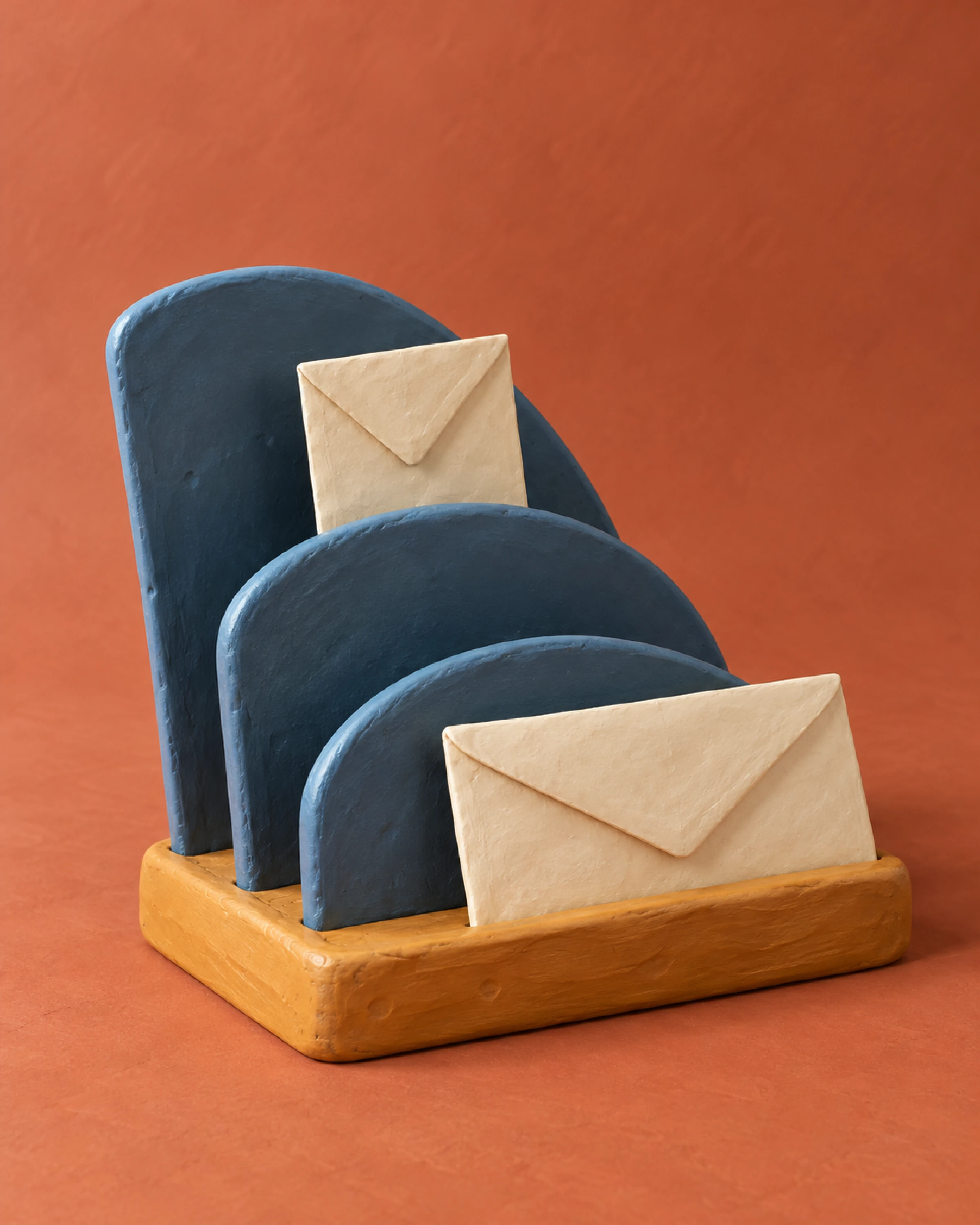
A letter rack with spreading fan-shaped dividers becomes a handmade clay miniature. Generous negative space and soft shadows turn an everyday product into a small sculptural still life.
Remix this referenceA Fan-Finned Letter Rack
- Form language
- Translate objects into hand-built clay slabs and rounded masses; preserve useful openings while allowing slight handmade irregularity.
- Contour
- Use softly compressed, hand-cut edges without drawn outlines; let corners bulge or flatten naturally.
- Mark-making
- Sparse thumb drags, shallow tool dents, and small edge pinches reveal making; vary their placement naturally.
- Surface rendering
- Render matte clay with softly blended tonal turns and uneven rubbed pigment, retaining tactile imperfections rather than polished uniformity.
Priority
The defining treatment is a sculptural clay miniature with visibly handmade surfaces.
What to avoid & what to check
Exact prompt for this example
MODULE OWNERSHIP
subject: Subject count, type, stable proportions and landmarks, resting face geometry, hair shape, physical materials, garment construction and permanent marks. No emotion, movement, color assignment or rendering recipe.
expression: Facial soft-tissue displacement and pupil direction, muscle coordination, regional intensity, asymmetry and onset/peak/release. No head/body pose, stable appearance, skin color or rendering.
gesture: Head/neck/body/limb orientation, joint movement, support, contact and pose-caused occlusion using existing anatomy. No eye/pupil movement, emotion, identity, props inventory or camera.
props: Prop count, type, construction, physical material and scale relative to the subject. Holding/contact belongs to gesture, position to composition, color to palette.
scene: Environment elements, terrain, backdrop/floor presence and structural detail. No canvas positions, camera, lighting, assigned colors or render texture.
camera: Projection, focal-length impression, camera elevation/yaw/roll, viewing distance and crop. No actor pose, world placement, lighting or canvas aspect ratio.
composition: Normalized 0-100% canvas positions, scale in frame, depth/overlap, focal hierarchy and margins. No joint pose, camera projection, rendering, subject/prop inventory or emotion.
palette: Color anchors, hue/saturation/value ranges, colors assigned to parts and approximate color coverage. No illumination direction, shading algorithm, physical material or layout.
lighting: Light-source direction/softness/intensity, ambient illumination, physical shadow direction/length and highlight position. Absence of directional illumination is allowed. No shading technique, palette or material changes.
style: Reusable form abstraction, contour weight/taper/edge quality, medium and mark scale/density/direction, surface rendering and tonal transition technique. No fixed subject proportions, anatomy, identity, expression, pose, palette, light-source direction, camera or layout.
output: Image count, aspect ratio, size, file/alpha requirements and global lettering/logo/watermark restrictions. No background scenery, crop, style, identity or pose.

SUBJECT
inventory: One original desktop letter rack, without people or animals.
geometry: Three broad fan-shaped dividers of graduated height rise from a low, elongated base, leaving open slots.
resting-face: No face or facial landmarks apply.
appearance: Bent sheet-steel dividers have rolled exposed edges and fit into a solid wood base.

PRIORITY


AVOID


CHECK


PROPS
inventory: Two plain paper envelopes: one tall and narrow, the other broad and squat.
construction: Folded paper with triangular flaps and gently bowed edges; each envelope is smaller than the tallest divider.

PRIORITY


AVOID


CHECK


SCENE
inventory: A continuous tabletop-and-backdrop sweep, without room architecture.
structure: The floor turns gradually into the backdrop, with no visible horizon seam or pedestal.

PRIORITY


AVOID


CHECK


CAMERA
projection: Near-orthographic perspective with a restrained long-lens impression.
viewpoint: A slightly elevated three-quarter view reveals the divider faces and the slots between them.
crop: A medium-wide product view includes the entire rack; only the broad envelope meets the lower crop.

PRIORITY


AVOID


CHECK


COMPOSITION
placement: The rack occupies the lower-left area; the upper-right remains spacious and uninterrupted.
depth: The tall envelope is partly hidden by a middle divider; the broad envelope overlaps the foreground edge.
spacing: Make the spreading divider silhouette primary, with envelopes as quiet secondary shapes and ample outer margins.

PRIORITY


AVOID


CHECK


PALETTE
colors: Use smoky blue, honey ochre, paper ivory, and muted terracotta as the four color anchors.
assignment: Assign blue to the dividers, ochre to the base, ivory to the envelopes, and terracotta to the sweep.
balance: Let subdued terracotta dominate; the blue product carries the strongest saturation and ivory provides relief.

PRIORITY


AVOID


CHECK


LIGHTING
sources: A broad soft source from the upper left, with gentle ambient fill.
shadows: Soft shadows extend toward the lower right, with deeper shading inside the divider slots.
highlights: Broad, restrained highlights sit on upper-left edges without sharp specular points.

PRIORITY


AVOID


CHECK


STYLE GUIDE
form-language: Translate objects into hand-built clay slabs and rounded masses; preserve useful openings while allowing slight handmade irregularity.
contour: Use softly compressed, hand-cut edges without drawn outlines; let corners bulge or flatten naturally.
mark-making: Sparse thumb drags, shallow tool dents, and small edge pinches reveal making; vary their placement naturally.
surface-rendering: Render matte clay with softly blended tonal turns and uneven rubbed pigment, retaining tactile imperfections rather than polished uniformity.

PRIORITY
The defining treatment is a sculptural clay miniature with visibly handmade surfaces.

AVOID


CHECK


OUTPUT
format: One image, portrait 4:5, 2400 × 3000 pixels, opaque PNG.
restrictions: No lettering, logos, signatures, or watermarks.

PRIORITY


AVOID


CHECK
Model information comes from image provenance. The same prompt may produce a different result.