Text to imageLandscapeStyle guide
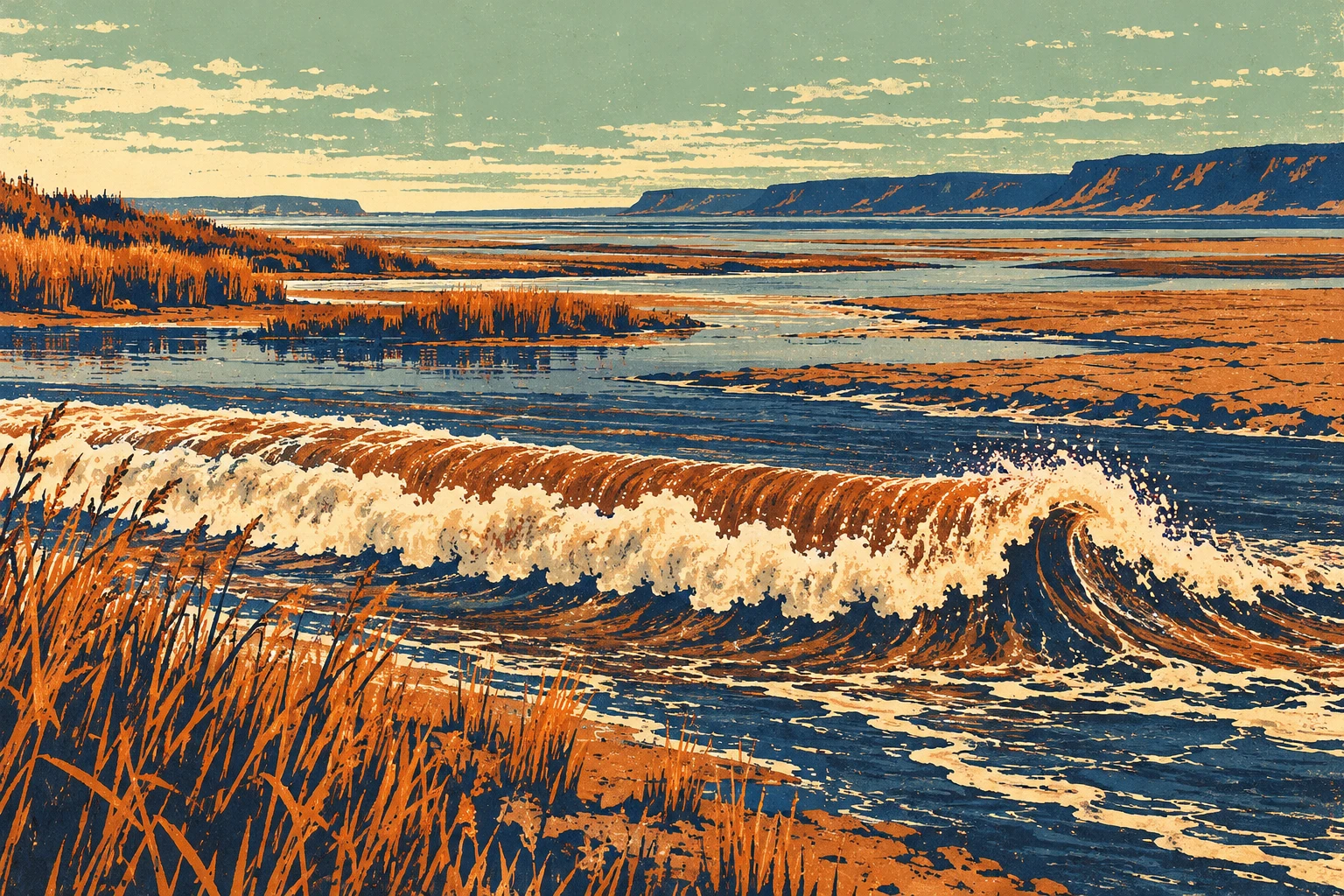
Tidal Bore Across the Salt Marsh
A long tidal crest curves between fractured mudflats and reed banks. Bold screenprinted shapes and overlapping inks turn the broad estuary into an immersive landscape.
Remix this referenceTidal Bore Across the Salt Marsh
- Form language
- Build a graphic screen print from broad interlocking masses, using repeated wedges and scallops to establish decisive shape rhythms.
- Contour
- Let adjacent ink fields define most contours; retain blunt cuts, occasional ragged edges and a few narrow unprinted slivers.
- Mark-making
- Use sparse dragged streaks and broken dry pulls within large shapes; allow their lengths and spacing to vary by hand.
- Surface rendering
- Model tone through overlapping ink fields and selective paper exposure, with slight registration slips and uneven ink bite.
Priority
Preserve the decisive shape rhythms and tangible ink overlap of a graphic screen print.
What to avoid & what to check
Exact prompt for this example
MODULE OWNERSHIP
subject: Subject count, type, stable proportions and landmarks, resting face geometry, hair shape, physical materials, garment construction and permanent marks. No emotion, movement, color assignment or rendering recipe.
expression: Facial soft-tissue displacement and pupil direction, muscle coordination, regional intensity, asymmetry and onset/peak/release. No head/body pose, stable appearance, skin color or rendering.
gesture: Head/neck/body/limb orientation, joint movement, support, contact and pose-caused occlusion using existing anatomy. No eye/pupil movement, emotion, identity, props inventory or camera.
props: Prop count, type, construction, physical material and scale relative to the subject. Holding/contact belongs to gesture, position to composition, color to palette.
scene: Environment elements, terrain, backdrop/floor presence and structural detail. No canvas positions, camera, lighting, assigned colors or render texture.
camera: Projection, focal-length impression, camera elevation/yaw/roll, viewing distance and crop. No actor pose, world placement, lighting or canvas aspect ratio.
composition: Normalized 0-100% canvas positions, scale in frame, depth/overlap, focal hierarchy and margins. No joint pose, camera projection, rendering, subject/prop inventory or emotion.
palette: Color anchors, hue/saturation/value ranges, colors assigned to parts and approximate color coverage. No illumination direction, shading algorithm, physical material or layout.
lighting: Light-source direction/softness/intensity, ambient illumination, physical shadow direction/length and highlight position. Absence of directional illumination is allowed. No shading technique, palette or material changes.
style: Reusable form abstraction, contour weight/taper/edge quality, medium and mark scale/density/direction, surface rendering and tonal transition technique. No fixed subject proportions, anatomy, identity, expression, pose, palette, light-source direction, camera or layout.
output: Image count, aspect ratio, size, file/alpha requirements and global lettering/logo/watermark restrictions. No background scenery, crop, style, identity or pose.

SUBJECT
inventory: One estuarine tidal bore is the natural subject; no people or animals.
geometry: A long, low wave has a hooked crest at one end and a thick, scalloped foam lip.
resting-face: No face is present.
appearance: The wave consists of sediment-bearing water and aerated foam; small foam divisions may vary naturally.

PRIORITY


AVOID


CHECK


PROPS
inventory: No separate props.
construction: No prop construction applies.

PRIORITY


AVOID


CHECK


SCENE
inventory: A broad tidal estuary contains reed banks, exposed mudflats, shallow tributaries and distant low bluffs.
structure: Branching channels divide shelves of cracked mud; irregular reed clumps interrupt their edges beneath open sky.

PRIORITY


AVOID


CHECK


CAMERA
projection: Use rectilinear perspective with a moderately wide, approximately 28 mm lens impression.
viewpoint: Look obliquely along the estuary from low bank height, with a level roll and a slight downward view.
crop: Use an expansive environmental view, cutting through nearby reeds while retaining the distant estuary opening.

PRIORITY


AVOID


CHECK


COMPOSITION
placement: The crest spans the lower half; its hooked end near 65% across and 55% down is the primary focus.
depth: Foreground reeds overlap the wave's left end; alternating mud shelves and channels lead toward the distant bluffs.
spacing: Keep the sky within the upper fifth, with broad water intervals separating the denser reed and bank shapes.

PRIORITY


AVOID


CHECK


PALETTE
colors: Use deep indigo, burnt orange, muted celadon and warm ivory as the small expressive color family.
assignment: Assign indigo to water and bluffs, orange to mud and reeds, celadon to sky, and ivory to foam.
balance: Let dark water and warm banks dominate; keep celadon restrained and ivory concentrated in the crest.

PRIORITY


AVOID


CHECK


LIGHTING
sources: Broad low sunlight enters from the left, supported by soft open-sky illumination.
shadows: Reed and bank shadows extend gently rightward; the wave's underside remains substantially darker.
highlights: The upper-left crest edge receives the strongest light, with quieter glints on exposed channel water.

PRIORITY


AVOID


CHECK


STYLE GUIDE
form-language: Build a graphic screen print from broad interlocking masses, using repeated wedges and scallops to establish decisive shape rhythms.
contour: Let adjacent ink fields define most contours; retain blunt cuts, occasional ragged edges and a few narrow unprinted slivers.
mark-making: Use sparse dragged streaks and broken dry pulls within large shapes; allow their lengths and spacing to vary by hand.
surface-rendering: Model tone through overlapping ink fields and selective paper exposure, with slight registration slips and uneven ink bite.

PRIORITY
Preserve the decisive shape rhythms and tangible ink overlap of a graphic screen print.

AVOID


CHECK


OUTPUT
format: Not applicable.
restrictions: Deliver one finished 3:2 landscape image, 2400 × 1600 pixels, opaque PNG; no lettering, logos or watermarks.

PRIORITY


AVOID


CHECK


FINAL INTEGRATION
composition + style: Let the printed shape rhythm reinforce the established depth without equalizing every layer's visual weight.
Model information comes from image provenance. The same prompt may produce a different result.