Text to imageArt stylesStyle guide
One Eggplant · Blended Charcoal
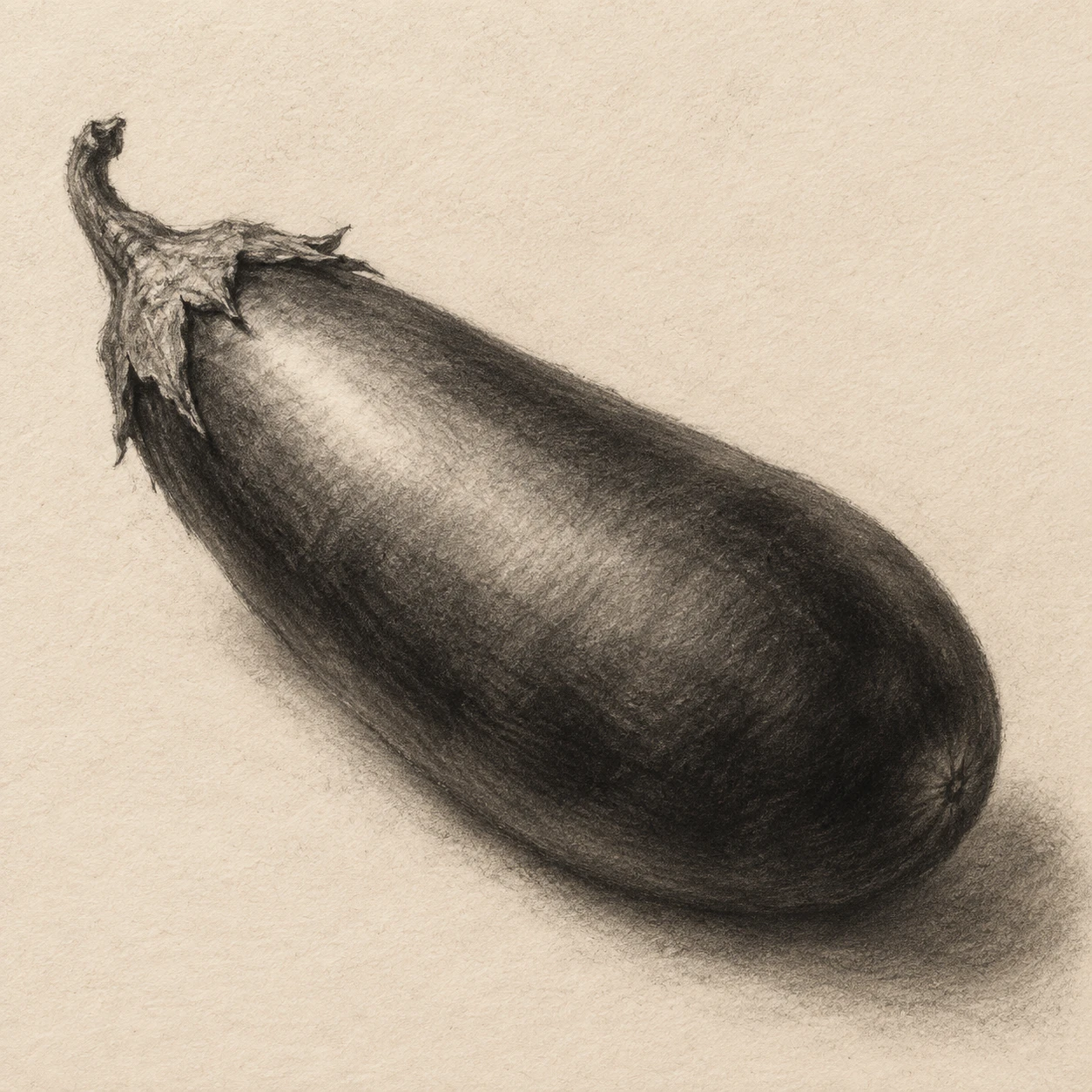
A monochrome drawing that selectively blends broad charcoal marks into an eggplant’s rounded body while retaining rough strokes at the calyx and edges.
One Eggplant · Blended Charcoal
- Shape & line
- Build the body with broad side-of-charcoal strokes that follow its long curve, then soften their internal boundaries with a blending stump. Keep the pointed calyx and bent stem legible through short angular strokes, and vary the outer contour between firm dark marks and softly rubbed passages.
- Color & light
- Use only charcoal grays and the warm paper color. Light the eggplant from the image’s upper left: preserve a broad pale area on its upper-left surface, blend through midgray into a dark lower-right underside, and extend a soft cast shadow from its contact with the surface toward the image’s lower right.
- Texture & material
- Let the paper tooth break up the unblended charcoal near the calyx and darker edge. Rub the central body into a smoother velvety tone while retaining faint directional traces; lift a small soft highlight with a kneaded eraser, keeping it visibly matte rather than glossy.
- Composition
- Keep the eggplant as the single dominant diagonal shape, occupying roughly the middle two-thirds of the frame. Concentrate the sharpest marks around the upper-left calyx, soften the lower-right body edge beside the cast shadow, and leave the surrounding paper mostly untouched so the contrast between drawn and blended areas remains easy to read.
Priority
Prioritize the visible transition from rough charcoal strokes to selectively blended volume.
What to avoid & what to check
Avoid uniformly smoothed shading, glossy highlights, and a continuous heavy outline.
Check that the calyx retains rough marks, the body has blended volume, and the shadow extends toward the lower right.
Exact prompt for this example
SUBJECT
Show exactly one whole eggplant with a plump elongated body, an attached pointed calyx, and a short curved stem, resting on its side on a plain surface.

COMPOSITION
Use a close, slightly elevated side view in a square frame. Place the stem toward the upper left and the rounded end toward the lower right, with the entire silhouette visible and generous paper around it.

STYLE GUIDE
1. Shape & line
Build the body with broad side-of-charcoal strokes that follow its long curve, then soften their internal boundaries with a blending stump. Keep the pointed calyx and bent stem legible through short angular strokes, and vary the outer contour between firm dark marks and softly rubbed passages.

2. Color & light
Use only charcoal grays and the warm paper color. Light the eggplant from the image’s upper left: preserve a broad pale area on its upper-left surface, blend through midgray into a dark lower-right underside, and extend a soft cast shadow from its contact with the surface toward the image’s lower right.

3. Texture & material
Let the paper tooth break up the unblended charcoal near the calyx and darker edge. Rub the central body into a smoother velvety tone while retaining faint directional traces; lift a small soft highlight with a kneaded eraser, keeping it visibly matte rather than glossy.

4. Composition
Keep the eggplant as the single dominant diagonal shape, occupying roughly the middle two-thirds of the frame. Concentrate the sharpest marks around the upper-left calyx, soften the lower-right body edge beside the cast shadow, and leave the surrounding paper mostly untouched so the contrast between drawn and blended areas remains easy to read.

PRIORITY
Preserve the requested identity, count, action, composition and output settings. Apply the style rules within those constraints; a style reference must not replace the subject or layout. Within the style: Prioritize the visible transition from rough charcoal strokes to selectively blended volume.

AVOID
Avoid uniformly smoothed shading, glossy highlights, and a continuous heavy outline.

OUTPUT
Create one square image of a finished charcoal drawing on warm off-white paper, without text, lettering, signatures, or borders.

SELF-CHECK
Check that the calyx retains rough marks, the body has blended volume, and the shadow extends toward the lower right.
Model information comes from image provenance. The same prompt may produce a different result.