Text to imageProductStyle guide
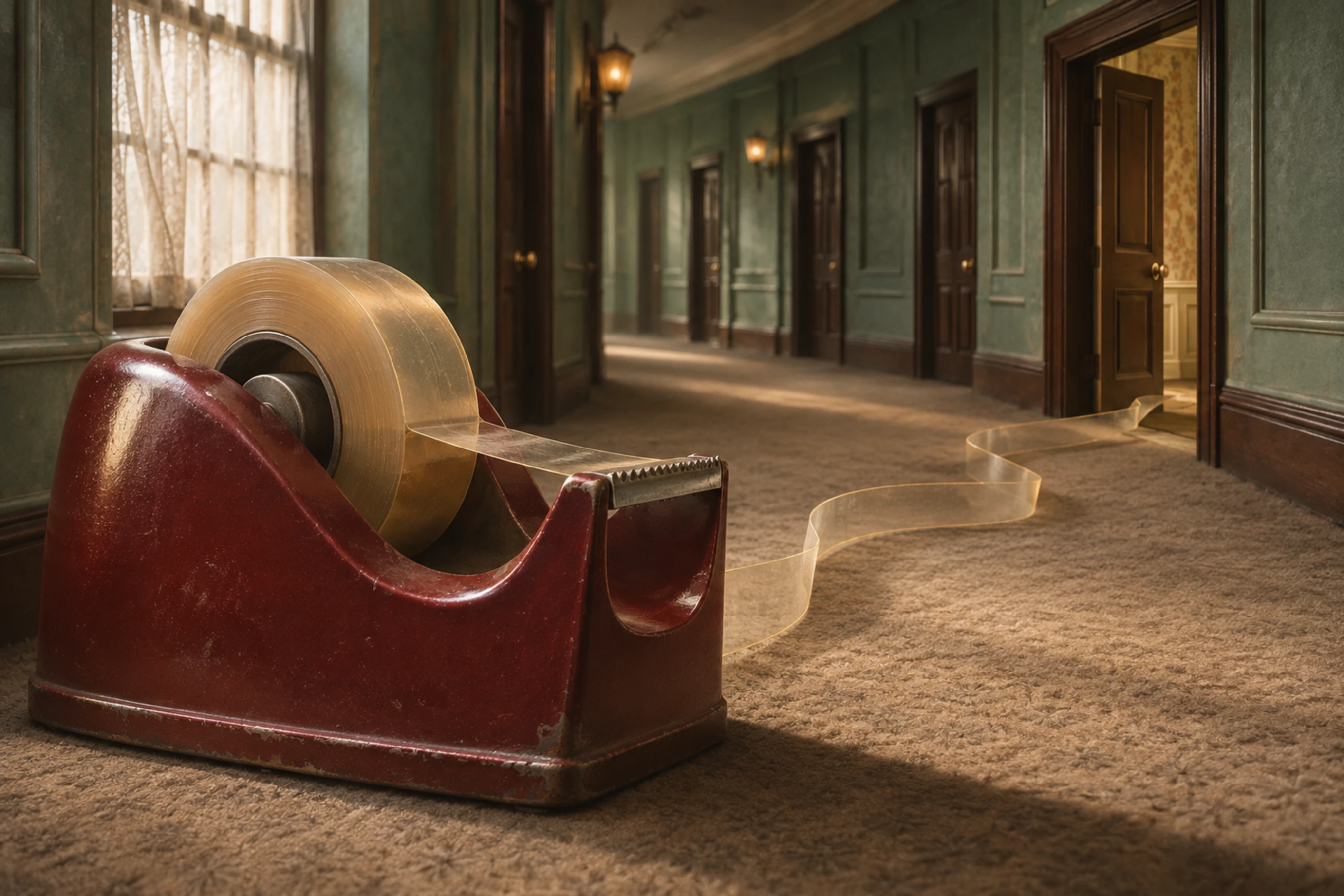
A Giant Tape Dispenser in a Hotel Corridor
Transparent tape trails from an enormous dispenser along an old hotel corridor. Analog grain and expressive depth make the familiar product’s unexpected scale feel tangible.
Remix this referenceA Giant Tape Dispenser in a Hotel Corridor
- Form language
- Render convincing volumes with restrained abstraction, subtle planar changes, and small local irregularities.
- Contour
- Use lens-resolved edges without drawn outlines; crisp focal edges soften progressively into distant optical blur.
- Mark-making
- Let irregular film grain breathe through middle tones, with slight halation around the brightest transitions.
- Surface rendering
- Use continuous photographic tone, a gentle highlight shoulder, and tactile focal detail against creamy depth falloff.
Priority
Make the image read as an analog photograph with expressive optical depth.
What to avoid & what to check
Exact prompt for this example
MODULE OWNERSHIP
subject: Subject count, type, stable proportions and landmarks, resting face geometry, hair shape, physical materials, garment construction and permanent marks. No emotion, movement, color assignment or rendering recipe.
expression: Facial soft-tissue displacement and pupil direction, muscle coordination, regional intensity, asymmetry and onset/peak/release. No head/body pose, stable appearance, skin color or rendering.
gesture: Head/neck/body/limb orientation, joint movement, support, contact and pose-caused occlusion using existing anatomy. No eye/pupil movement, emotion, identity, props inventory or camera.
props: Prop count, type, construction, physical material and scale relative to the subject. Holding/contact belongs to gesture, position to composition, color to palette.
scene: Environment elements, terrain, backdrop/floor presence and structural detail. No canvas positions, camera, lighting, assigned colors or render texture.
camera: Projection, focal-length impression, camera elevation/yaw/roll, viewing distance and crop. No actor pose, world placement, lighting or canvas aspect ratio.
composition: Normalized 0-100% canvas positions, scale in frame, depth/overlap, focal hierarchy and margins. No joint pose, camera projection, rendering, subject/prop inventory or emotion.
palette: Color anchors, hue/saturation/value ranges, colors assigned to parts and approximate color coverage. No illumination direction, shading algorithm, physical material or layout.
lighting: Light-source direction/softness/intensity, ambient illumination, physical shadow direction/length and highlight position. Absence of directional illumination is allowed. No shading technique, palette or material changes.
style: Reusable form abstraction, contour weight/taper/edge quality, medium and mark scale/density/direction, surface rendering and tonal transition technique. No fixed subject proportions, anatomy, identity, expression, pose, palette, light-source direction, camera or layout.
output: Image count, aspect ratio, size, file/alpha requirements and global lettering/logo/watermark restrictions. No background scenery, crop, style, identity or pose.

SUBJECT
inventory: One oversized desktop tape dispenser with its integral roll and continuous loose strip; no people.
geometry: A broad weighted base supports a recessed spool cradle and a projecting cutter nose with a finger recess.
resting-face: No facial features apply.
appearance: An enameled cast-metal body, steel cutting teeth, and translucent adhesive film; small scuffs may vary.

PRIORITY


AVOID


CHECK


PROPS
inventory: No separate props.
construction: No prop construction applies.

PRIORITY


AVOID


CHECK


SCENE
inventory: An old hotel corridor with carpet, paneled guest-room doors, tall baseboards, and a tall window.
structure: The corridor turns through a shallow bend; repeated door recesses and a partly open doorway establish ordinary building scale.

PRIORITY


AVOID


CHECK


CAMERA
projection: Natural photographic perspective with a normal-to-mild-wide lens impression.
viewpoint: A low, level three-quarter view looks along the corridor from a moderate distance.
crop: Include the complete dispenser and enough corridor to make the distant doors readable.

PRIORITY


AVOID


CHECK


COMPOSITION
placement: The dispenser occupies the lower-left foreground; its tape follows a loose S toward a doorway at middle right.
depth: Read the dispenser first, the tape second, and the receding rooms last; the product rises nearly to a nearby door handle.
spacing: Keep breathing room around the cutter and let the corridor opening carry the spacious upper-right field.

PRIORITY


AVOID


CHECK


PALETTE
colors: Muted oxblood, faded sea green, oatmeal, warm amber, and deep brown.
assignment: Assign oxblood to the dispenser, sea green to walls, oatmeal to carpet, brown to doors, and faint amber to tape.
balance: Let subdued surroundings dominate, with the richer product color providing a compact accent.

PRIORITY


AVOID


CHECK


LIGHTING
sources: Soft daylight enters through the rear-left window, with weak ambient fill from the corridor.
shadows: Broad, soft shadows extend toward the right foreground and gather beneath the base.
highlights: A broad rear-left highlight traces the body shoulder; narrow glints reveal the tape edges.

PRIORITY


AVOID


CHECK


STYLE GUIDE
form-language: Render convincing volumes with restrained abstraction, subtle planar changes, and small local irregularities.
contour: Use lens-resolved edges without drawn outlines; crisp focal edges soften progressively into distant optical blur.
mark-making: Let irregular film grain breathe through middle tones, with slight halation around the brightest transitions.
surface-rendering: Use continuous photographic tone, a gentle highlight shoulder, and tactile focal detail against creamy depth falloff.

PRIORITY
Make the image read as an analog photograph with expressive optical depth.

AVOID


CHECK


OUTPUT
format: One finished image, landscape 3:2, 3000 × 2000 pixels, opaque PNG.
restrictions: No lettering, room numbers, logos, signatures, or watermarks.

PRIORITY


AVOID


CHECK


FINAL INTEGRATION
camera + composition + style: Let photographic depth reinforce the scale surprise while retaining enough environmental clarity to understand it.
Model information comes from image provenance. The same prompt may produce a different result.