Text to imageCharacterStyle guide
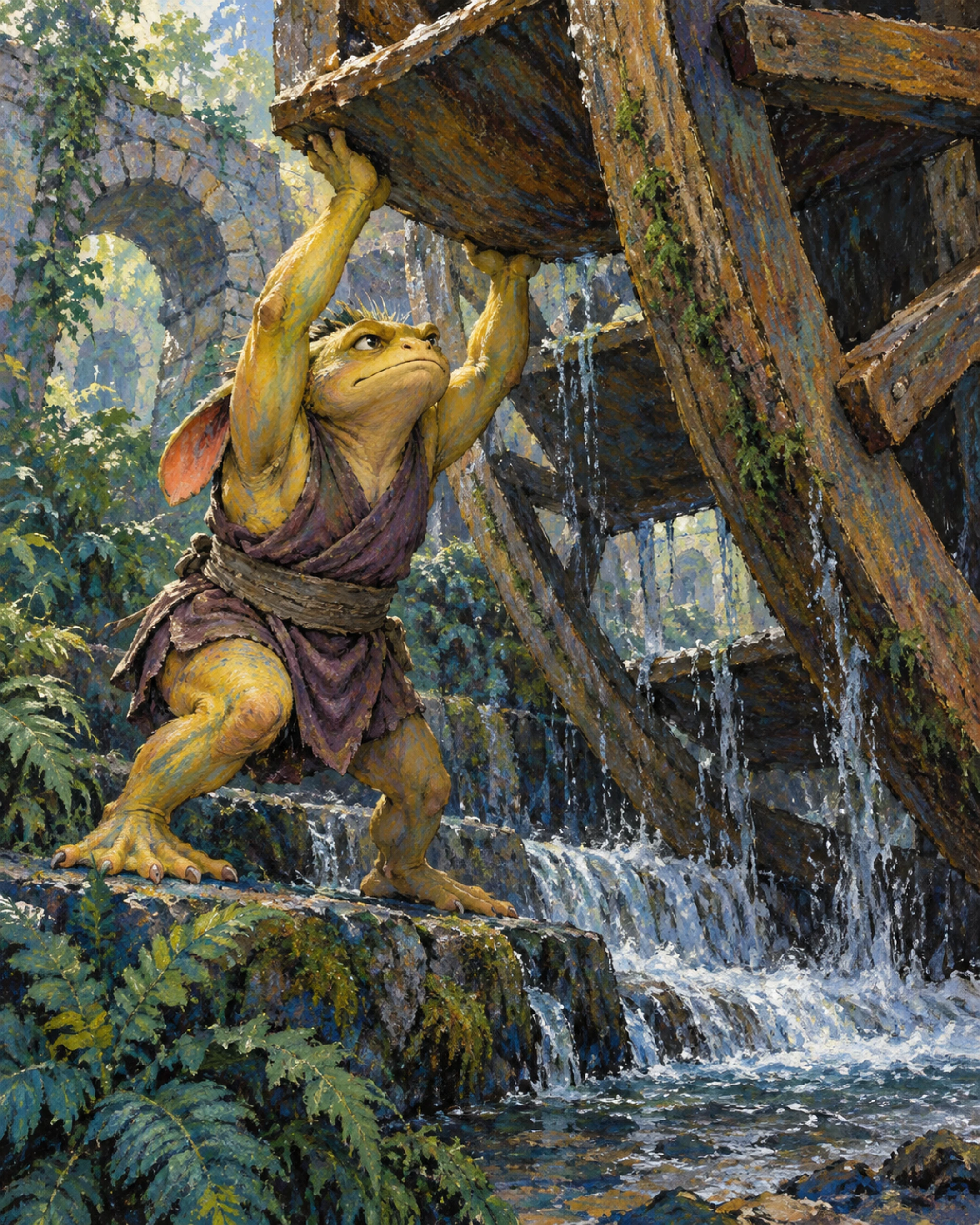
Creature Lifting a Waterwheel Paddle
A scoop-eared creature pushes up a waterwheel paddle inside a fern-choked watercourse. Rubbed oil pastel and scratched passages connect the winding spaces with dreamlike continuity.
Remix this referenceCreature Lifting a Waterwheel Paddle
- Form language
- Compress forms into swelling masses and interlocking wedges; let secondary shapes drift slightly while keeping their construction readable.
- Contour
- Use broken, blunt pastel edges that alternately dissolve into neighboring masses and return as short dark pressure strokes.
- Mark-making
- Rub broad oil-pastel sweeps together, then scratch irregular looping and diagonal marks through selected passages.
- Surface rendering
- Build waxy opaque deposits over rubbed translucent veils; retain dragged crumbs and exposed underlayers for uneven, dreamlike transitions.
Priority
Keep the rubbed and scratched oil pastel visibly active across the finished image.
What to avoid & what to check
Exact prompt for this example
MODULE OWNERSHIP
subject: Subject count, type, stable proportions and landmarks, resting face geometry, hair shape, physical materials, garment construction and permanent marks. No emotion, movement, color assignment or rendering recipe.
expression: Facial soft-tissue displacement and pupil direction, muscle coordination, regional intensity, asymmetry and onset/peak/release. No head/body pose, stable appearance, skin color or rendering.
gesture: Head/neck/body/limb orientation, joint movement, support, contact and pose-caused occlusion using existing anatomy. No eye/pupil movement, emotion, identity, props inventory or camera.
props: Prop count, type, construction, physical material and scale relative to the subject. Holding/contact belongs to gesture, position to composition, color to palette.
scene: Environment elements, terrain, backdrop/floor presence and structural detail. No canvas positions, camera, lighting, assigned colors or render texture.
camera: Projection, focal-length impression, camera elevation/yaw/roll, viewing distance and crop. No actor pose, world placement, lighting or canvas aspect ratio.
composition: Normalized 0-100% canvas positions, scale in frame, depth/overlap, focal hierarchy and margins. No joint pose, camera projection, rendering, subject/prop inventory or emotion.
palette: Color anchors, hue/saturation/value ranges, colors assigned to parts and approximate color coverage. No illumination direction, shading algorithm, physical material or layout.
lighting: Light-source direction/softness/intensity, ambient illumination, physical shadow direction/length and highlight position. Absence of directional illumination is allowed. No shading technique, palette or material changes.
style: Reusable form abstraction, contour weight/taper/edge quality, medium and mark scale/density/direction, surface rendering and tonal transition technique. No fixed subject proportions, anatomy, identity, expression, pose, palette, light-source direction, camera or layout.
output: Image count, aspect ratio, size, file/alpha requirements and global lettering/logo/watermark restrictions. No background scenery, crop, style, identity or pose.

SUBJECT
inventory: One original amphibious creature, actor A; no supporting figures.
geometry: A pear-shaped trunk, blunt wedge head, long forearms, broad webbed feet and hanging scoop-shaped ears.
resting-face: Small wide-set eyes, low straight brows, a shallow muzzle and a long horizontal mouth define the resting face.
appearance: Smooth bare skin, a short crown bristle ridge and a sleeveless wrap tunic with an overlapping front and broad belt.

PRIORITY


AVOID


CHECK


EXPRESSION — ACTOR A
brows: The inner brows lower into a shallow V.
lids: Upper lids narrow slightly; lower lids press upward.
cheeks: Cheeks tighten without swelling or lifting into a smile.
nose: Nostrils remain relaxed, with no pronounced flare.
mouth: Lips press together, with one corner drawn slightly outward.
jaw: The jaw sets firmly without opening.
gaze: Pupils track upward toward the paddle.
coordination: Focused eyes and a restrained mouth carry effort without an angry snarl.
timing: Hold the sustained apex of effort, with the uneven mouth corner still visible.

PRIORITY


AVOID


CHECK


GESTURE
head: A lifts the chin between the raised arms, keeping the neck visibly extended.
torso: The trunk leans forward from a low brace, with one shoulder higher under the load.
limbs: Both arms reach overhead with bent elbows; staggered legs brace on the ledge.
contact: Both palms push the paddle's underside upward; both webbed soles remain planted on stone.

PRIORITY


AVOID


CHECK


PROPS
inventory: No separate props.
construction: No prop construction applies.

PRIORITY


AVOID


CHECK


SCENE
inventory: An old timber waterwheel, a narrow stone spillway, fern thickets and fragments of a mill arcade.
structure: The wheel stands within a stepped channel; ledges, shallow pools and broken arches form connected recesses.

PRIORITY


AVOID


CHECK


CAMERA
projection: Perspective with a moderately wide lens impression and gentle near-to-far expansion.
viewpoint: Look obliquely along the channel from just below A's face height, with a level horizon.
crop: Include A's full body; let the wheel rim and nearest vegetation continue beyond the crop.

PRIORITY


AVOID


CHECK


COMPOSITION
placement: A occupies the lower-left third; the hands and paddle lead toward the upper middle.
depth: Foreground fronds overlap the ledge; the wheel fills the right side, with arches receding through its gaps.
spacing: Make the face-hand-paddle passage the first read, leaving breathing space around the face within the dense setting.

PRIORITY


AVOID


CHECK


PALETTE
colors: Petrol blue, sulfur yellow, muted mulberry, weathered ochre and small coral accents.
assignment: Sulfur yellow defines A's skin, coral the ear interiors, mulberry the tunic, ochre the wheel and petrol the surroundings.
balance: Cool darks occupy most of the image; the smaller yellow mass provides the strongest value and saturation contrast.

PRIORITY


AVOID


CHECK


LIGHTING
sources: Broad soft daylight enters from above left, with dim ambient light inside the mill recesses.
shadows: Soft cast shadows fall downward and right; the wheel creates a broad shadow across the channel.
highlights: Broad highlights touch the crown, upper forearms and paddle lip; pool reflections remain subdued.

PRIORITY


AVOID


CHECK


STYLE GUIDE
form-language: Compress forms into swelling masses and interlocking wedges; let secondary shapes drift slightly while keeping their construction readable.
contour: Use broken, blunt pastel edges that alternately dissolve into neighboring masses and return as short dark pressure strokes.
mark-making: Rub broad oil-pastel sweeps together, then scratch irregular looping and diagonal marks through selected passages.
surface-rendering: Build waxy opaque deposits over rubbed translucent veils; retain dragged crumbs and exposed underlayers for uneven, dreamlike transitions.

PRIORITY
Keep the rubbed and scratched oil pastel visibly active across the finished image.

AVOID


CHECK


OUTPUT
format: One finished image, 4:5 aspect ratio, 2048 × 2560 pixels, opaque PNG.
restrictions: No lettering, logos or watermarks.

PRIORITY


AVOID


CHECK
Model information comes from image provenance. The same prompt may produce a different result.