Text to imageIllustrationStyle guide
Glassblower in the Vine Hall
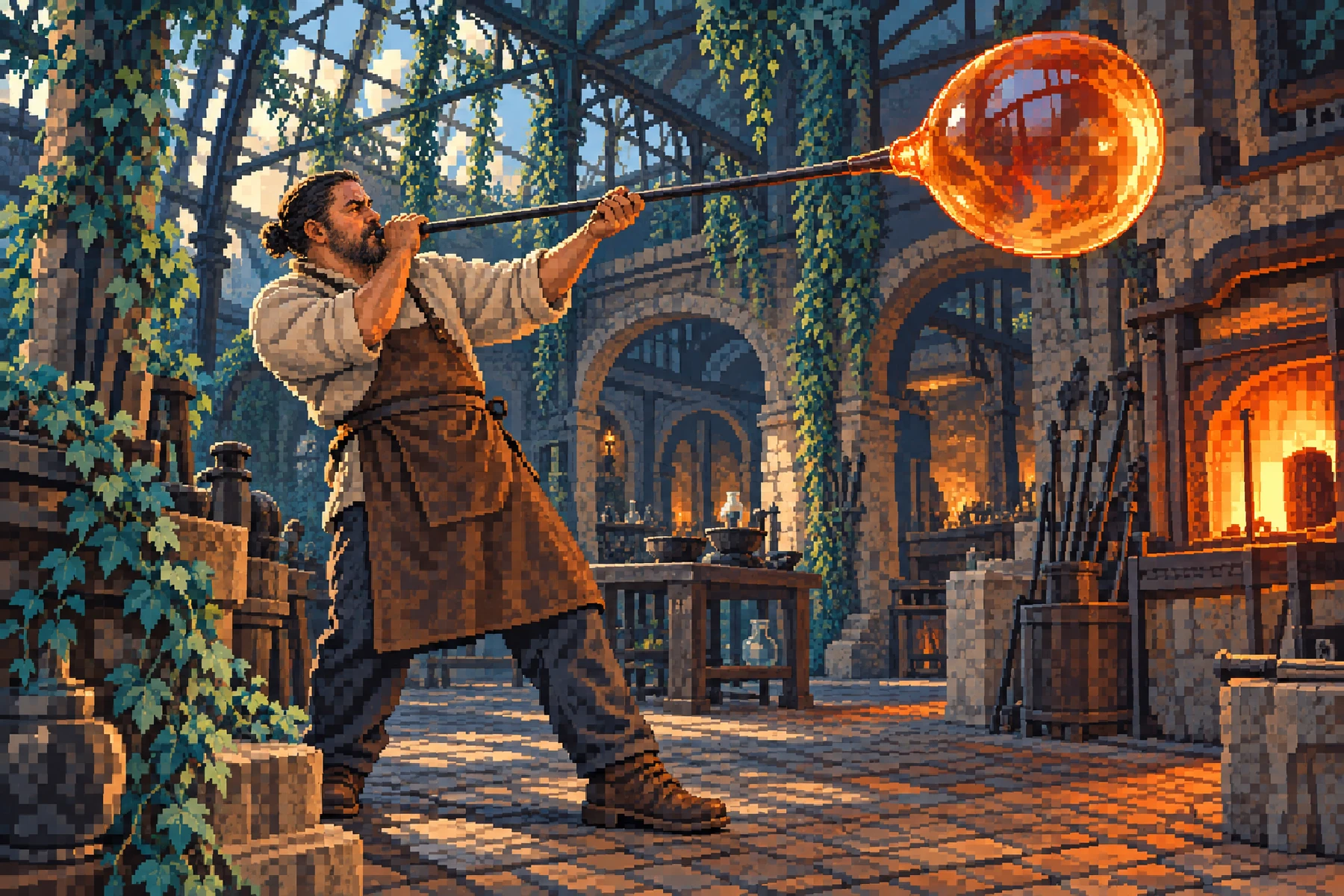
A glassblower raises a glowing glass sphere inside a workshop overtaken by vines. Interwoven pixel clusters and stepped edges knit the deep interior into a tapestry-like illustration.
Remix this referenceGlassblower in the Vine Hall
- Form language
- Reduce forms to interlocking pixel masses, letting broad shapes read first and smaller stepped clusters articulate their joins.
- Contour
- Build deliberate low-resolution stair-step edges; use selective thick block contours and occasional broken edges instead of uniform outlines.
- Mark-making
- Alternate short horizontal and vertical pixel runs like over-and-under weaving; vary their cadence naturally within the same coarse mark language.
- Surface rendering
- Use stepped tonal patches with interwoven boundary clusters; broad calm areas contrast with denser woven passages, without smooth airbrushed transitions.
Priority
The defining treatment is woven pixel-art shapes with deliberate low-resolution edges.
What to avoid & what to check
Exact prompt for this example
MODULE OWNERSHIP
subject: Subject count, type, stable proportions and landmarks, resting face geometry, hair shape, physical materials, garment construction and permanent marks. No emotion, movement, color assignment or rendering recipe.
expression: Facial soft-tissue displacement and pupil direction, muscle coordination, regional intensity, asymmetry and onset/peak/release. No head/body pose, stable appearance, skin color or rendering.
gesture: Head/neck/body/limb orientation, joint movement, support, contact and pose-caused occlusion using existing anatomy. No eye/pupil movement, emotion, identity, props inventory or camera.
props: Prop count, type, construction, physical material and scale relative to the subject. Holding/contact belongs to gesture, position to composition, color to palette.
scene: Environment elements, terrain, backdrop/floor presence and structural detail. No canvas positions, camera, lighting, assigned colors or render texture.
camera: Projection, focal-length impression, camera elevation/yaw/roll, viewing distance and crop. No actor pose, world placement, lighting or canvas aspect ratio.
composition: Normalized 0-100% canvas positions, scale in frame, depth/overlap, focal hierarchy and margins. No joint pose, camera projection, rendering, subject/prop inventory or emotion.
palette: Color anchors, hue/saturation/value ranges, colors assigned to parts and approximate color coverage. No illumination direction, shading algorithm, physical material or layout.
lighting: Light-source direction/softness/intensity, ambient illumination, physical shadow direction/length and highlight position. Absence of directional illumination is allowed. No shading technique, palette or material changes.
style: Reusable form abstraction, contour weight/taper/edge quality, medium and mark scale/density/direction, surface rendering and tonal transition technique. No fixed subject proportions, anatomy, identity, expression, pose, palette, light-source direction, camera or layout.
output: Image count, aspect ratio, size, file/alpha requirements and global lettering/logo/watermark restrictions. No background scenery, crop, style, identity or pose.

SUBJECT
inventory: A is one original adult glassblower; there are no other figures.
geometry: A has a sturdy build, broad palms and a recognizable face with broad cheekbones, a straight nose and a small chin.
resting-face: The resting face has straight brows, shallow upper-lid folds and a broad mouth with an even lip line.
appearance: Hair forms a compact low knot; a cotton wrap jacket, leather apron and heavy leather shoes complete the workwear.

PRIORITY


AVOID


CHECK


EXPRESSION — ACTOR A
brows: Brows draw slightly inward, with the nearer brow a little lower.
lids: Upper lids lower slightly while lower lids remain gently firm.
cheeks: Cheeks remain nearly at rest, without a smile-driven lift.
nose: Nose wings stay relaxed without flaring or wrinkling.
mouth: Lips meet with light compression; both corners remain level.
jaw: The jaw sets lightly without an exaggerated clench.
gaze: Pupils track the attached glass sphere.
coordination: Concentration is carried by brows and lids while the lower face stays quiet.
timing: Capture the held apex of concentration, with no sudden facial recoil.

PRIORITY


AVOID


CHECK


GESTURE
head: A raises the chin slightly, extending the neck toward the lifted end of the pipe.
torso: The torso leans back slightly to counterbalance the forward reach, with weight settled over the rear foot.
limbs: Both arms lift the pipe diagonally; the forward elbow opens while the nearer elbow stays bent, feet staggered.
contact: Both hands grip the pipe shaft at separated points; both soles stay planted on the floor.

PRIORITY


AVOID


CHECK


PROPS
inventory: One long steel blowpipe carries one glass sphere, roughly as wide as A's torso.
construction: The hollow pipe has a plain mouthpiece; the glass sphere joins its tip through a short glass neck.

PRIORITY


AVOID


CHECK


SCENE
inventory: An old glasshouse workshop contains a built-in furnace, masonry benches, climbing vines and a worn brick floor.
structure: Repeated iron roof ribs span several bays; missing panes admit vines, and open archways connect deeper work chambers.

PRIORITY


AVOID


CHECK


CAMERA
projection: Use natural perspective with a normal-lens impression and moderate depth convergence.
viewpoint: View from slightly below chest height at a three-quarter angle to A, with an unrolled horizon.
crop: Use a medium-wide view retaining A's full figure, both hands and the entire glass sphere.

PRIORITY


AVOID


CHECK


COMPOSITION
placement: A occupies the left third; the sphere commands the upper middle-right, with the furnace farther right.
depth: Foreground vines overlap the hall edges; A occupies the middle layer, with arches receding behind the sphere.
spacing: Keep breathing room around the sphere and a clear gap around the arms; let peripheral architecture run off-frame.

PRIORITY


AVOID


CHECK


PALETTE
colors: Anchor the palette in deep indigo, muted petrol teal, ember orange and warm chalk cream.
assignment: Indigo belongs to roof ribs and recesses, teal to vines, orange to glass and furnace, cream to jacket and masonry.
balance: Dark cool colors dominate; cream forms smaller quiet passages, and saturated orange remains a compact accent.

PRIORITY


AVOID


CHECK


LIGHTING
sources: The sphere gives strong local light; soft daylight enters from the upper left, with weaker furnace illumination.
shadows: Daylight casts broad soft shadows toward the lower right; the sphere creates smaller shadows away from itself.
highlights: Sphere-facing fingers, cheek and apron receive the strongest highlights; roof-facing edges catch softer daylight.

PRIORITY


AVOID


CHECK


STYLE GUIDE
form-language: Reduce forms to interlocking pixel masses, letting broad shapes read first and smaller stepped clusters articulate their joins.
contour: Build deliberate low-resolution stair-step edges; use selective thick block contours and occasional broken edges instead of uniform outlines.
mark-making: Alternate short horizontal and vertical pixel runs like over-and-under weaving; vary their cadence naturally within the same coarse mark language.
surface-rendering: Use stepped tonal patches with interwoven boundary clusters; broad calm areas contrast with denser woven passages, without smooth airbrushed transitions.

PRIORITY
The defining treatment is woven pixel-art shapes with deliberate low-resolution edges.

AVOID


CHECK


OUTPUT
format: Deliver one landscape image at 3:2, 1800 × 1200 pixels, as an opaque PNG.
restrictions: No lettering, logos, signatures or watermarks.

PRIORITY


AVOID


CHECK


FINAL INTEGRATION
expression + gesture + composition: Facial concentration and the sustained lift cooperate as one readable action within the focal arrangement.
style + lighting + scene: The woven treatment carries the illumination through connected spaces while preserving their structural depth.
Model information comes from image provenance. The same prompt may produce a different result.