Text to imageCafe & brandStyle guide
Chair Across the Fence
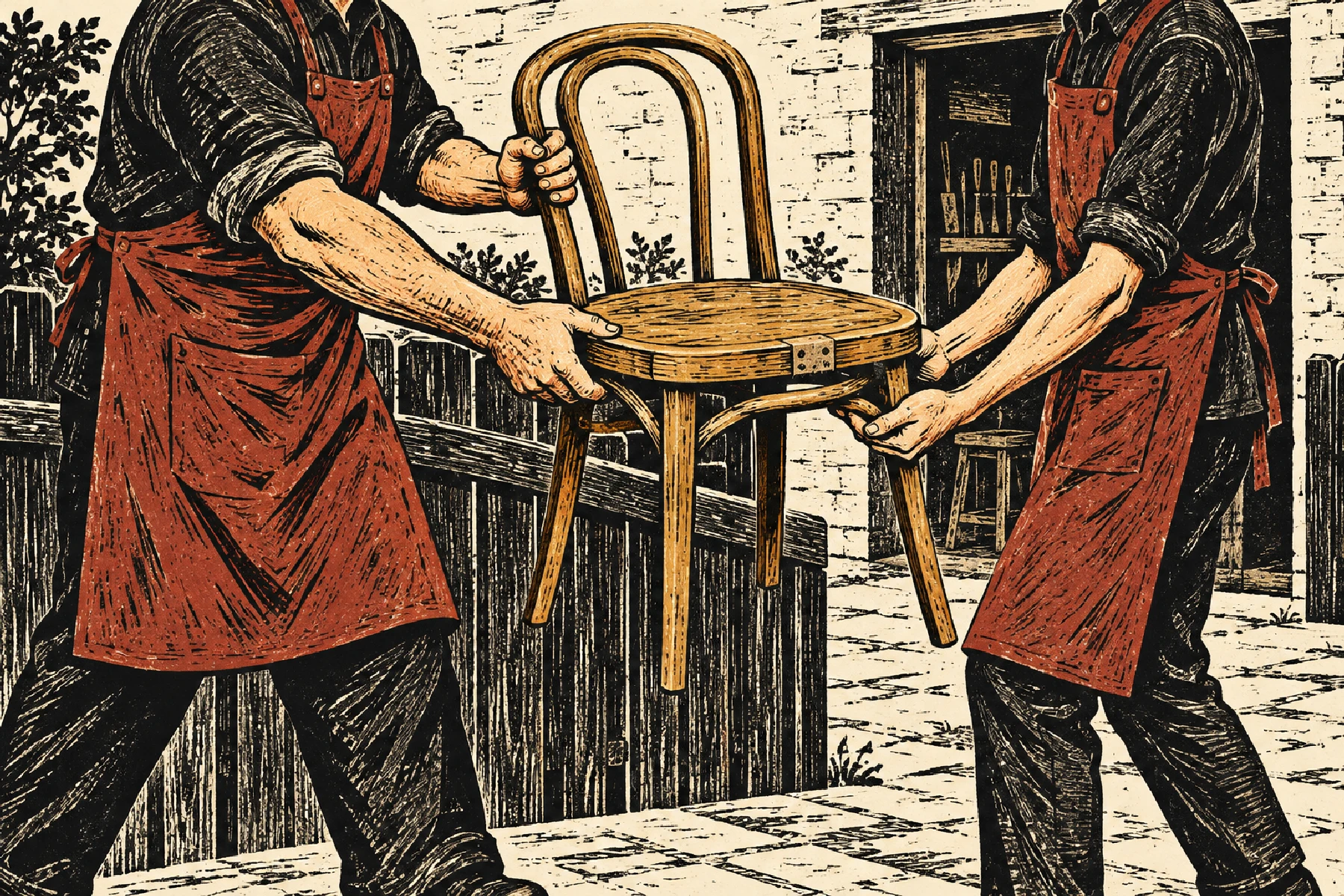
Two furniture reuse workers pass a repaired chair across a low fence. Overlapping arms, a looping chair back and rhythmic carved marks turn their shared effort into a bold linocut brand illustration.
Remix this referenceChair Across the Fence
- Form language
- Compress forms into broad interlocking masses, retaining generous internal openings and irregular corners.
- Contour
- Use weighty relief-print edges with small gouged interruptions; contours swell and narrow rather than stay uniform.
- Mark-making
- Carve rhythmic curved channels and short wedge cuts in changing clusters; allow natural variation in spacing and pressure.
- Surface rendering
- Build tones from printed masses and carved reserves, with occasional thin ink patches and slight handmade registration drift.
Priority
Make bold linocut carving visibly define the image.
What to avoid & what to check
Exact prompt for this example
MODULE OWNERSHIP
subject: Subject count, type, stable proportions and landmarks, resting face geometry, hair shape, physical materials, garment construction and permanent marks. No emotion, movement, color assignment or rendering recipe.
expression: Facial soft-tissue displacement and pupil direction, muscle coordination, regional intensity, asymmetry and onset/peak/release. No head/body pose, stable appearance, skin color or rendering.
gesture: Head/neck/body/limb orientation, joint movement, support, contact and pose-caused occlusion using existing anatomy. No eye/pupil movement, emotion, identity, props inventory or camera.
props: Prop count, type, construction, physical material and scale relative to the subject. Holding/contact belongs to gesture, position to composition, color to palette.
scene: Environment elements, terrain, backdrop/floor presence and structural detail. No canvas positions, camera, lighting, assigned colors or render texture.
camera: Projection, focal-length impression, camera elevation/yaw/roll, viewing distance and crop. No actor pose, world placement, lighting or canvas aspect ratio.
composition: Normalized 0-100% canvas positions, scale in frame, depth/overlap, focal hierarchy and margins. No joint pose, camera projection, rendering, subject/prop inventory or emotion.
palette: Color anchors, hue/saturation/value ranges, colors assigned to parts and approximate color coverage. No illumination direction, shading algorithm, physical material or layout.
lighting: Light-source direction/softness/intensity, ambient illumination, physical shadow direction/length and highlight position. Absence of directional illumination is allowed. No shading technique, palette or material changes.
style: Reusable form abstraction, contour weight/taper/edge quality, medium and mark scale/density/direction, surface rendering and tonal transition technique. No fixed subject proportions, anatomy, identity, expression, pose, palette, light-source direction, camera or layout.
output: Image count, aspect ratio, size, file/alpha requirements and global lettering/logo/watermark restrictions. No background scenery, crop, style, identity or pose.

SUBJECT
inventory: Two adult workshop workers, A and B, with no additional figures.
geometry: A has a broad build; B is slender. Both have ordinary adult proportions and substantial hands.
resting-face: No resting facial geometry is prescribed.
appearance: Both wear woven shirts with rolled sleeves and heavy canvas bib aprons; minor garment details may vary.

PRIORITY


AVOID


CHECK


EXPRESSION — ACTOR A
brows: Brow displacement is unprescribed.
lids: Eyelid displacement is unprescribed.
cheeks: Cheek displacement is unprescribed.
nose: Nasal tension is unprescribed.
mouth: Lip displacement is unprescribed.
jaw: Jaw opening or tension is unprescribed.
gaze: Pupil direction is unprescribed.
coordination: No coordinated facial contraction is prescribed.
timing: Facial performance remains inactive throughout the handoff.

PRIORITY


AVOID


CHECK


EXPRESSION — ACTOR B
brows: Brow displacement is unprescribed.
lids: Eyelid displacement is unprescribed.
cheeks: Cheek displacement is unprescribed.
nose: Nasal tension is unprescribed.
mouth: Lip displacement is unprescribed.
jaw: Jaw opening or tension is unprescribed.
gaze: Pupil direction is unprescribed.
coordination: No coordinated facial contraction is prescribed.
timing: Facial performance remains inactive throughout the handoff.

PRIORITY


AVOID


CHECK


GESTURE
head: No head or neck movement is prescribed.
torso: A leans toward the fence; B shifts backward slightly to receive the chair's weight.
limbs: A extends both arms while B bends the receiving elbows; their knees remain softly braced.
contact: A grips the back and seat edge; B supports the seat underside. Their overlapping hands remain distinct.

PRIORITY


AVOID


CHECK


PROPS
inventory: One repaired wooden chair, of ordinary adult seating scale.
construction: A bentwood loop back joins a solid seat and splayed legs; a wooden repair patch reinforces the seat.

PRIORITY


AVOID


CHECK


SCENE
inventory: A shared workshop courtyard with a low plank fence, paving and an open workshop doorway.
structure: The waist-high fence divides adjoining work yards; the doorway has a plain lintel and deep jamb.

PRIORITY


AVOID


CHECK


CAMERA
projection: Mild perspective with a normal-lens impression.
viewpoint: A slightly oblique frontal view at chest height, from medium distance, with no roll.
crop: Crop both workers from shoulders to below the knees, excluding their faces and retaining the complete chair.

PRIORITY


AVOID


CHECK


COMPOSITION
placement: A enters from the left edge and B from the right; the chair bridges the central 60% of the canvas width.
depth: The chair and exchanging hands lead; apron shapes overlap the fence, with the doorway receding behind B.
spacing: Keep open space above and within the chair back; let the lower fence continue beyond the edges.

PRIORITY


AVOID


CHECK


PALETTE
colors: Warm ivory, coal black, brick red and honey ochre, with restrained saturation.
assignment: Use ochre for the chair, brick red for aprons, black for shirts and fence, and ivory for the courtyard.
balance: Ivory and black occupy the largest areas; red and ochre provide compact, memorable accents.

PRIORITY


AVOID


CHECK


LIGHTING
sources: Broad, soft daylight arrives from the upper left, with gentle ambient fill.
shadows: Short shadows fall toward the lower right; contact shadows gather beneath the seat and hands.
highlights: Light catches the chair's upper curve and the upper surfaces of the forearms.

PRIORITY


AVOID


CHECK


STYLE GUIDE
form-language: Compress forms into broad interlocking masses, retaining generous internal openings and irregular corners.
contour: Use weighty relief-print edges with small gouged interruptions; contours swell and narrow rather than stay uniform.
mark-making: Carve rhythmic curved channels and short wedge cuts in changing clusters; allow natural variation in spacing and pressure.
surface-rendering: Build tones from printed masses and carved reserves, with occasional thin ink patches and slight handmade registration drift.

PRIORITY
Make bold linocut carving visibly define the image.

AVOID


CHECK


OUTPUT
format: Deliver one opaque PNG image, landscape 3:2, at 1800 × 1200 pixels.
restrictions: No lettering, logos or watermarks.

PRIORITY


AVOID


CHECK


FINAL INTEGRATION
gesture + props + composition: The shared handoff should remain readable through the overlapping shapes.
palette + style: The limited palette and relief-print vocabulary should form a coherent workshop brand image.
Model information comes from image provenance. The same prompt may produce a different result.