Text to imageCharacterStyle guide
Ferret Stuck in the Cat Flap
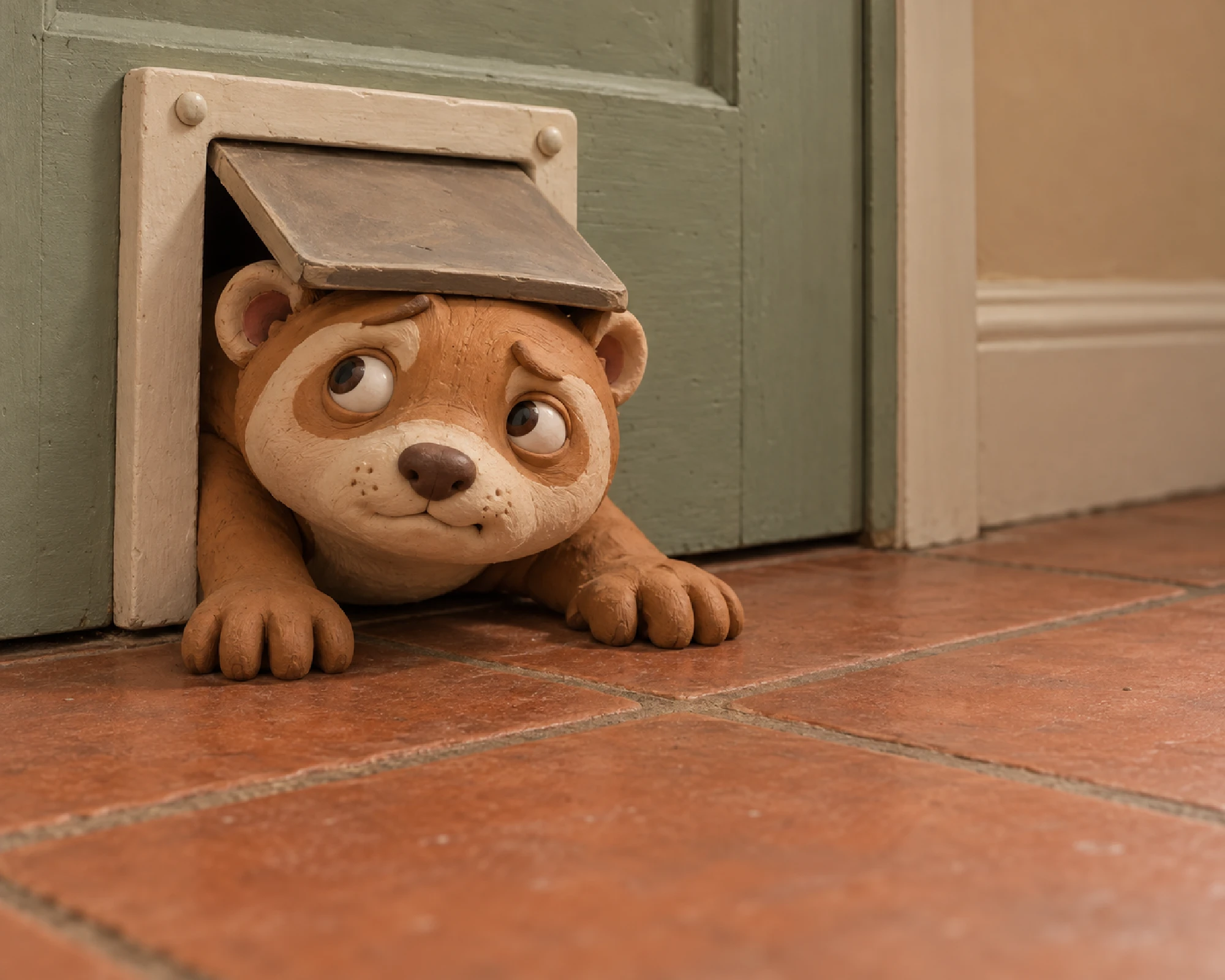
An oversized ferret pokes its face and forepaws through a kitchen cat flap, glancing up sheepishly. Handmade clay turns a familiar threshold into a gently comic mismatch of scale.
Remix this referenceFerret Stuck in the Cat Flap
- Form language
- Build forms from hand-shaped rounded masses, reducing small detail to shallow relief while preserving gently irregular volume.
- Contour
- Use physical silhouettes without ink outlines; softly pinched rims and uneven joins keep edges visibly handmade.
- Mark-making
- Let a few broad thumb sweeps and small tool presses follow the modeled forms, varying naturally rather than repeating a texture pattern.
- Surface rendering
- Render matte clay with soft continuous tonal turns, shallow dents and occasional compressed seams; retain tactile unevenness.
Priority
Make the sculptural clay miniature convincing through hand-shaped volume and tactile surface changes
What to avoid & what to check
Exact prompt for this example
MODULE OWNERSHIP
subject: Subject count, type, stable proportions and landmarks, resting face geometry, hair shape, physical materials, garment construction and permanent marks. No emotion, movement, color assignment or rendering recipe.
expression: Facial soft-tissue displacement and pupil direction, muscle coordination, regional intensity, asymmetry and onset/peak/release. No head/body pose, stable appearance, skin color or rendering.
gesture: Head/neck/body/limb orientation, joint movement, support, contact and pose-caused occlusion using existing anatomy. No eye/pupil movement, emotion, identity, props inventory or camera.
props: Prop count, type, construction, physical material and scale relative to the subject. Holding/contact belongs to gesture, position to composition, color to palette.
scene: Environment elements, terrain, backdrop/floor presence and structural detail. No canvas positions, camera, lighting, assigned colors or render texture.
camera: Projection, focal-length impression, camera elevation/yaw/roll, viewing distance and crop. No actor pose, world placement, lighting or canvas aspect ratio.
composition: Normalized 0-100% canvas positions, scale in frame, depth/overlap, focal hierarchy and margins. No joint pose, camera projection, rendering, subject/prop inventory or emotion.
palette: Color anchors, hue/saturation/value ranges, colors assigned to parts and approximate color coverage. No illumination direction, shading algorithm, physical material or layout.
lighting: Light-source direction/softness/intensity, ambient illumination, physical shadow direction/length and highlight position. Absence of directional illumination is allowed. No shading technique, palette or material changes.
style: Reusable form abstraction, contour weight/taper/edge quality, medium and mark scale/density/direction, surface rendering and tonal transition technique. No fixed subject proportions, anatomy, identity, expression, pose, palette, light-source direction, camera or layout.
output: Image count, aspect ratio, size, file/alpha requirements and global lettering/logo/watermark restrictions. No background scenery, crop, style, identity or pose.

SUBJECT
inventory: One original oversized ferret character made from modeling clay.
geometry: A broad wedge-shaped head, short rounded muzzle, small round ears, elongated body and substantial forepaws.
resting-face: Low brow ridges, oval eyes, rounded cheek pads, a blunt triangular nose and a short level mouth.
appearance: A bare clay body without garments or accessories; small whisker-root bumps distinguish the muzzle.

PRIORITY


AVOID


CHECK


EXPRESSION — ACTOR A
brows: Inner brow ridges rise slightly, with one higher than the other.
lids: Upper lids narrow gently while the lower lids remain relaxed.
cheeks: Cheek pads gather subtly beside the closed mouth.
nose: The nose stays unwrinkled, with relaxed nostrils.
mouth: The mouth closes into a small uneven line, one corner tucked inward.
jaw: The jaw stays gently closed without clenching.
gaze: Pupils glance upward and to the character's left.
coordination: Uneven brows and the tucked mouth corner share a restrained sheepish tension.
timing: Hold the peak of the sheepish reaction.

PRIORITY


AVOID


CHECK


GESTURE
head: A extends the head through the opening with the chin low and neck compressed.
torso: The visible shoulder bases bunch against the opening; the rest of the torso remains concealed.
limbs: Both forepaws emerge beneath the muzzle and spread outward, one slightly farther forward.
contact: Forepaws brace on the hallway floor while the flap rests against the crown, partly covering the ears.

PRIORITY


AVOID


CHECK


PROPS
inventory: No separate props.
construction: No prop construction applies.

PRIORITY


AVOID


CHECK


SCENE
inventory: A domestic hallway with a kitchen door, a small pet flap, skirting boards and a tiled floor.
structure: The paneled door contains a rigid pet-flap frame and hinged cover; the opening barely admits the ferret's head.

PRIORITY


AVOID


CHECK


CAMERA
projection: Photographic perspective with a moderate wide-lens impression suitable for a tabletop miniature.
viewpoint: View close to floor level from the hallway, slightly to one side of the door, without roll.
crop: Include the door's lower section and ample floor around the complete visible head and paws.

PRIORITY


AVOID


CHECK


COMPOSITION
placement: The face sits around 38% across and 60% down; floor space opens broadly toward the right.
depth: The face leads, paws form the next layer, and the overlapping flap and door establish the enclosing depth.
spacing: Give the face about a third of the frame width, retaining enough door and floor for the scale mismatch to read.

PRIORITY


AVOID


CHECK


PALETTE
colors: Caramel, oatmeal, sage green and muted terracotta create a warm, subdued palette.
assignment: Caramel covers the ferret, oatmeal its muzzle and flap frame, sage the door, and terracotta the floor.
balance: Sage and terracotta provide broad muted fields; lighter oatmeal separates facial details from caramel.

PRIORITY


AVOID


CHECK


LIGHTING
sources: A broad soft source from upper left illuminates the miniature with gentle ambient fill.
shadows: Short soft shadows extend rightward beneath the paws; the opening retains a deeper recessed shadow.
highlights: Wide subdued highlights sit on the crown, nose bridge and upper paw surfaces.

PRIORITY


AVOID


CHECK


STYLE GUIDE
form-language: Build forms from hand-shaped rounded masses, reducing small detail to shallow relief while preserving gently irregular volume.
contour: Use physical silhouettes without ink outlines; softly pinched rims and uneven joins keep edges visibly handmade.
mark-making: Let a few broad thumb sweeps and small tool presses follow the modeled forms, varying naturally rather than repeating a texture pattern.
surface-rendering: Render matte clay with soft continuous tonal turns, shallow dents and occasional compressed seams; retain tactile unevenness.

PRIORITY
Make the sculptural clay miniature convincing through hand-shaped volume and tactile surface changes

AVOID


CHECK


OUTPUT
format: One finished 5:4 image, 2000 × 1600 pixels, PNG with opaque alpha.
restrictions: No lettering, logos or watermarks.

PRIORITY


AVOID


CHECK


FINAL INTEGRATION
subject + scene + gesture: Make the difference in scale legible through the encounter between character and architecture.
expression + style + lighting: Preserve readable facial acting within the modeled surfaces; incidental handmade irregularities may vary coherently.
expression + gesture: The sheepish reaction peaks after the unsuccessful attempt to squeeze through the opening.
Model information comes from image provenance. The same prompt may produce a different result.