Text to imageArt stylesStyle guide
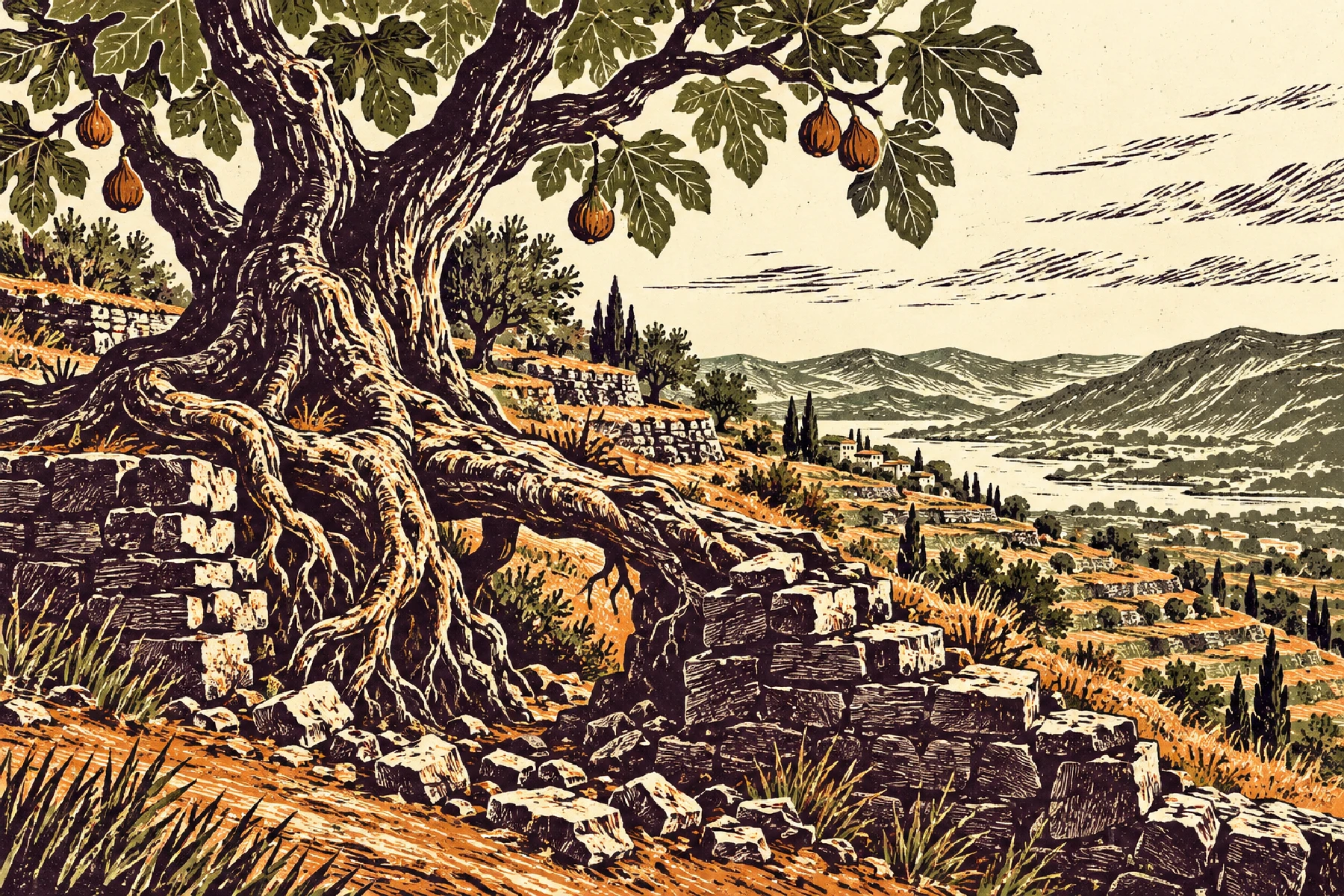
Fig Roots Across a Broken Terrace
Fig roots bridge a broken garden terrace. Bold carved rhythms and an open valley give this linocut scene the enduring presence of an old garden.
Remix this referenceFig Roots Across a Broken Terrace
- Form language
- Reduce complex forms into forceful interlocking masses and open cutouts; let small irregularities vary within a consistent graphic vocabulary.
- Contour
- Use stout, slightly nicked edges with occasional abrupt tapers; reserve thin contours for internal separations rather than outlining everything.
- Mark-making
- Carve rhythmic gouge strokes in bending runs, alternating broad scoops with short tapered cuts and allowing uneven handmade cadence.
- Surface rendering
- Build tones through printed solids interrupted by carved reserves; retain slight ink drag and uneven pressure, with transitions made by changing cut density.
Priority
The finished image must visibly read as bold linocut with carved rhythmic marks.
What to avoid & what to check
Exact prompt for this example
MODULE OWNERSHIP
subject: Subject count, type, stable proportions and landmarks, resting face geometry, hair shape, physical materials, garment construction and permanent marks. No emotion, movement, color assignment or rendering recipe.
expression: Facial soft-tissue displacement and pupil direction, muscle coordination, regional intensity, asymmetry and onset/peak/release. No head/body pose, stable appearance, skin color or rendering.
gesture: Head/neck/body/limb orientation, joint movement, support, contact and pose-caused occlusion using existing anatomy. No eye/pupil movement, emotion, identity, props inventory or camera.
props: Prop count, type, construction, physical material and scale relative to the subject. Holding/contact belongs to gesture, position to composition, color to palette.
scene: Environment elements, terrain, backdrop/floor presence and structural detail. No canvas positions, camera, lighting, assigned colors or render texture.
camera: Projection, focal-length impression, camera elevation/yaw/roll, viewing distance and crop. No actor pose, world placement, lighting or canvas aspect ratio.
composition: Normalized 0-100% canvas positions, scale in frame, depth/overlap, focal hierarchy and margins. No joint pose, camera projection, rendering, subject/prop inventory or emotion.
palette: Color anchors, hue/saturation/value ranges, colors assigned to parts and approximate color coverage. No illumination direction, shading algorithm, physical material or layout.
lighting: Light-source direction/softness/intensity, ambient illumination, physical shadow direction/length and highlight position. Absence of directional illumination is allowed. No shading technique, palette or material changes.
style: Reusable form abstraction, contour weight/taper/edge quality, medium and mark scale/density/direction, surface rendering and tonal transition technique. No fixed subject proportions, anatomy, identity, expression, pose, palette, light-source direction, camera or layout.
output: Image count, aspect ratio, size, file/alpha requirements and global lettering/logo/watermark restrictions. No background scenery, crop, style, identity or pose.

SUBJECT
inventory: One mature fig tree, with exposed roots, foliage and a few attached fruits; no human or animal subjects.
geometry: A forked trunk supports a spreading crown of lobed leaves; thick roots divide into smaller gripping branches.
resting-face: No face or facial landmarks apply.
appearance: Woody bark has shallow fissures; roots have rounded worn surfaces, leaves broad blades, and fruits soft pear-shaped bodies.

PRIORITY


AVOID


CHECK


PROPS
inventory: No separate props.
construction: No prop construction applies.

PRIORITY


AVOID


CHECK


SCENE
inventory: An abandoned hillside garden with a broken dry-stone retaining wall, loose stones and distant cultivated slopes.
structure: The wall retains an earthen terrace beside an irregular breach; successive field terraces descend into a broad valley.

PRIORITY


AVOID


CHECK


CAMERA
projection: Natural perspective with a moderately wide lens impression and restrained distance compression.
viewpoint: Look obliquely along the terrace from a slightly elevated position, with a gentle downward view and level roll.
crop: Use a landscape viewing distance; include the root bridge completely while allowing the outer crown to leave the frame.

PRIORITY


AVOID


CHECK


COMPOSITION
placement: Gather the tree and broken wall toward the left; make the exposed root bridge the focus and leave the right broadly open.
depth: Roots overlap the wall breach in the foreground; descending terraces recede behind them toward the distant valley.
spacing: Alternate compact tree-and-stone masses with generous open intervals; preserve a clear opening beneath the main root.

PRIORITY


AVOID


CHECK


PALETTE
colors: Use near-black aubergine, muted olive, burnt orange and warm ivory, with strong dark-to-light separation.
assignment: Assign aubergine to trunk and masonry, olive to foliage, orange to fruit and exposed earth, and ivory to open air.
balance: Ivory occupies the largest share; aubergine supplies the darkest values, olive supports it, and orange remains a sparse accent.

PRIORITY


AVOID


CHECK


LIGHTING
sources: Broad daylight arrives softly from the upper left, with enough ambient light to keep the wall breach visible.
shadows: Roots cast short shadows down and right across the stones; the recess beneath the terrace remains deepest.
highlights: Light catches the upper-left root ridges and exposed stone tops without sharp glints.

PRIORITY


AVOID


CHECK


STYLE GUIDE
form-language: Reduce complex forms into forceful interlocking masses and open cutouts; let small irregularities vary within a consistent graphic vocabulary.
contour: Use stout, slightly nicked edges with occasional abrupt tapers; reserve thin contours for internal separations rather than outlining everything.
mark-making: Carve rhythmic gouge strokes in bending runs, alternating broad scoops with short tapered cuts and allowing uneven handmade cadence.
surface-rendering: Build tones through printed solids interrupted by carved reserves; retain slight ink drag and uneven pressure, with transitions made by changing cut density.

PRIORITY
The finished image must visibly read as bold linocut with carved rhythmic marks.

AVOID


CHECK


OUTPUT
format: Deliver one landscape image at 3:2, 1800 × 1200 pixels, as an opaque PNG.
restrictions: No lettering, logos, signatures or watermarks.

PRIORITY


AVOID


CHECK


FINAL INTEGRATION
subject + scene + style: Use one shared print vocabulary while keeping the tree and terrace structurally distinguishable.
Model information comes from image provenance. The same prompt may produce a different result.