Text to imagePortraitStyle guide
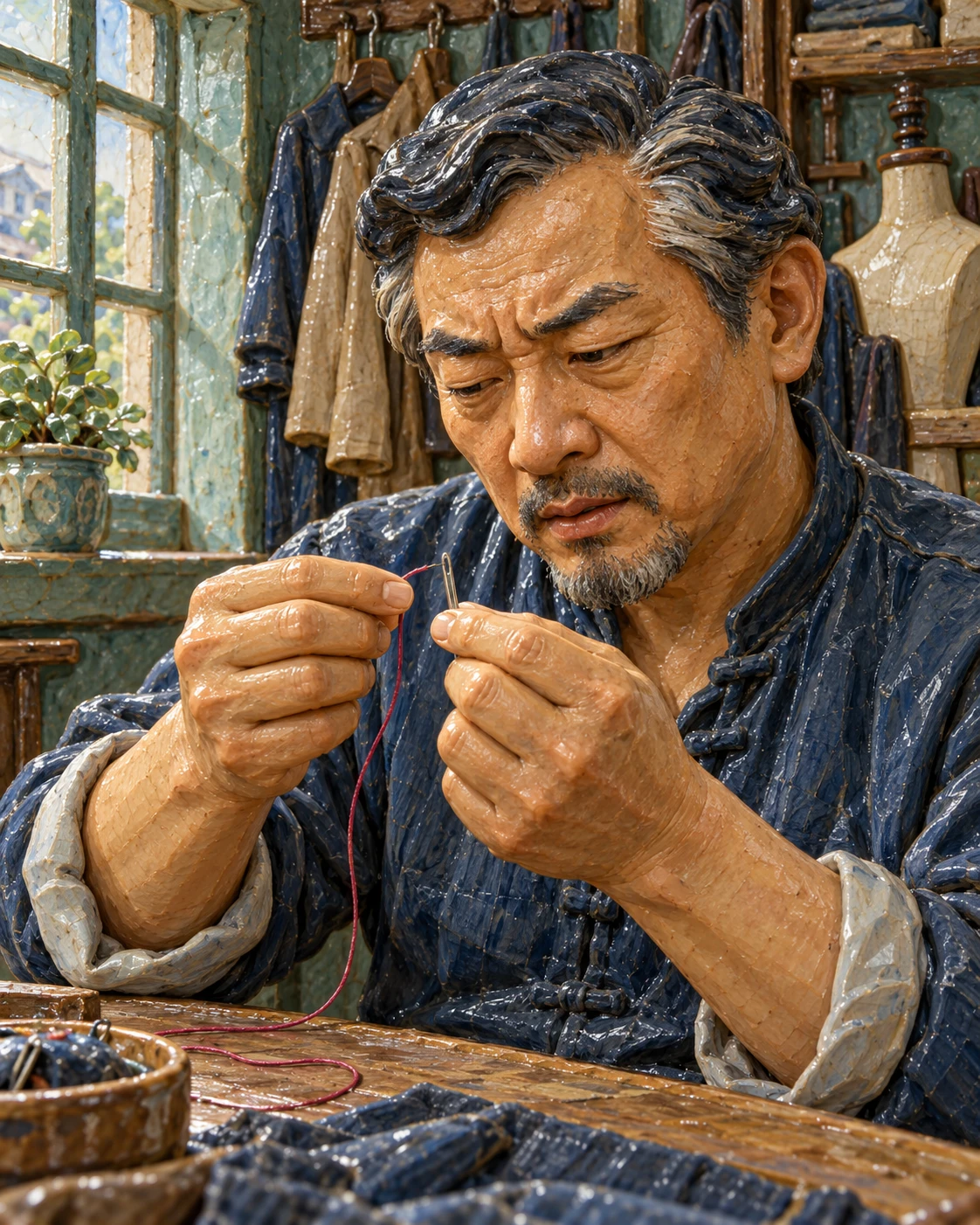
A Man Threading a Needle
In a clothing repair shop, an older man narrows one eye while threading a needle. Modeled hands and face rise from a ceramic relief whose glaze gathers in the recesses.
Remix this referenceA Man Threading a Needle
- Form language
- Build a ceramic relief illustration from softly joined raised masses over nested shallow planes; compress depth while preserving clear volume.
- Contour
- Use rounded beveled edges with occasional hand-cut scallops; let incised grooves separate adjoining forms instead of drawn outlines.
- Mark-making
- Leave broad spatula sweeps on raised areas and sparse incised arcs in recesses; allow their spacing and pressure to vary naturally.
- Surface rendering
- Model thick glossy glaze pooling in grooves and thinning over ridges; use softly blended tonal turns interrupted by irregular glaze edges.
Priority
Make modeled relief depth and uneven glaze accumulation visibly define the medium.
What to avoid & what to check
Exact prompt for this example
MODULE OWNERSHIP
subject: Subject count, type, stable proportions and landmarks, resting face geometry, hair shape, physical materials, garment construction and permanent marks. No emotion, movement, color assignment or rendering recipe.
expression: Facial soft-tissue displacement and pupil direction, muscle coordination, regional intensity, asymmetry and onset/peak/release. No head/body pose, stable appearance, skin color or rendering.
gesture: Head/neck/body/limb orientation, joint movement, support, contact and pose-caused occlusion using existing anatomy. No eye/pupil movement, emotion, identity, props inventory or camera.
props: Prop count, type, construction, physical material and scale relative to the subject. Holding/contact belongs to gesture, position to composition, color to palette.
scene: Environment elements, terrain, backdrop/floor presence and structural detail. No canvas positions, camera, lighting, assigned colors or render texture.
camera: Projection, focal-length impression, camera elevation/yaw/roll, viewing distance and crop. No actor pose, world placement, lighting or canvas aspect ratio.
composition: Normalized 0-100% canvas positions, scale in frame, depth/overlap, focal hierarchy and margins. No joint pose, camera projection, rendering, subject/prop inventory or emotion.
palette: Color anchors, hue/saturation/value ranges, colors assigned to parts and approximate color coverage. No illumination direction, shading algorithm, physical material or layout.
lighting: Light-source direction/softness/intensity, ambient illumination, physical shadow direction/length and highlight position. Absence of directional illumination is allowed. No shading technique, palette or material changes.
style: Reusable form abstraction, contour weight/taper/edge quality, medium and mark scale/density/direction, surface rendering and tonal transition technique. No fixed subject proportions, anatomy, identity, expression, pose, palette, light-source direction, camera or layout.
output: Image count, aspect ratio, size, file/alpha requirements and global lettering/logo/watermark restrictions. No background scenery, crop, style, identity or pose.

SUBJECT
inventory: One older adult man, actor A.
geometry: A compact oval face, prominent nose bridge, broad hands and an ordinary adult build establish his recognizable construction.
resting-face: Naturally narrow eye openings, a thin upper lip, fuller lower lip and softly folded cheek contours.
appearance: Short hair sweeps into one broad wave; a cropped goatee and a collarless cotton shirt with cloth buttons and rolled cuffs complete his appearance.

PRIORITY


AVOID


CHECK


EXPRESSION — ACTOR A
brows: Draw the brows slightly inward, with a stronger contraction on his right.
lids: Narrow the right eye more than the left while keeping both slightly open.
cheeks: Gather slight tension beside the upper lip without lifting the cheeks into a smile.
nose: Keep the nostrils relaxed and the bridge unwrinkled.
mouth: Part the lips narrowly with a small uneven pinch at one corner.
jaw: Release the jaw just enough for the narrow lip opening.
gaze: Direct both pupils downward toward the thread end.
coordination: Let the unequal squint carry the effort while the lower face stays comparatively loose.
timing: Hold the facial tension at the apex of concentration.

PRIORITY


AVOID


CHECK


GESTURE
head: Dip the chin toward the work and incline the neck slightly forward.
torso: Lean forward from a seated position, keeping the shoulders low and slightly uneven.
limbs: Raise both bent arms below the face; bring the fingertips together while the elbows remain comfortably apart.
contact: The left thumb and forefinger steady the needle; the right fingertips guide the thread end toward its eye, pausing just before entry.

PRIORITY


AVOID


CHECK


PROPS
inventory: One sewing needle and one loose length of thread, both at ordinary hand-sewing scale.
construction: A slender steel needle has an elongated eye; the cotton thread forms a soft continuous strand.

PRIORITY


AVOID


CHECK


SCENE
inventory: A compact clothing repair shop with hanging coats, a deep window recess and a workbench.
structure: A thick masonry window reveal and hanging garment forms enclose the room; the workbench has a worn solid top.

PRIORITY


AVOID


CHECK


CAMERA
projection: Use a gentle portrait-lens perspective with little near-to-far exaggeration.
viewpoint: Observe from face height at a shallow three-quarter angle, without camera roll.
crop: Frame from above the hair to the lower chest, including both hands and a small amount of the workbench; crop peripheral coats freely.

PRIORITY


AVOID


CHECK


COMPOSITION
placement: Set the face right of center and the hand group below-left; arrange the thread in a small connecting curve, its end beside the needle eye.
depth: Hands overlap the shirt, while the face stands clear of layered coats and the deeper window recess.
spacing: Make the face primary and the fingertip gap secondary; leave breathing room around the hands.

PRIORITY


AVOID


CHECK


PALETTE
colors: Use honey amber, muted celadon, deep ink blue, warm ivory and a small raspberry accent.
assignment: Assign amber to skin, ivory and ink blue to hair, ink blue to the shirt, celadon to the room and raspberry to the thread.
balance: Keep the cool room and shirt dominant, with concentrated warm skin and a very small saturated thread accent.

PRIORITY


AVOID


CHECK


LIGHTING
sources: A broad window source from the upper left provides soft directional light with gentle ambient fill.
shadows: Raised forms cast short soft shadows toward the lower right; deeper recesses retain stronger shadow.
highlights: Broken highlights catch upper-left ridges, with small bright accents on the knuckles and nose.

PRIORITY


AVOID


CHECK


STYLE GUIDE
form-language: Build a ceramic relief illustration from softly joined raised masses over nested shallow planes; compress depth while preserving clear volume.
contour: Use rounded beveled edges with occasional hand-cut scallops; let incised grooves separate adjoining forms instead of drawn outlines.
mark-making: Leave broad spatula sweeps on raised areas and sparse incised arcs in recesses; allow their spacing and pressure to vary naturally.
surface-rendering: Model thick glossy glaze pooling in grooves and thinning over ridges; use softly blended tonal turns interrupted by irregular glaze edges.

PRIORITY
Make modeled relief depth and uneven glaze accumulation visibly define the medium.

AVOID


CHECK


OUTPUT
format: Deliver one finished image.
restrictions: One image, 4:5, 1600 × 2000 pixels, opaque PNG; no lettering, logos or watermarks.

PRIORITY


AVOID


CHECK


FINAL INTEGRATION
expression + gesture: Synchronize the facial apex with the threading stage defined in gesture.
Model information comes from image provenance. The same prompt may produce a different result.