Text to imageIllustrationStyle guide
Giant Nasturtium in a Laundromat
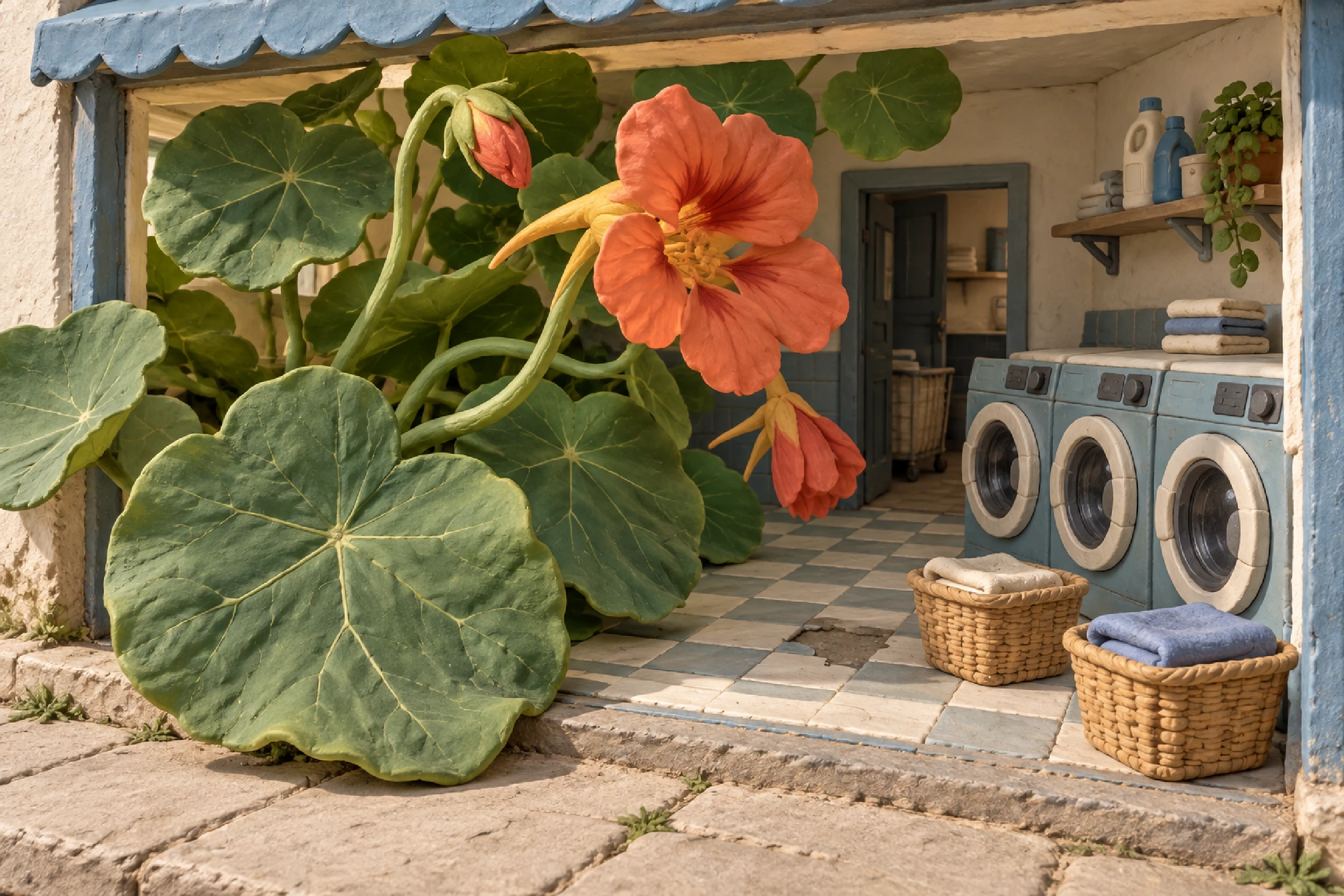
A sculptural clay miniature shows a giant nasturtium filling a neighborhood laundromat. Small washers and baskets beneath its leaves reveal the scale surprise, while hand-shaped edges and compressed marks make the impossible space inviting.
Remix this referenceGiant Nasturtium in a Laundromat
- Form language
- Translate forms into hand-built sculptural masses with gently swollen planes and compressed minor details; preserve structural distinctions while allowing coherent irregularity rather than mechanically repeated shape templates.
- Contour
- Use uninked relief edges with rounded transitions, occasional pinched corners, and slight handmade waviness; vary edge thickness naturally while keeping the contours substantial and deliberately shaped.
- Mark-making
- Reveal the clay-miniature medium through shallow thumb compressions, broad smoothing passes, and occasional tool indentations; let their visibility vary naturally instead of applying a repeated texture stamp.
- Surface rendering
- Render matte tactile surfaces with slow tonal turns over rounded relief and small interruptions at compressed marks. Retain uneven hand finishing, allowing quieter passages beside more visibly worked areas.
Priority
Make hand-shaped relief visibly distinct.
What to avoid & what to check
Avoid identical texture noise on every surface.
Edges and compressed marks suggest individual making.
Exact prompt for this example
MODULE OWNERSHIP
subject: Subject count, type, stable proportions and landmarks, resting face geometry, hair shape, physical materials, garment construction and permanent marks. No emotion, movement, color assignment or rendering recipe.
expression: Facial soft-tissue displacement and pupil direction, muscle coordination, regional intensity, asymmetry and onset/peak/release. No head/body pose, stable appearance, skin color or rendering.
gesture: Head/neck/body/limb orientation, joint movement, support, contact and pose-caused occlusion using existing anatomy. No eye/pupil movement, emotion, identity, props inventory or camera.
props: Prop count, type, construction, physical material and scale relative to the subject. Holding/contact belongs to gesture, position to composition, color to palette.
scene: Environment elements, terrain, backdrop/floor presence and structural detail. No canvas positions, camera, lighting, assigned colors or render texture.
camera: Projection, focal-length impression, camera elevation/yaw/roll, viewing distance and crop. No actor pose, world placement, lighting or canvas aspect ratio.
composition: Normalized 0-100% canvas positions, scale in frame, depth/overlap, focal hierarchy and margins. No joint pose, camera projection, rendering, subject/prop inventory or emotion.
palette: Color anchors, hue/saturation/value ranges, colors assigned to parts and approximate color coverage. No illumination direction, shading algorithm, physical material or layout.
lighting: Light-source direction/softness/intensity, ambient illumination, physical shadow direction/length and highlight position. Absence of directional illumination is allowed. No shading technique, palette or material changes.
style: Reusable form abstraction, contour weight/taper/edge quality, medium and mark scale/density/direction, surface rendering and tonal transition technique. No fixed subject proportions, anatomy, identity, expression, pose, palette, light-source direction, camera or layout.
output: Image count, aspect ratio, size, file/alpha requirements and global lettering/logo/watermark restrictions. No background scenery, crop, style, identity or pose.

SUBJECT
inventory: One oversized nasturtium plant is the main subject, with branching stems, several leaves, and a small flower cluster. No people or animals appear.
geometry: Keep rounded shield-like leaves with slightly off-center stem attachments, fleshy curved stems, and open flowers with distinct rear spurs.
appearance: Construct the plant from modeled clay: substantial leaf discs, rounded stem sections, and separately formed petals joined into complete blooms.

PRIORITY
Keep the enlarged plant unmistakably a nasturtium.

AVOID
Avoid generic fantasy foliage.

CHECK
Shield leaves and spurred flowers establish identity.

PROPS
inventory: Include three front-loading washers, two laundry baskets, and two folded cloths. A washer front is about half a main leaf's width.
construction: Washers have clay box housings, thick circular door rims, inset glass discs, and plain controls; baskets use woven fiber and cloths use soft fabric.

PRIORITY
Use familiar equipment to explain the scale reversal.

AVOID
Avoid ornamental doll-furniture construction.

CHECK
The small equipment remains readily recognizable.

SCENE
inventory: Build a neighborhood laundromat with an open shopfront, tiled floor, plaster side walls, rear service doorway, shallow awning, and pavement apron.
structure: The shop is a simple rectangular room. A broken patch interrupts the floor tiles, and the broad front opening joins the interior to the pavement.

PRIORITY
Make the everyday shop immediately recognizable.

AVOID
Avoid elaborate fantasy architecture.

CHECK
The room supports a familiar laundromat setting.

CAMERA
projection: Use gently compressed photographic perspective with a close miniature-viewing impression, preserving separation between interior and pavement.
viewpoint: Look through the open front from a slightly elevated three-quarter viewpoint, revealing one side wall more fully, with neutral roll.
crop: Frame the shop opening, the complete principal bloom, and a short pavement apron; retain the entire nearest basket.

PRIORITY
Offer an inviting view into the miniature room.

AVOID
Avoid a flat elevation that erases depth.

CHECK
Interior depth reads without extreme perspective.

COMPOSITION
placement: The plant fills the left-center and much of the frame height. Group washers on the right and stagger baskets near the opening. Place one folded cloth inside each basket.
depth: Make the principal bloom the first focus, washer doors second, and rear doorway last. Leaves overlap equipment without concealing its defining forms.
spacing: Arrange one broad leaf across the shop opening and over the pavement. Leave a breathing gap beside the bloom and asymmetric outer margins.

PRIORITY
Make the plant's spill into ordinary space the discovery.

AVOID
Avoid a centered plant with evenly spaced accessories.

CHECK
Overlaps reveal both the shop and the scale surprise.

PALETTE
colors: Use muted jade, persimmon coral, butter cream, and dusty blue, supported by quiet charcoal accents and mostly middle-to-light values.
assignment: Assign jade to foliage, coral to flowers, cream to walls and pavement, dusty blue to washers and selected tiles, and charcoal to door interiors.
balance: Jade and cream carry the broad color fields; coral supplies a compact vivid accent. Allow gentle hue variation within this small family.

PRIORITY
Let coral flowers enliven the restrained palette.

AVOID
Avoid unrelated rainbow-colored accessories.

CHECK
Flowers remain the clearest chromatic accent.

LIGHTING
sources: A broad soft source enters from the upper front-left, with gentle ambient fill reaching the back of the room.
shadows: Leaves cast broad soft shadows toward the rear-right across equipment and floor; short contact shadows ground the baskets and shop.
highlights: Keep highlights broad on upper leaf and petal surfaces, with smaller subdued glints on the washer door discs.

PRIORITY
Reveal the model's relief through soft illumination.

AVOID
Avoid theatrical spotlights and hard shadows.

CHECK
Relief remains legible within the leaf shadows.

STYLE GUIDE
form-language: Translate forms into hand-built sculptural masses with gently swollen planes and compressed minor details; preserve structural distinctions while allowing coherent irregularity rather than mechanically repeated shape templates.
contour: Use uninked relief edges with rounded transitions, occasional pinched corners, and slight handmade waviness; vary edge thickness naturally while keeping the contours substantial and deliberately shaped.
mark-making: Reveal the clay-miniature medium through shallow thumb compressions, broad smoothing passes, and occasional tool indentations; let their visibility vary naturally instead of applying a repeated texture stamp.
surface-rendering: Render matte tactile surfaces with slow tonal turns over rounded relief and small interruptions at compressed marks. Retain uneven hand finishing, allowing quieter passages beside more visibly worked areas.

PRIORITY
Make hand-shaped relief visibly distinct.

AVOID
Avoid identical texture noise on every surface.

CHECK
Edges and compressed marks suggest individual making.

OUTPUT
format: Deliver one finished image as an opaque PNG, 3:2 landscape aspect ratio, at 2400 × 1600 pixels.
restrictions: Include no lettering, logos, watermarks, borders, or assembly instructions anywhere in the image.

PRIORITY
Present one complete finished image.

AVOID
Avoid model-kit or process-sheet presentation.

CHECK
The finished file contains one uninterrupted image.

FINAL INTEGRATION
subject + props + scene + composition: Botanical recognition, familiar equipment, and selective overlap cooperate to make the scale surprise understandable at a glance.
camera + lighting + style: Viewing distance, illumination, and surface treatment cooperate to make handmade relief readable while sustaining inviting depth.
Model information comes from image provenance. The same prompt may produce a different result.