Text to imageArt stylesStyle guide
Exposed Roots in the Glasshouse
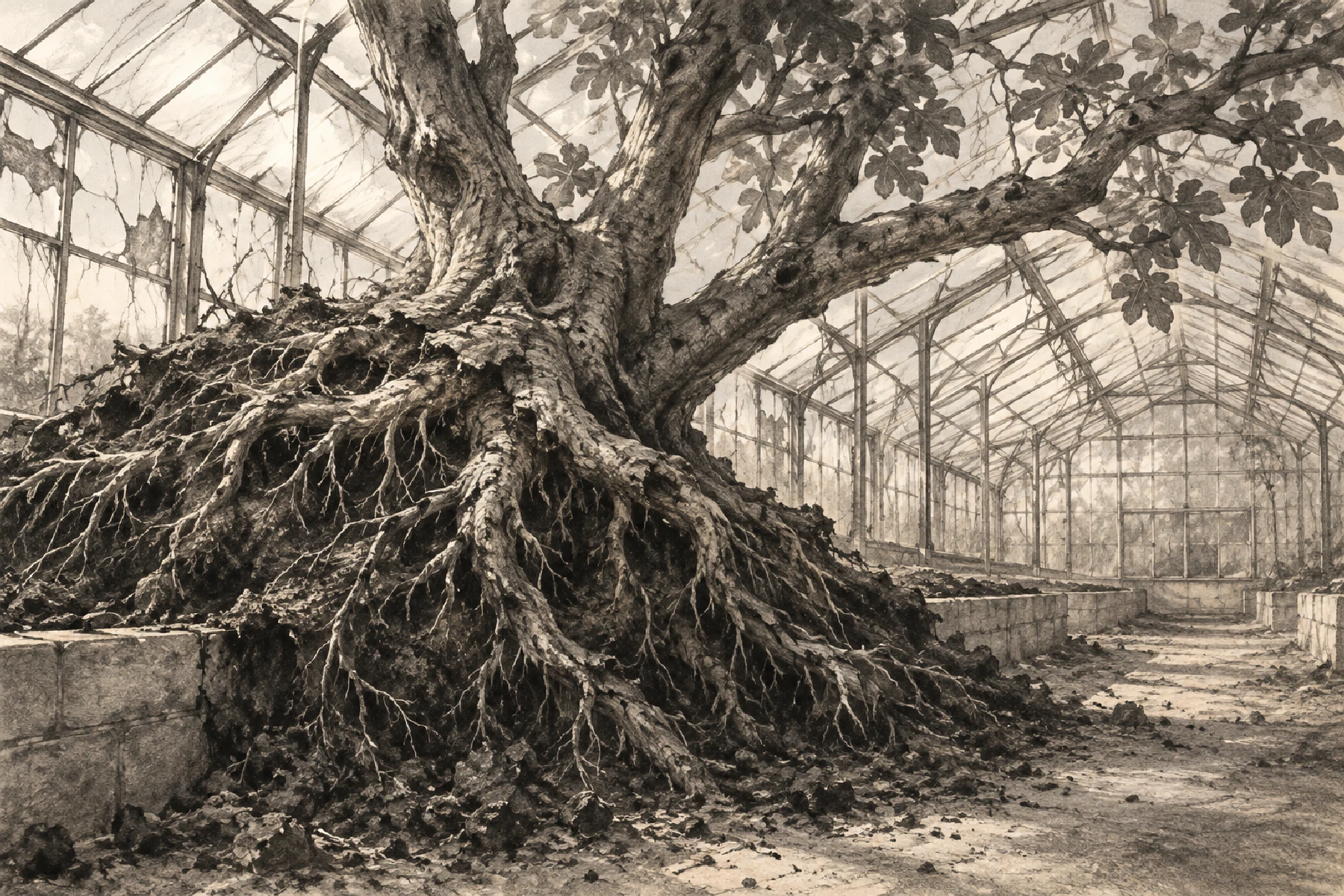
The exposed roots of a fallen fig tree fan through an empty glasshouse. Smudged charcoal and erased light give weight to the roots while preserving the spacious hush around them.
Remix this referenceExposed Roots in the Glasshouse
- Form language
- Build observed forms from broad interlocking masses, then select a few structural interruptions; incidental detail may vary naturally.
- Contour
- Let compressed-charcoal edges thicken, fracture, and disappear into adjacent tones; reserve sharp accents for structural turns.
- Mark-making
- Combine broad side strokes and hand-rubbed smudges with sparse directional scratches; keep pressure and spacing visibly irregular.
- Surface rendering
- Accumulate smoky charcoal veils, then lift passages with a kneaded eraser; retain paper tooth and imperfect erased transitions.
Priority
The finished image must visibly depend on rubbed charcoal and erased light.
What to avoid & what to check
Exact prompt for this example
MODULE OWNERSHIP
subject: Subject count, type, stable proportions and landmarks, resting face geometry, hair shape, physical materials, garment construction and permanent marks. No emotion, movement, color assignment or rendering recipe.
expression: Facial soft-tissue displacement and pupil direction, muscle coordination, regional intensity, asymmetry and onset/peak/release. No head/body pose, stable appearance, skin color or rendering.
gesture: Head/neck/body/limb orientation, joint movement, support, contact and pose-caused occlusion using existing anatomy. No eye/pupil movement, emotion, identity, props inventory or camera.
props: Prop count, type, construction, physical material and scale relative to the subject. Holding/contact belongs to gesture, position to composition, color to palette.
scene: Environment elements, terrain, backdrop/floor presence and structural detail. No canvas positions, camera, lighting, assigned colors or render texture.
camera: Projection, focal-length impression, camera elevation/yaw/roll, viewing distance and crop. No actor pose, world placement, lighting or canvas aspect ratio.
composition: Normalized 0-100% canvas positions, scale in frame, depth/overlap, focal hierarchy and margins. No joint pose, camera projection, rendering, subject/prop inventory or emotion.
palette: Color anchors, hue/saturation/value ranges, colors assigned to parts and approximate color coverage. No illumination direction, shading algorithm, physical material or layout.
lighting: Light-source direction/softness/intensity, ambient illumination, physical shadow direction/length and highlight position. Absence of directional illumination is allowed. No shading technique, palette or material changes.
style: Reusable form abstraction, contour weight/taper/edge quality, medium and mark scale/density/direction, surface rendering and tonal transition technique. No fixed subject proportions, anatomy, identity, expression, pose, palette, light-source direction, camera or layout.
output: Image count, aspect ratio, size, file/alpha requirements and global lettering/logo/watermark restrictions. No background scenery, crop, style, identity or pose.

SUBJECT
inventory: One mature fig tree with an exposed root mass; no people or animals.
geometry: A knotted root crown opens into a broad root fan; a substantial trunk divides into irregular forks.
resting-face: No face or facial landmarks apply.
appearance: Ridged bark, fibrous broken roots, clinging earth, and a few broad lobed leaves establish its physical character.

PRIORITY


AVOID


CHECK


PROPS
inventory: No separate props.
construction: No prop construction applies.

PRIORITY


AVOID


CHECK


SCENE
inventory: An empty glasshouse contains masonry planting beds, a soil aisle, metal ribs, and partly broken glazing.
structure: Repeated roof bays span the enclosure; disturbed soil breaks the aisle beside an opened planting bed.

PRIORITY


AVOID


CHECK


CAMERA
projection: Use natural perspective with a moderate wide-lens impression and restrained convergence.
viewpoint: Look obliquely along the aisle from a low standing viewpoint, with a level horizon.
crop: Include the complete root fan and ample roof space; let the outermost branch tips leave the right edge.

PRIORITY


AVOID


CHECK


COMPOSITION
placement: The root fan dominates the left third; the trunk runs low toward the right beneath a broad open upper field.
depth: Roots overlap the nearest bed; successive roof bays recede behind them as quieter secondary structure.
spacing: Make the root crown the focal knot; leave generous intervals between it, the distant ribs, and the frame.

PRIORITY


AVOID


CHECK


PALETTE
colors: Use warm ivory, silvery gray, and deep charcoal black in an almost monochrome range.
assignment: Ivory belongs to the paper and pale glazing; roots carry the deepest blacks, with gray across earth and ribs.
balance: Let pale and middle values dominate, with concentrated dark accents around the root crown.

PRIORITY


AVOID


CHECK


LIGHTING
sources: Broad daylight enters from the upper left through the roof, supported by soft ambient fill.
shadows: Soft shadows extend rightward across the soil; recesses beneath the roots remain substantially darker.
highlights: Catch light on upper-left root edges and occasional glazing edges without making them sparkle.

PRIORITY


AVOID


CHECK


STYLE GUIDE
form-language: Build observed forms from broad interlocking masses, then select a few structural interruptions; incidental detail may vary naturally.
contour: Let compressed-charcoal edges thicken, fracture, and disappear into adjacent tones; reserve sharp accents for structural turns.
mark-making: Combine broad side strokes and hand-rubbed smudges with sparse directional scratches; keep pressure and spacing visibly irregular.
surface-rendering: Accumulate smoky charcoal veils, then lift passages with a kneaded eraser; retain paper tooth and imperfect erased transitions.

PRIORITY
The finished image must visibly depend on rubbed charcoal and erased light.

AVOID


CHECK


OUTPUT
format: Deliver one finished image, landscape 3:2, 1800 × 1200 pixels, opaque PNG.
restrictions: No lettering, logos, signatures, or watermarks.

PRIORITY


AVOID


CHECK


FINAL INTEGRATION
subject + composition + style: Selective observation gives the focal structure specificity while allowing surrounding passages to remain open.
lighting + style: Erasure interprets the established illumination rather than adding independent luminous effects.
Model information comes from image provenance. The same prompt may produce a different result.