Text to imageArt stylesStyle guide
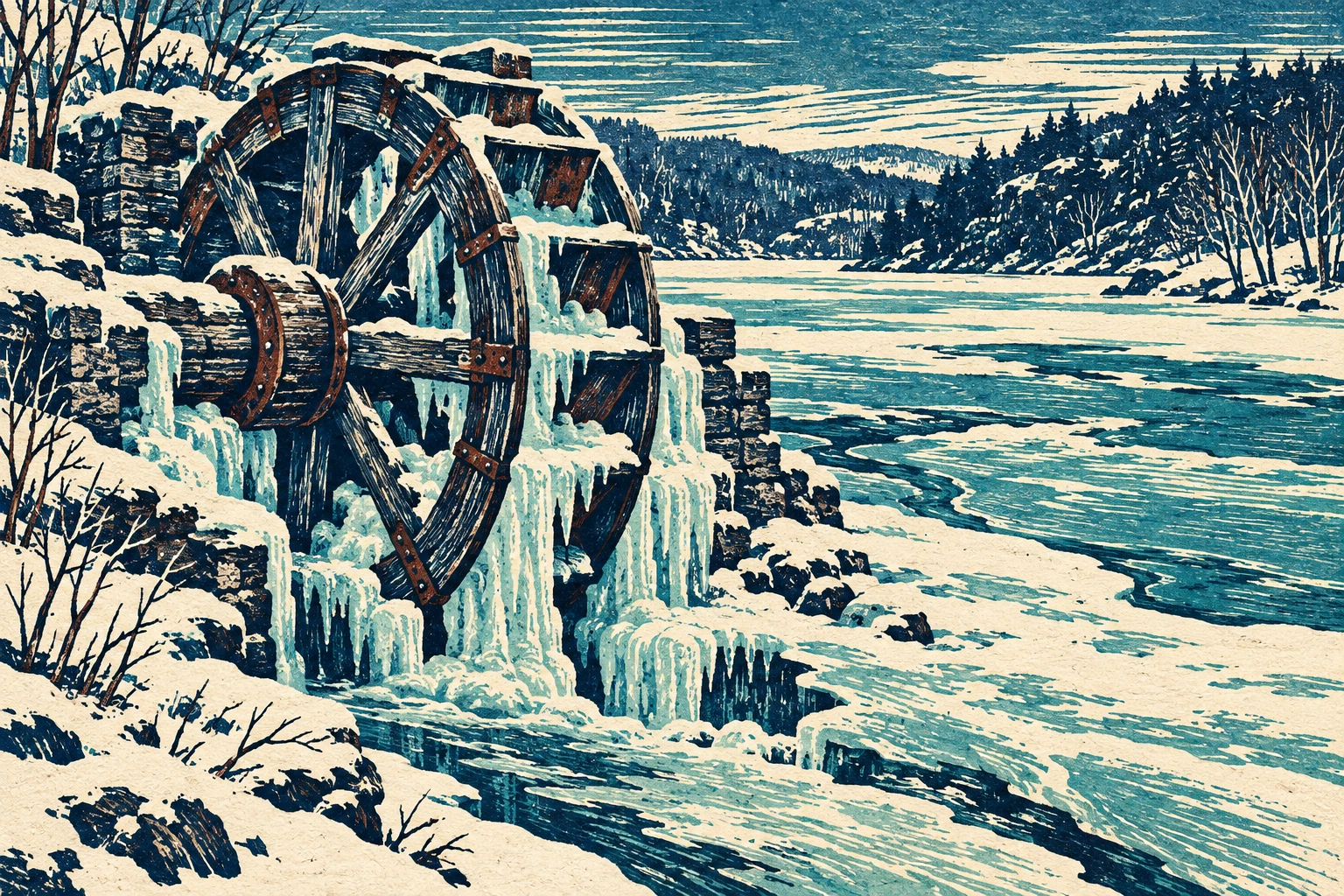
Ice in the Waterwheel
Ice grows between the paddles of an abandoned waterwheel beside an open winter river. A bold linocut illustration contrasts heavy ink masses with rhythmic carved lines.
Remix this referenceIce in the Waterwheel
- Form language
- Reduce forms to interlocking wedges, arcs and open cuts; simplify small detail while preserving distinct structural silhouettes.
- Contour
- Use bold relief-print edges with blunt breaks and occasional tapered gouges; let boundaries alternate between solid and interrupted.
- Mark-making
- Carve unequal sweeping channels and short hooked cuts in rhythmic groups; vary their width and spacing with a visible hand-cut cadence.
- Surface rendering
- Build tone through retained ink masses and widening cut intervals, with slight ink skips and imperfect overprints on fibrous paper.
Priority
Make the bold linocut treatment visibly depend on carved rhythmic marks.
What to avoid & what to check
Exact prompt for this example
MODULE OWNERSHIP
subject: Subject count, type, stable proportions and landmarks, resting face geometry, hair shape, physical materials, garment construction and permanent marks. No emotion, movement, color assignment or rendering recipe.
expression: Facial soft-tissue displacement and pupil direction, muscle coordination, regional intensity, asymmetry and onset/peak/release. No head/body pose, stable appearance, skin color or rendering.
gesture: Head/neck/body/limb orientation, joint movement, support, contact and pose-caused occlusion using existing anatomy. No eye/pupil movement, emotion, identity, props inventory or camera.
props: Prop count, type, construction, physical material and scale relative to the subject. Holding/contact belongs to gesture, position to composition, color to palette.
scene: Environment elements, terrain, backdrop/floor presence and structural detail. No canvas positions, camera, lighting, assigned colors or render texture.
camera: Projection, focal-length impression, camera elevation/yaw/roll, viewing distance and crop. No actor pose, world placement, lighting or canvas aspect ratio.
composition: Normalized 0-100% canvas positions, scale in frame, depth/overlap, focal hierarchy and margins. No joint pose, camera projection, rendering, subject/prop inventory or emotion.
palette: Color anchors, hue/saturation/value ranges, colors assigned to parts and approximate color coverage. No illumination direction, shading algorithm, physical material or layout.
lighting: Light-source direction/softness/intensity, ambient illumination, physical shadow direction/length and highlight position. Absence of directional illumination is allowed. No shading technique, palette or material changes.
style: Reusable form abstraction, contour weight/taper/edge quality, medium and mark scale/density/direction, surface rendering and tonal transition technique. No fixed subject proportions, anatomy, identity, expression, pose, palette, light-source direction, camera or layout.
output: Image count, aspect ratio, size, file/alpha requirements and global lettering/logo/watermark restrictions. No background scenery, crop, style, identity or pose.

SUBJECT
inventory: One abandoned timber mill waterwheel; no people or animals.
geometry: An open wheel with a heavy hub, broad radial spokes and blunt paddle boxes around its thick rim.
resting-face: No face or facial landmarks apply.
appearance: Weathered timber with split ends and worn iron straps; minor wear patterns may vary naturally.

PRIORITY


AVOID


CHECK


PROPS
inventory: No separate props.
construction: No prop construction applies.

PRIORITY


AVOID


CHECK


SCENE
inventory: An abandoned millrace beside a frozen river, with a broken stone abutment, snow shelves and sparse bare alders.
structure: The wheel remains mounted over the narrow channel; ice curtains bridge its paddle gaps and join the frozen spill below.

PRIORITY


AVOID


CHECK


CAMERA
projection: Natural perspective with a moderately wide lens impression and restrained depth convergence.
viewpoint: View from the opposite bank, slightly above the wheel hub and oblique enough to reveal the paddle depth.
crop: A broad environmental view includes the complete wheel and a generous reach of river.

PRIORITY


AVOID


CHECK


COMPOSITION
placement: The wheel dominates the left third; the river opens across the right half, with a small alder cluster near the far edge.
depth: The wheel overlaps the abutment; the channel leads behind it into the open river and distant bank.
spacing: Make the ice-filled wheel the focal knot, balanced by spacious river intervals and generous room above the rim.

PRIORITY


AVOID


CHECK


PALETTE
colors: Midnight blue, subdued turquoise, iron-rust red and warm ivory form a limited, expressive palette.
assignment: Use blue for the wheel and banks, turquoise for ice and river, rust for a few exposed paddle faces, and ivory for snow.
balance: Ivory and blue carry most of the image; turquoise connects them, while rust remains a restrained accent.

PRIORITY


AVOID


CHECK


LIGHTING
sources: Soft winter daylight enters from the upper right, with broad ambient fill from the open sky.
shadows: Broad, soft shadows fall toward the lower left; paddle recesses retain deeper shade.
highlights: Light catches the upper-right ice edges and the exposed tops of the rim and snow shelves.

PRIORITY


AVOID


CHECK


STYLE GUIDE
form-language: Reduce forms to interlocking wedges, arcs and open cuts; simplify small detail while preserving distinct structural silhouettes.
contour: Use bold relief-print edges with blunt breaks and occasional tapered gouges; let boundaries alternate between solid and interrupted.
mark-making: Carve unequal sweeping channels and short hooked cuts in rhythmic groups; vary their width and spacing with a visible hand-cut cadence.
surface-rendering: Build tone through retained ink masses and widening cut intervals, with slight ink skips and imperfect overprints on fibrous paper.

PRIORITY
Make the bold linocut treatment visibly depend on carved rhythmic marks.

AVOID


CHECK


OUTPUT
format: One finished illustration.
restrictions: One landscape image, 3:2 aspect ratio, 1800 × 1200 pixels, opaque PNG; no lettering, logos or watermarks.

PRIORITY


AVOID


CHECK


FINAL INTEGRATION
composition + style: Preserve the composition's spacious intervals as the carved mark density changes across the image.
Model information comes from image provenance. The same prompt may produce a different result.