Text to imageIllustrationStyle guide
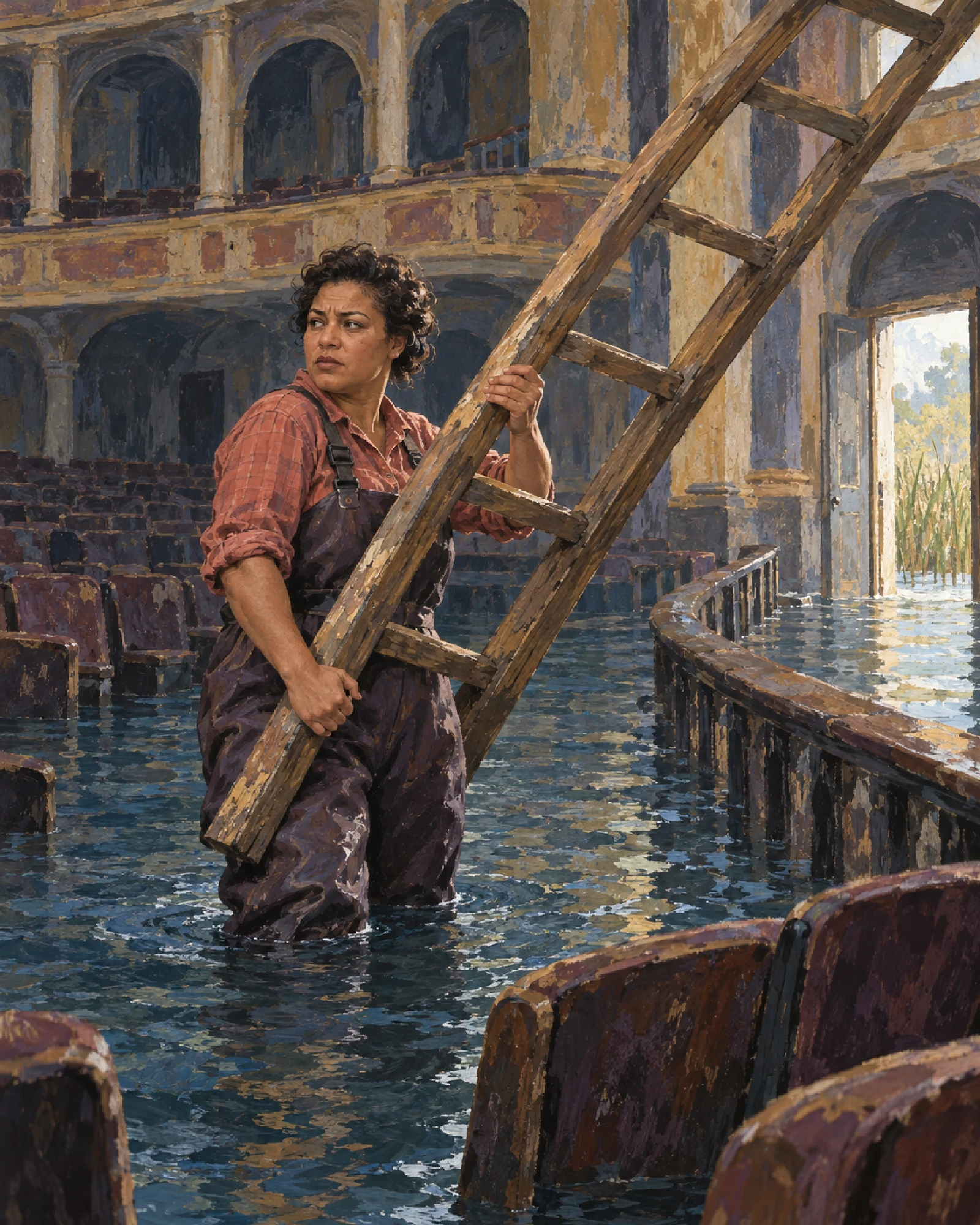
Ladder in the Flooded Theater
A woman lifts and turns a wooden ladder past a curved railing in a flooded theater. Layered seating, balconies and rippling water surround the gesture, brought together by loose, visibly opaque gouache brushwork.
Remix this referenceLadder in the Flooded Theater
- Form language
- Simplify forms into broad interlocking masses, allowing irregular silhouettes and selective descriptive details.
- Contour
- Let painted edges define most contours; vary them between blunt, broken and softly lost, with occasional tapered accents.
- Mark-making
- Use loose gouache with loaded opaque sweeps, uneven bristle trails and a few dry scumbles; marks vary with the form.
- Surface rendering
- Build tone through overlapping matte patches, leaving earlier strokes exposed and blending only selected transitions.
Priority
Keep opaque gouache brushwork visibly present in the finished image.
What to avoid & what to check
Exact prompt for this example
MODULE OWNERSHIP
subject: Subject count, type, stable proportions and landmarks, resting face geometry, hair shape, physical materials, garment construction and permanent marks. No emotion, movement, color assignment or rendering recipe.
expression: Facial soft-tissue displacement and pupil direction, muscle coordination, regional intensity, asymmetry and onset/peak/release. No head/body pose, stable appearance, skin color or rendering.
gesture: Head/neck/body/limb orientation, joint movement, support, contact and pose-caused occlusion using existing anatomy. No eye/pupil movement, emotion, identity, props inventory or camera.
props: Prop count, type, construction, physical material and scale relative to the subject. Holding/contact belongs to gesture, position to composition, color to palette.
scene: Environment elements, terrain, backdrop/floor presence and structural detail. No canvas positions, camera, lighting, assigned colors or render texture.
camera: Projection, focal-length impression, camera elevation/yaw/roll, viewing distance and crop. No actor pose, world placement, lighting or canvas aspect ratio.
composition: Normalized 0-100% canvas positions, scale in frame, depth/overlap, focal hierarchy and margins. No joint pose, camera projection, rendering, subject/prop inventory or emotion.
palette: Color anchors, hue/saturation/value ranges, colors assigned to parts and approximate color coverage. No illumination direction, shading algorithm, physical material or layout.
lighting: Light-source direction/softness/intensity, ambient illumination, physical shadow direction/length and highlight position. Absence of directional illumination is allowed. No shading technique, palette or material changes.
style: Reusable form abstraction, contour weight/taper/edge quality, medium and mark scale/density/direction, surface rendering and tonal transition technique. No fixed subject proportions, anatomy, identity, expression, pose, palette, light-source direction, camera or layout.
output: Image count, aspect ratio, size, file/alpha requirements and global lettering/logo/watermark restrictions. No background scenery, crop, style, identity or pose.

SUBJECT
inventory: A is one adult woman; no other people or animals are present.
geometry: A has a sturdy ordinary build, broad shoulders and substantial hands; retain recognizable human proportions.
resting-face: Her resting face has rounded cheeks, a broad nose, straight brows and a full lower lip.
appearance: Short swept-back curls, rubber chest waders and a woven shirt with rolled sleeves; minor clothing details may vary.

PRIORITY


AVOID


CHECK


EXPRESSION — ACTOR A
brows: Draw the brows slightly inward, with a small unevenness between them.
lids: Narrow the upper lids gently while keeping the eyes visibly open.
cheeks: Keep the cheeks relaxed, without a smile lift.
nose: Keep the nostrils relaxed, without a pronounced flare.
mouth: Press the lips together lightly, with one corner slightly firmer.
jaw: Set the jaw gently without exposing teeth or exaggerating tension.
gaze: Direct both pupils toward the aisle.
coordination: Let the slight brow contraction lead; keep the lower face quieter.
timing: Hold the expression at its restrained apex, with no visible release yet.

PRIORITY


AVOID


CHECK


GESTURE
head: Turn her head toward the aisle, keeping the chin slightly forward and the face readable.
torso: Twist the torso into the turn, with weight settled over a staggered stance in the shallow water.
limbs: Raise one forearm across the chest and keep the other lower, lifting the ladder's far end above the railing.
contact: The lower hand grips a side rail near the hip; the raised hand braces a rung.

PRIORITY


AVOID


CHECK


PROPS
inventory: One wooden ladder, roughly twice A's torso length, is the only separate prop.
construction: Two solid timber rails joined by stout rungs; worn corners and small repairs may vary naturally.

PRIORITY


AVOID


CHECK


SCENE
inventory: An old theater with flooded lower seating, a curved railing, plaster columns, a balcony and an open side doorway.
structure: Stepped seat rows descend into shallow water; balcony arches repeat above, and reeds grow beyond the doorway. The aisle beyond the railing remains unobstructed.

PRIORITY


AVOID


CHECK


CAMERA
projection: Use natural perspective with a moderately wide focal-length impression and gently receding architecture.
viewpoint: View from standing eye level, obliquely across the auditorium, with a level camera roll.
crop: Show the whole figure and ladder from an environmental distance; crop the nearest architecture at the edges.

PRIORITY


AVOID


CHECK


COMPOSITION
placement: Place A near 40% across and 65% down, about 40% of frame height; the ladder extends into the upper-right area.
depth: Cropped foreground seats overlap the flooded aisle; A occupies the middle layer, with arches receding behind. Water obscures the feet.
spacing: Make the hands and ladder junction the first focal point; leave an open water interval before the doorway.

PRIORITY


AVOID


CHECK


PALETTE
colors: Anchor the image in muted ochre, deep ultramarine, dusty coral and aubergine, with restrained pale cream.
assignment: Ochre walls and ladder, ultramarine water, coral shirt, aubergine waders and recesses, warm brown skin.
balance: Ochre and blue occupy most surfaces; coral stays a small saturated accent, with cream used sparingly.

PRIORITY


AVOID


CHECK


LIGHTING
sources: Broad soft daylight enters from the upper right through the doorway; dim ambient light fills the theater.
shadows: Soft shadows fall leftward across nearby surfaces, with subdued contrast in the distant seating.
highlights: Light catches the upper-right edges of the hands and rails, with scattered reflections on the water.

PRIORITY


AVOID


CHECK


STYLE GUIDE
form-language: Simplify forms into broad interlocking masses, allowing irregular silhouettes and selective descriptive details.
contour: Let painted edges define most contours; vary them between blunt, broken and softly lost, with occasional tapered accents.
mark-making: Use loose gouache with loaded opaque sweeps, uneven bristle trails and a few dry scumbles; marks vary with the form.
surface-rendering: Build tone through overlapping matte patches, leaving earlier strokes exposed and blending only selected transitions.

PRIORITY
Keep opaque gouache brushwork visibly present in the finished image.

AVOID


CHECK


OUTPUT
format: One finished illustration, portrait 4:5, 1600 × 2000 pixels, opaque PNG.
restrictions: No lettering, logos, signatures or watermarks.

PRIORITY


AVOID


CHECK


FINAL INTEGRATION
gesture + composition: Let the visible contact explain the action while the surrounding intervals make its path readable.
scene + style: Preserve enough structural cues to read the layered interior while allowing brushwork to merge secondary details.
Model information comes from image provenance. The same prompt may produce a different result.