Text to imageCalligraphyStyle guide
Low Thunder in Split Brush Strokes
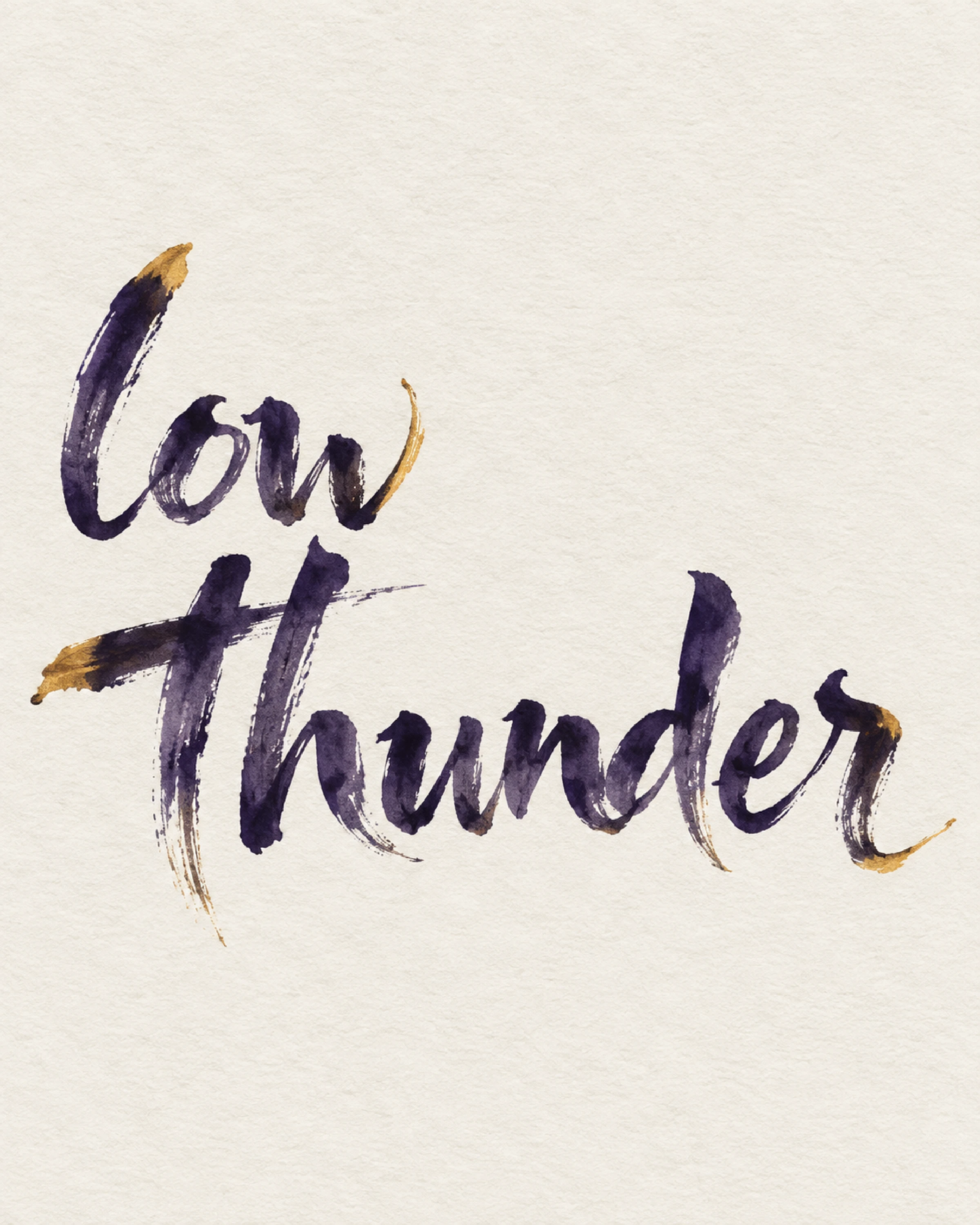
Deep violet brush lettering spreads asymmetrically, with ochre ink traces between lingering terminals and generous empty space.
Remix this referenceLow Thunder in Split Brush Strokes
- Form language
- Build letterforms from compressed broad masses and elastic narrow links, allowing irregular widths within a coherent handwritten vocabulary.
- Contour
- Let loaded edges swell into blunt shoulders, then taper into frayed tips; preserve enough continuous contour for immediate reading.
- Mark-making
- Alternate broad pressure strokes with brisk hairlines and occasional split-bristle trails; vary the rhythm naturally without ornamental flourishes.
- Surface rendering
- Let dense ink pools open into translucent washes and dry skips, with soft absorption at selected edges and quiet paper texture beneath.
Priority
Expressive ink variation must reveal gestural brush calligraphy while keeping every word readable.
What to avoid & what to check
Exact prompt for this example
MODULE OWNERSHIP
subject: Subject count, type, stable proportions and landmarks, resting face geometry, hair shape, physical materials, garment construction and permanent marks. No emotion, movement, color assignment or rendering recipe.
expression: Facial soft-tissue displacement and pupil direction, muscle coordination, regional intensity, asymmetry and onset/peak/release. No head/body pose, stable appearance, skin color or rendering.
gesture: Head/neck/body/limb orientation, joint movement, support, contact and pose-caused occlusion using existing anatomy. No eye/pupil movement, emotion, identity, props inventory or camera.
props: Prop count, type, construction, physical material and scale relative to the subject. Holding/contact belongs to gesture, position to composition, color to palette.
scene: Environment elements, terrain, backdrop/floor presence and structural detail. No canvas positions, camera, lighting, assigned colors or render texture.
camera: Projection, focal-length impression, camera elevation/yaw/roll, viewing distance and crop. No actor pose, world placement, lighting or canvas aspect ratio.
composition: Normalized 0-100% canvas positions, scale in frame, depth/overlap, focal hierarchy and margins. No joint pose, camera projection, rendering, subject/prop inventory or emotion.
palette: Color anchors, hue/saturation/value ranges, colors assigned to parts and approximate color coverage. No illumination direction, shading algorithm, physical material or layout.
lighting: Light-source direction/softness/intensity, ambient illumination, physical shadow direction/length and highlight position. Absence of directional illumination is allowed. No shading technique, palette or material changes.
style: Reusable form abstraction, contour weight/taper/edge quality, medium and mark scale/density/direction, surface rendering and tonal transition technique. No fixed subject proportions, anatomy, identity, expression, pose, palette, light-source direction, camera or layout.
output: Image count, aspect ratio, size, file/alpha requirements and global lettering/logo/watermark restrictions. No background scenery, crop, style, identity or pose.

SUBJECT
inventory: One original English calligraphic inscription of two words; no figures.
geometry: Write "low thunder" in recognizable lowercase letters, retaining open counters and a distinct word boundary.
resting-face: No faces are present.
appearance: Pigment ink on an uncoated paper support; no attached ornaments.

PRIORITY


AVOID


CHECK


PROPS
inventory: No separate props.
construction: No prop construction applies.

PRIORITY


AVOID


CHECK


SCENE
inventory: An uninterrupted paper field is the entire backdrop; no depicted environment.
structure: No horizon, floor, borders or architectural divisions.

PRIORITY


AVOID


CHECK


CAMERA
projection: Orthographic reproduction with no perspective convergence.
viewpoint: View the artwork straight on, with no yaw, elevation offset or roll.
crop: Show the complete inscription and its surrounding field; physical sheet edges remain outside the crop.

PRIORITY


AVOID


CHECK


COMPOSITION
placement: Set the shorter word high at the left; let the longer word span the lower middle and extend toward the right.
depth: Keep a single graphic plane; the longer word leads, while the shorter word provides a compact opening.
spacing: Leave a broad empty wedge above the longer word on the right, generous outer margins and clear gaps between letter bodies.

PRIORITY


AVOID


CHECK


PALETTE
colors: Near-black storm violet, muted golden ochre and pale warm gray.
assignment: Use storm violet for the main lettering, ochre for occasional terminal passages and warm gray for the paper.
balance: The pale field dominates; violet carries the inscription and ochre remains a restrained accent.

PRIORITY


AVOID


CHECK


LIGHTING
sources: Broad, even frontal illumination with no conspicuous directional source.
shadows: No visible cast shadows or relief shadows.
highlights: Keep illumination diffuse, without localized glare.

PRIORITY


AVOID


CHECK


STYLE GUIDE
form-language: Build letterforms from compressed broad masses and elastic narrow links, allowing irregular widths within a coherent handwritten vocabulary.
contour: Let loaded edges swell into blunt shoulders, then taper into frayed tips; preserve enough continuous contour for immediate reading.
mark-making: Alternate broad pressure strokes with brisk hairlines and occasional split-bristle trails; vary the rhythm naturally without ornamental flourishes.
surface-rendering: Let dense ink pools open into translucent washes and dry skips, with soft absorption at selected edges and quiet paper texture beneath.

PRIORITY
Expressive ink variation must reveal gestural brush calligraphy while keeping every word readable.

AVOID


CHECK


OUTPUT
format: One finished image, portrait 4:5, 2400 × 3000 pixels, opaque PNG.
restrictions: Allow primary lettering; forbid additional text, logos and watermarks.

PRIORITY


AVOID


CHECK


FINAL INTEGRATION
subject + output: The subject inscription "low thunder" is the primary lettering permitted by output.
Model information comes from image provenance. The same prompt may produce a different result.