Text to imageCafe & brandStyle guide
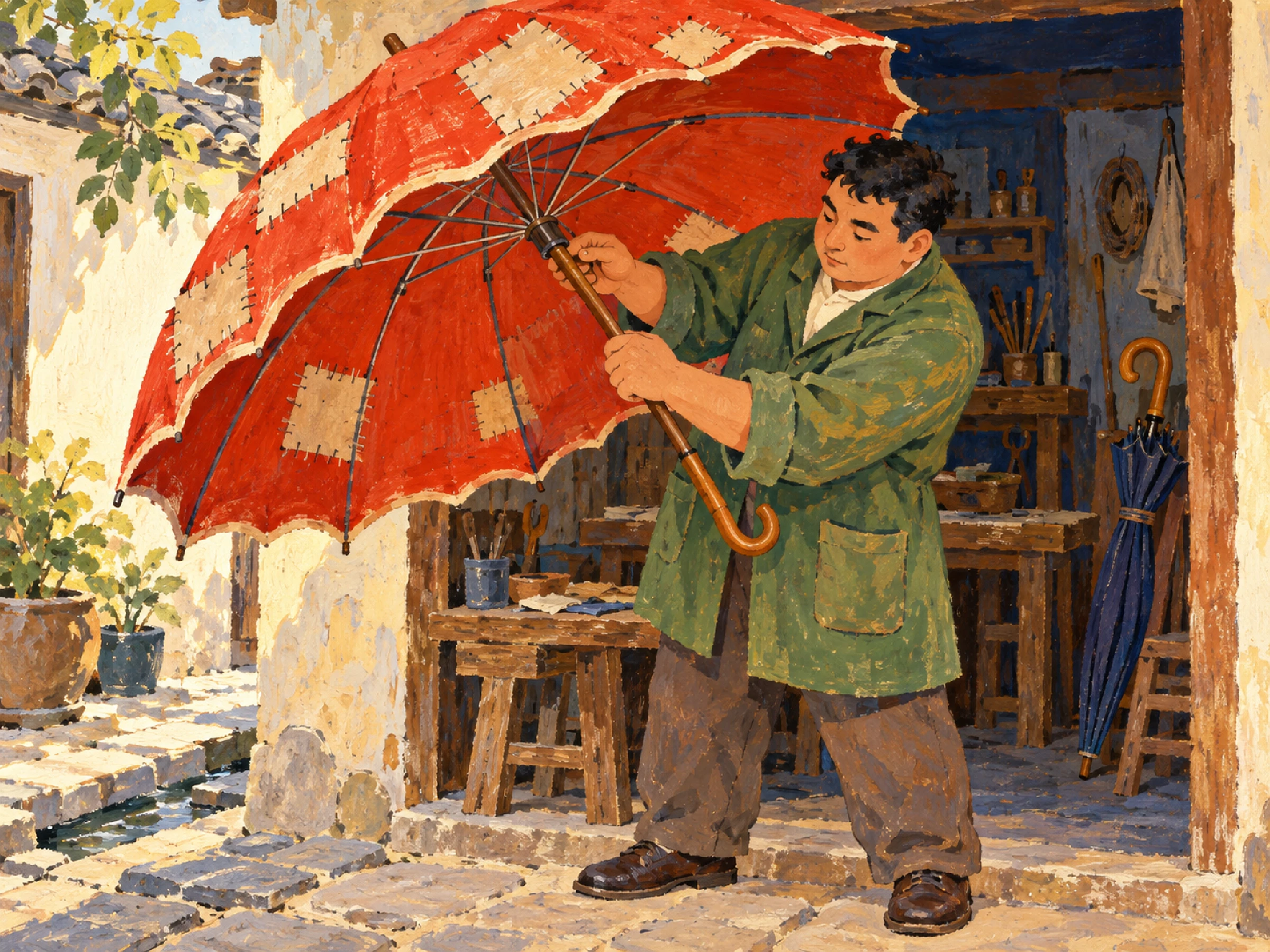
Opening an Umbrella in the Repair Shop
An umbrella-repair brand illustration of a maker opening a patched canopy among overlapping workshop forms. Lively folk-painted marks and decorative simplification give the small shop a welcoming, industrious character.
Remix this referenceOpening an Umbrella in the Repair Shop
- Form language
- Simplify forms into buoyant wedges, scallops and rounded blocks; decorative repetition may vary freely within this vocabulary.
- Contour
- Use irregular brush contours that thicken at turns, occasionally break and let neighboring shapes merge.
- Mark-making
- Opaque paint carries lively dashes and broad bristle sweeps; repeated marks change size and spacing naturally.
- Surface rendering
- Build uneven matte layers with dry skips and glimpses of underpaint; broad tonal patches replace smooth modeling.
Priority
Make the naive folk painting visibly lively and decoratively simplified.
What to avoid & what to check
Exact prompt for this example
MODULE OWNERSHIP
subject: Subject count, type, stable proportions and landmarks, resting face geometry, hair shape, physical materials, garment construction and permanent marks. No emotion, movement, color assignment or rendering recipe.
expression: Facial soft-tissue displacement and pupil direction, muscle coordination, regional intensity, asymmetry and onset/peak/release. No head/body pose, stable appearance, skin color or rendering.
gesture: Head/neck/body/limb orientation, joint movement, support, contact and pose-caused occlusion using existing anatomy. No eye/pupil movement, emotion, identity, props inventory or camera.
props: Prop count, type, construction, physical material and scale relative to the subject. Holding/contact belongs to gesture, position to composition, color to palette.
scene: Environment elements, terrain, backdrop/floor presence and structural detail. No canvas positions, camera, lighting, assigned colors or render texture.
camera: Projection, focal-length impression, camera elevation/yaw/roll, viewing distance and crop. No actor pose, world placement, lighting or canvas aspect ratio.
composition: Normalized 0-100% canvas positions, scale in frame, depth/overlap, focal hierarchy and margins. No joint pose, camera projection, rendering, subject/prop inventory or emotion.
palette: Color anchors, hue/saturation/value ranges, colors assigned to parts and approximate color coverage. No illumination direction, shading algorithm, physical material or layout.
lighting: Light-source direction/softness/intensity, ambient illumination, physical shadow direction/length and highlight position. Absence of directional illumination is allowed. No shading technique, palette or material changes.
style: Reusable form abstraction, contour weight/taper/edge quality, medium and mark scale/density/direction, surface rendering and tonal transition technique. No fixed subject proportions, anatomy, identity, expression, pose, palette, light-source direction, camera or layout.
output: Image count, aspect ratio, size, file/alpha requirements and global lettering/logo/watermark restrictions. No background scenery, crop, style, identity or pose.

SUBJECT
inventory: One original adult umbrella maker, actor A.
geometry: A compact adult build with broad hands, sturdy legs and a short neck.
resting-face: A broad oval face has straight brows, wide-set eyes, a rounded nose and a wide mouth.
appearance: Short curls accompany a cotton-twill work coat with roomy sleeves and patch pockets, plain trousers and leather shoes.

PRIORITY


AVOID


CHECK


EXPRESSION — ACTOR A
brows: Both brows remain level, without an inward pinch.
lids: Upper lids rest slightly low; lower lids remain relaxed.
cheeks: Cheeks remain soft, without a smile-driven lift.
nose: Nostrils stay relaxed and the nose bridge remains unwrinkled.
mouth: Lips meet lightly with both corners at rest.
jaw: The jaw rests closed without clenching.
gaze: Pupils point down-left toward the umbrella runner.
coordination: The directed pupils accompany otherwise quiet, balanced facial muscles.
timing: Capture the sustained neutral apex during the inspection.

PRIORITY


AVOID


CHECK


GESTURE
head: A angles the head toward the runner; the face remains visible beside the canopy edge.
torso: The torso inclines toward the umbrella as the shoulders spread with the opening action.
limbs: Bent elbows open outward; staggered feet support the forward reach without a deep lunge.
contact: One hand steadies the shaft while the other pushes the runner upward beneath the spreading canopy.

PRIORITY


AVOID


CHECK


PROPS
inventory: Two adult-scale umbrellas: one broad repaired umbrella and one closed umbrella.
construction: Fabric gores cover slender metal ribs with wooden handles; conspicuous sewn patches repair the broad canopy, which has a scalloped edge.

PRIORITY


AVOID


CHECK


SCENE
inventory: A courtyard repair shop contains a workbench, storage niches, a wall hook and a tiled threshold.
structure: An uneven plaster doorway connects the shallow workshop to courtyard paving with a narrow drainage channel.

PRIORITY


AVOID


CHECK


CAMERA
projection: Use mild perspective with the natural spatial impression of a normal lens.
viewpoint: Look into the shop from adult eye level at a side three-quarter viewpoint, without camera roll.
crop: A medium-wide view includes the maker's shoes, the entire opening canopy and the shop doorway.

PRIORITY


AVOID


CHECK


COMPOSITION
placement: The canopy fills much of the left two-thirds; the maker occupies the lower right.
depth: The canopy overlaps the maker's shoulder and bench; the closed umbrella sits deeper inside the doorway.
spacing: Read the opening umbrella first, then the hands; leave breathing room around its edge.

PRIORITY


AVOID


CHECK


PALETTE
colors: Use warm cream, vermilion, leaf green and a restrained deep ultramarine.
assignment: Assign vermilion to the open canopy, green to the coat, cream to plaster and patches, ultramarine to recesses.
balance: Cream supplies the broad quiet field; a generous warm canopy is interrupted by smaller cool accents.

PRIORITY


AVOID


CHECK


LIGHTING
sources: Broad, soft daylight enters from the upper-left courtyard doorway, with gentle indoor ambient light.
shadows: Soft-edged shadows fall lower-right and deepen beneath the canopy and bench.
highlights: Broad highlights touch upper-left canopy ridges, with small glints on exposed ribs.

PRIORITY


AVOID


CHECK


STYLE GUIDE
form-language: Simplify forms into buoyant wedges, scallops and rounded blocks; decorative repetition may vary freely within this vocabulary.
contour: Use irregular brush contours that thicken at turns, occasionally break and let neighboring shapes merge.
mark-making: Opaque paint carries lively dashes and broad bristle sweeps; repeated marks change size and spacing naturally.
surface-rendering: Build uneven matte layers with dry skips and glimpses of underpaint; broad tonal patches replace smooth modeling.

PRIORITY
Make the naive folk painting visibly lively and decoratively simplified.

AVOID


CHECK


OUTPUT
format: One finished illustration, landscape 4:3, 2400 × 1800 pixels, opaque PNG.
restrictions: No lettering, logos or watermarks.

PRIORITY


AVOID


CHECK


FINAL INTEGRATION
gesture + style: Let decorative simplification support the opening action while keeping hand contacts legible.
Model information comes from image provenance. The same prompt may produce a different result.