Text to imageCharacterStyle guide
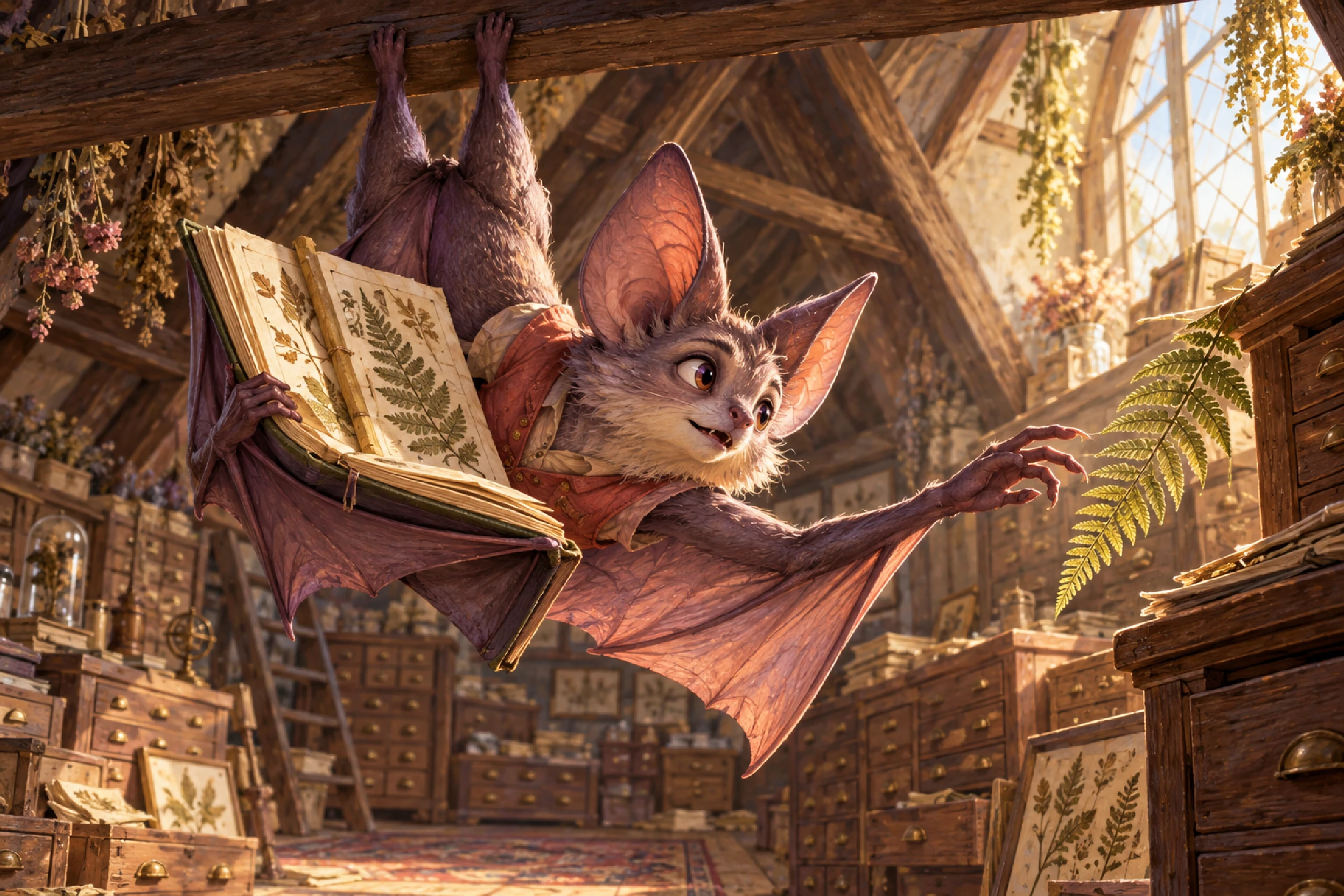
Bat Archivist Catching a Pressed Fern
Hanging upside down from a beam, a bat archivist catches a fern slipping from an open folio. Overlapping wings and paper unfold through luminous, continuous painterly tones.
Remix this referenceBat Archivist Catching a Pressed Fern
- Form language
- Use supple, interlocking volumes with selective simplification; let broad masses remain readable while small forms dissolve into neighboring tone.
- Contour
- Build contours from lost-and-found painted edges, sharpening only brief passages; avoid a continuous enclosing ink line.
- Mark-making
- Lay translucent broad brush sweeps beneath smaller broken strokes; vary stroke length and let occasional drag marks remain visible.
- Surface rendering
- Develop luminous continuous tones through thin layered veils and softly mingled transitions; preserve a few thicker, tactile paint accents.
Priority
Let luminous continuous-tone painting, visibly shaped by varied brushwork, define the finish.
What to avoid & what to check
Exact prompt for this example
MODULE OWNERSHIP
subject: Subject count, type, stable proportions and landmarks, resting face geometry, hair shape, physical materials, garment construction and permanent marks. No emotion, movement, color assignment or rendering recipe.
expression: Facial soft-tissue displacement and pupil direction, muscle coordination, regional intensity, asymmetry and onset/peak/release. No head/body pose, stable appearance, skin color or rendering.
gesture: Head/neck/body/limb orientation, joint movement, support, contact and pose-caused occlusion using existing anatomy. No eye/pupil movement, emotion, identity, props inventory or camera.
props: Prop count, type, construction, physical material and scale relative to the subject. Holding/contact belongs to gesture, position to composition, color to palette.
scene: Environment elements, terrain, backdrop/floor presence and structural detail. No canvas positions, camera, lighting, assigned colors or render texture.
camera: Projection, focal-length impression, camera elevation/yaw/roll, viewing distance and crop. No actor pose, world placement, lighting or canvas aspect ratio.
composition: Normalized 0-100% canvas positions, scale in frame, depth/overlap, focal hierarchy and margins. No joint pose, camera projection, rendering, subject/prop inventory or emotion.
palette: Color anchors, hue/saturation/value ranges, colors assigned to parts and approximate color coverage. No illumination direction, shading algorithm, physical material or layout.
lighting: Light-source direction/softness/intensity, ambient illumination, physical shadow direction/length and highlight position. Absence of directional illumination is allowed. No shading technique, palette or material changes.
style: Reusable form abstraction, contour weight/taper/edge quality, medium and mark scale/density/direction, surface rendering and tonal transition technique. No fixed subject proportions, anatomy, identity, expression, pose, palette, light-source direction, camera or layout.
output: Image count, aspect ratio, size, file/alpha requirements and global lettering/logo/watermark restrictions. No background scenery, crop, style, identity or pose.

SUBJECT
inventory: One original adult anthropomorphic bat archivist, actor A; no secondary characters.
geometry: A compact furry body, large leaf-shaped ears, a short muzzle and wing membranes joining the forearms to the flanks.
resting-face: Wide-set eyes, low brow ridges, a rounded nose pad and a small flexible mouth beneath the muzzle.
appearance: Short fur forms a shaggy cheek ruff; a sleeveless linen vest leaves the wing membranes free.

PRIORITY


AVOID


CHECK


EXPRESSION — ACTOR A
brows: Brow tissue lifts on both sides, one side slightly ahead of the other.
lids: Upper lids rise while the lower lids remain softly curved.
cheeks: The cheek pads remain loose without a smile lift.
nose: The nose pad stays relaxed with no wrinkling.
mouth: The lips separate into a small uneven opening.
jaw: The jaw begins to drop slightly.
gaze: Both pupils focus on the fern.
coordination: The widened eyes lead; the small mouth opening follows without panic tension.
timing: Show the first instant of recognition.

PRIORITY


AVOID


CHECK


GESTURE
head: The inverted head turns toward the reaching hand, with the neck extending out of the ruff.
torso: The hanging torso twists gently away from the beam into a loose suspended curve.
limbs: Both feet hook the beam; one arm folds around the folio while the other reaches with cupped fingers.
contact: Hooked feet support the body; fingertips just meet the fern as it slides free of the page; the folded arm partly hides its membrane.

PRIORITY


AVOID


CHECK


PROPS
inventory: One open archival folio about torso-sized and one pressed fern roughly as long as a forearm.
construction: The folio has a cloth spine and thick rag-paper leaves; the dried fern has a slender stem and delicate paired leaflets.

PRIORITY


AVOID


CHECK


SCENE
inventory: An attic botanical archive with exposed roof beams, built-in specimen drawers and a broad dormer window.
structure: Sloping rafters enclose the room; the dormer interrupts the roof and the drawer fronts form an uneven stepped run.

PRIORITY


AVOID


CHECK


CAMERA
projection: Use moderate wide-angle perspective with clear room depth and restrained foreground enlargement.
viewpoint: Look slightly upward from across the attic at a three-quarter angle; keep the camera level.
crop: Include the entire hanging character, the supporting beam and enough room to establish the archive.

PRIORITY


AVOID


CHECK


COMPOSITION
placement: Place the figure across the middle, the face near 55% across and 60% down, and the fern farther right.
depth: The open folio crosses the wing and torso; face, reaching hand and fern form the leading sequence over receding drawers.
spacing: Keep a clear pocket around the catching fingers while allowing the beam and nearest drawers to leave the frame.

PRIORITY


AVOID


CHECK


PALETTE
colors: Use mulberry, muted coral, parchment gold and fern green, with pale peach and violet tonal accents.
assignment: Mulberry defines fur and wings, coral the vest, gold the paper, green the fern, and subdued peach the archive.
balance: Keep the room mostly muted and the fern distinctly green; pale peach highlights and violet shadow notes connect the hues.

PRIORITY


AVOID


CHECK


LIGHTING
sources: A broad dormer light enters from the upper right, supported by soft room bounce.
shadows: Soft beam shadows extend down and left; overlapping paper and wings cast closer, firmer contact shadows.
highlights: Light catches the window-facing cheek ruff, ear rims and paper edges, with a thin transmitted glow through the fern.

PRIORITY


AVOID


CHECK


STYLE GUIDE
form-language: Use supple, interlocking volumes with selective simplification; let broad masses remain readable while small forms dissolve into neighboring tone.
contour: Build contours from lost-and-found painted edges, sharpening only brief passages; avoid a continuous enclosing ink line.
mark-making: Lay translucent broad brush sweeps beneath smaller broken strokes; vary stroke length and let occasional drag marks remain visible.
surface-rendering: Develop luminous continuous tones through thin layered veils and softly mingled transitions; preserve a few thicker, tactile paint accents.

PRIORITY
Let luminous continuous-tone painting, visibly shaped by varied brushwork, define the finish.

AVOID


CHECK


OUTPUT
format: One finished image, 3:2 landscape, 2400 × 1600 pixels, opaque PNG.
restrictions: No readable lettering, logos, signatures or watermarks.

PRIORITY


AVOID


CHECK
Model information comes from image provenance. The same prompt may produce a different result.