Text to imageAnimationStyle guide
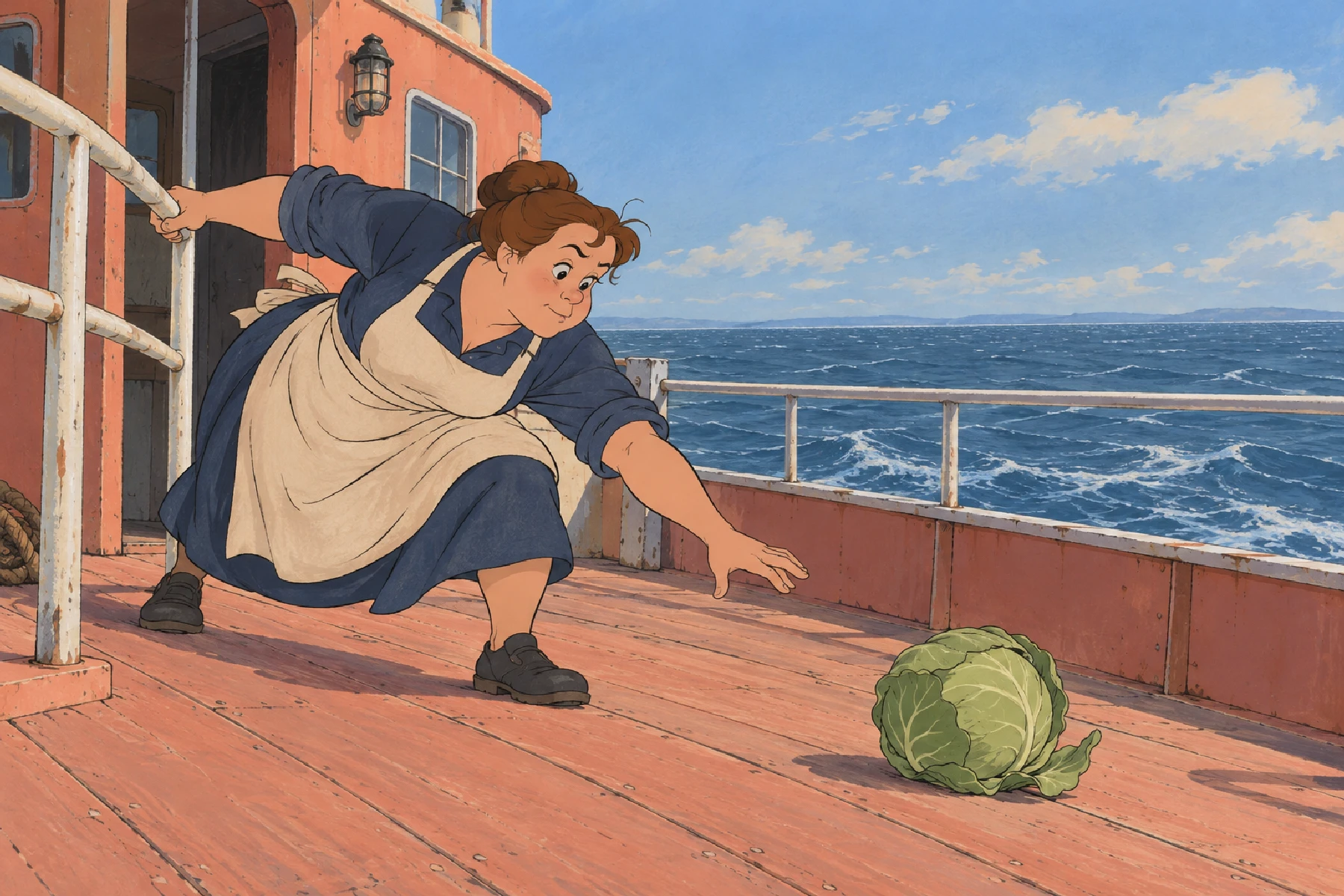
Cook Reaching for a Rolling Cabbage
On a sloping ferry deck, a cook grips the railing and reaches for a rolling cabbage. Open water and restless xerographic lines give this precarious little moment room to breathe.
Remix this referenceCook Reaching for a Rolling Cabbage
- Form language
- Build legible masses with selective angular simplification; let small secondary shapes vary within the same economical vocabulary.
- Contour
- Use sketch-like contours with lightly irregular weight, tapered exits and occasional open joins rather than uniformly polished ink.
- Mark-making
- Retain selective short doubled contours and broken pencil traces; vary their length and pressure with a natural drawing rhythm.
- Surface rendering
- Use flat cel fills with few tonal steps and slight line-to-fill misregistration; supporting surfaces allow broad, uneven opaque brushwork.
Priority
Rendering medium: hand-drawn 2D xerographic cel-animation illustration; formal rendering reference: Walt Disney Studios · 1960s · One Hundred and One Dalmatians (1961)
What to avoid & what to check
Exact prompt for this example
MODULE OWNERSHIP
subject: Subject count, type, stable proportions and landmarks, resting face geometry, hair shape, physical materials, garment construction and permanent marks. No emotion, movement, color assignment or rendering recipe.
expression: Facial soft-tissue displacement and pupil direction, muscle coordination, regional intensity, asymmetry and onset/peak/release. No head/body pose, stable appearance, skin color or rendering.
gesture: Head/neck/body/limb orientation, joint movement, support, contact and pose-caused occlusion using existing anatomy. No eye/pupil movement, emotion, identity, props inventory or camera.
props: Prop count, type, construction, physical material and scale relative to the subject. Holding/contact belongs to gesture, position to composition, color to palette.
scene: Environment elements, terrain, backdrop/floor presence and structural detail. No canvas positions, camera, lighting, assigned colors or render texture.
camera: Projection, focal-length impression, camera elevation/yaw/roll, viewing distance and crop. No actor pose, world placement, lighting or canvas aspect ratio.
composition: Normalized 0-100% canvas positions, scale in frame, depth/overlap, focal hierarchy and margins. No joint pose, camera projection, rendering, subject/prop inventory or emotion.
palette: Color anchors, hue/saturation/value ranges, colors assigned to parts and approximate color coverage. No illumination direction, shading algorithm, physical material or layout.
lighting: Light-source direction/softness/intensity, ambient illumination, physical shadow direction/length and highlight position. Absence of directional illumination is allowed. No shading technique, palette or material changes.
style: Reusable form abstraction, contour weight/taper/edge quality, medium and mark scale/density/direction, surface rendering and tonal transition technique. No fixed subject proportions, anatomy, identity, expression, pose, palette, light-source direction, camera or layout.
output: Image count, aspect ratio, size, file/alpha requirements and global lettering/logo/watermark restrictions. No background scenery, crop, style, identity or pose.

SUBJECT
inventory: A is one original adult woman, a ferry cook; no other people or animals.
geometry: A has a sturdy pear-shaped build, substantial forearms, short legs and broad, practical feet.
resting-face: A has a broad nose, straight brows, a rounded chin and a fuller lower lip.
appearance: Her hair forms a compact bun; she wears a cotton shirt, wrap apron, gathered skirt and rubber-soled shoes.

PRIORITY


AVOID


CHECK


EXPRESSION — ACTOR A
brows: Inner brows draw down slightly, with the right brow a little lower.
lids: Upper lids open attentively; lower lids tighten lightly.
cheeks: Cheeks remain mostly relaxed, with slight tension beside the mouth.
nose: Nostrils remain relaxed without a nose wrinkle.
mouth: Lips press together lightly, one corner tucked inward.
jaw: The jaw firms slightly without clenching.
gaze: Both pupils track downward toward the cabbage.
coordination: A focused upper face leads; the restrained mouth adds quiet comic resolve.
timing: Capture the onset: brow tension has arrived before the lips fully tighten.

PRIORITY


AVOID


CHECK


GESTURE
head: A extends her neck and dips her chin toward her reaching hand.
torso: Her torso pitches forward and twists away from the railing, with her hips held low.
limbs: Her right arm reaches low with open fingers; one knee bends deeply while the other leg braces behind.
contact: Her left hand grips the railing and both soles bear on the deck; the reaching hand has not touched the cabbage.

PRIORITY


AVOID


CHECK


PROPS
inventory: One cabbage, roughly as wide as A's head.
construction: Overlapping fleshy leaves form a dense round core, with one loose outer leaf.

PRIORITY


AVOID


CHECK


SCENE
inventory: An open ferry deck, a tubular railing, a small deckhouse and an uninterrupted stretch of sea.
structure: The deck slopes gently with the ferry's roll; plank joints and a raised doorway sill establish the working vessel.

PRIORITY


AVOID


CHECK


CAMERA
projection: Perspective with a moderate wide-lens impression and restrained depth exaggeration.
viewpoint: View from waist height at a three-quarter side angle, with no camera roll.
crop: A full-body environmental view retains the entire reach and surrounding deck.

PRIORITY


AVOID


CHECK


COMPOSITION
placement: A occupies the left third at about half the canvas height; the cabbage sits low, just right of center.
depth: A overlaps the railing and deckhouse; the cabbage occupies the nearer deck, with open sea beyond.
spacing: The face-to-hand-to-cabbage sequence leads attention; spacious sea fills the upper right, with clear gaps around the reach.

PRIORITY


AVOID


CHECK


PALETTE
colors: Use sea blue-gray, faded coral, warm cream, deep navy, cabbage green and charcoal.
assignment: Assign blue-gray to sea, coral to deck and deckhouse, cream to apron, navy to clothing, green to cabbage and charcoal to lines.
balance: Muted cool expanses dominate; warm architectural fields support a small, fresher green accent and natural warm skin tones.

PRIORITY


AVOID


CHECK


LIGHTING
sources: Broad daylight enters softly from the upper left, with generous ambient fill.
shadows: Short, soft shadows fall toward the right across the deck.
highlights: Quiet highlights gather on upper-left-facing edges without sharp glare.

PRIORITY


AVOID


CHECK


STYLE GUIDE
form-language: Build legible masses with selective angular simplification; let small secondary shapes vary within the same economical vocabulary.
contour: Use sketch-like contours with lightly irregular weight, tapered exits and occasional open joins rather than uniformly polished ink.
mark-making: Retain selective short doubled contours and broken pencil traces; vary their length and pressure with a natural drawing rhythm.
surface-rendering: Use flat cel fills with few tonal steps and slight line-to-fill misregistration; supporting surfaces allow broad, uneven opaque brushwork.

PRIORITY
Rendering medium: hand-drawn 2D xerographic cel-animation illustration; formal rendering reference: Walt Disney Studios · 1960s · One Hundred and One Dalmatians (1961)

AVOID


CHECK


OUTPUT
format: One finished image, landscape 3:2, 1800 × 1200 pixels, opaque PNG.
restrictions: No lettering, logos or watermarks.

PRIORITY


AVOID


CHECK


FINAL INTEGRATION
expression + gesture + composition: Let facial acting and bodily action read as one interrupted task, with composition providing room for its anticipated continuation.
Art direction
디즈니 / Walt Disney Studios · 1960s · 101마리 달마시안(1961) / One Hundred and One Dalmatians (1961) ↗- Use legible form masses with selective angular simplification
- Sketch-like contours with small weight irregularities instead of polished ink uniformity
- Retain selective short doubled contour traces and broken pencil-like marks
- Flat fills with few tonal levels and slight line-to-fill edge misregistration
Model information comes from image provenance. The same prompt may produce a different result.