Text to imageCharacterStyle guide
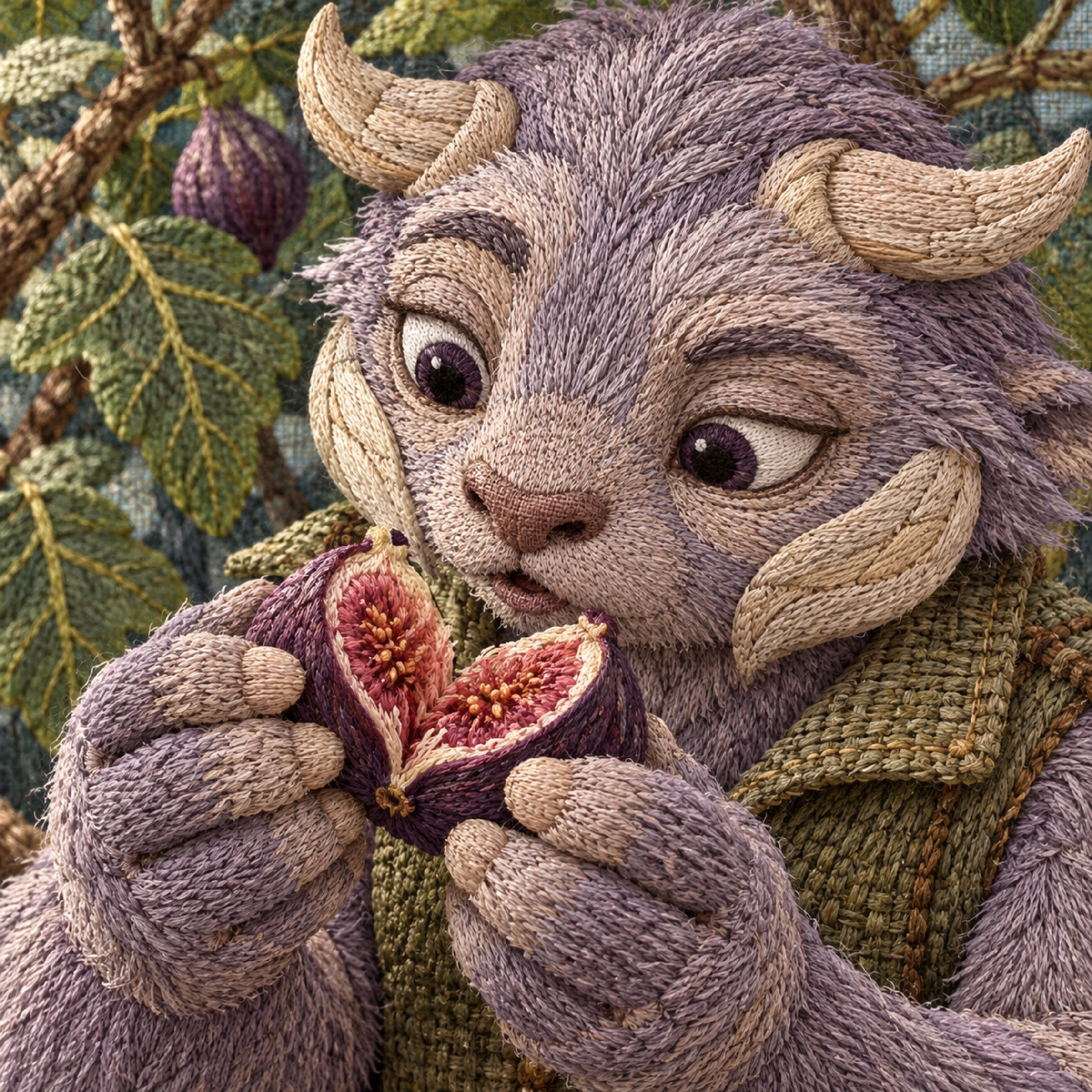
Cheek-Plated Forager Smelling a Split Fig
A small forager with hard cheek plates and soft fur lifts a freshly split fig beneath its nose. An intimate embroidered portrait uses directional stitches and raised threadwork to give its curiosity a tactile presence.
Remix this referenceCheek-Plated Forager Smelling a Split Fig
- Form language
- Translate volumes into nested appliqué-like shapes with rounded simplification; let minor details vary within the same handmade vocabulary.
- Contour
- Build selective outlines from irregular couching stitches, leaving some edges defined only by adjoining stitch directions.
- Mark-making
- Use curving long-and-short stitches, compact satin passages, and occasional knots; preserve natural changes in stitch length and tension.
- Surface rendering
- Pad selected shapes into low thread relief, blend tones through interleaved strands, and leave woven ground visible between stitched areas.
Priority
The finished image must read as raised embroidery with visible individual thread paths.
What to avoid & what to check
Exact prompt for this example
MODULE OWNERSHIP
subject: Subject count, type, stable proportions and landmarks, resting face geometry, hair shape, physical materials, garment construction and permanent marks. No emotion, movement, color assignment or rendering recipe.
expression: Facial soft-tissue displacement and pupil direction, muscle coordination, regional intensity, asymmetry and onset/peak/release. No head/body pose, stable appearance, skin color or rendering.
gesture: Head/neck/body/limb orientation, joint movement, support, contact and pose-caused occlusion using existing anatomy. No eye/pupil movement, emotion, identity, props inventory or camera.
props: Prop count, type, construction, physical material and scale relative to the subject. Holding/contact belongs to gesture, position to composition, color to palette.
scene: Environment elements, terrain, backdrop/floor presence and structural detail. No canvas positions, camera, lighting, assigned colors or render texture.
camera: Projection, focal-length impression, camera elevation/yaw/roll, viewing distance and crop. No actor pose, world placement, lighting or canvas aspect ratio.
composition: Normalized 0-100% canvas positions, scale in frame, depth/overlap, focal hierarchy and margins. No joint pose, camera projection, rendering, subject/prop inventory or emotion.
palette: Color anchors, hue/saturation/value ranges, colors assigned to parts and approximate color coverage. No illumination direction, shading algorithm, physical material or layout.
lighting: Light-source direction/softness/intensity, ambient illumination, physical shadow direction/length and highlight position. Absence of directional illumination is allowed. No shading technique, palette or material changes.
style: Reusable form abstraction, contour weight/taper/edge quality, medium and mark scale/density/direction, surface rendering and tonal transition technique. No fixed subject proportions, anatomy, identity, expression, pose, palette, light-source direction, camera or layout.
output: Image count, aspect ratio, size, file/alpha requirements and global lettering/logo/watermark restrictions. No background scenery, crop, style, identity or pose.

SUBJECT
inventory: One original small humanoid forager with fur, cheek plates, and short brow horns.
geometry: A broad wedge-shaped head, compact shoulders, rounded hands, swept cheek plates, and flattened crescent horns.
resting-face: Wide-set round eyes, a low broad nose, a short mouth, and a shallow cleft chin define the resting face.
appearance: Fine fur surrounds smooth keratin cheek plates and horns; a woven vest has a broad folded collar and simple front overlap.

PRIORITY


AVOID


CHECK


EXPRESSION — ACTOR A
brows: The right brow lifts while the left remains nearly at rest.
lids: Upper lids open a little wider; lower lids remain soft.
cheeks: Soft cheek tissue stays relaxed around the fixed plates.
nose: Nostrils widen gently at the beginning of a sniff.
mouth: Lips part narrowly without lifting the corners.
jaw: The jaw releases slightly, with no pronounced drop.
gaze: Both pupils turn downward toward the exposed fig flesh.
coordination: One lifted brow and a restrained sniff suggest discovery before pleasure or dislike develops.
timing: Show the onset of recognition, before the mouth forms a stronger response.

PRIORITY


AVOID


CHECK


GESTURE
head: The head dips toward the fruit, with a small sideways inclination.
torso: The upper torso inclines forward, shoulders loosely gathered around the hands.
limbs: Both forearms rise close to the chest; the hands gently draw the joined fruit halves apart.
contact: Thumb pads support the skin while fingertips cradle its sides; the fruit stops just beneath the nose.

PRIORITY


AVOID


CHECK


PROPS
inventory: One ripe fig, small enough to fit between the character's cupped hands.
construction: The fig is torn into two lobes still joined at the base, with thin skin and densely seeded soft flesh.

PRIORITY


AVOID


CHECK


SCENE
inventory: A close fig-grove setting with a few broad leaves and fragments of forked branches; no floor is visible.
structure: Sparse leaf and branch shapes suggest a grove without describing a complete landscape.

PRIORITY


AVOID


CHECK


CAMERA
projection: A shallow-perspective portrait with a short-telephoto impression.
viewpoint: Look from eye level at a slight three-quarter yaw, with no camera roll.
crop: Crop tightly through the outer horns, shoulders, and lower wrists while retaining both eyes and the whole fig.

PRIORITY


AVOID


CHECK


COMPOSITION
placement: Let the face fill the upper-right field and the opened fig anchor the lower-left; the eyes lead into the fruit.
depth: Hands overlap the collar and the fig overlaps the lower muzzle; leaves sit behind the uninterrupted eye line.
spacing: Allow generous open ground beside the lower cheek to give the face breathing room.

PRIORITY


AVOID


CHECK


PALETTE
colors: Smoky lavender, oatmeal, mulberry, and muted olive, with deep aubergine accents.
assignment: Lavender fur, oatmeal plates and horns, an olive vest and leaves, mulberry fig flesh, and aubergine fig skin and pupils.
balance: Quiet lavender and oatmeal dominate; the small, richer fruit provides the strongest saturation.

PRIORITY


AVOID


CHECK


LIGHTING
sources: A broad upper-left light falls across the subject, supported by low ambient fill.
shadows: Short soft shadows fall down-right from raised details, with deeper shade beneath the hands.
highlights: Small glints follow upper-left ridges while broader highlights stay subdued.

PRIORITY


AVOID


CHECK


STYLE GUIDE
form-language: Translate volumes into nested appliqué-like shapes with rounded simplification; let minor details vary within the same handmade vocabulary.
contour: Build selective outlines from irregular couching stitches, leaving some edges defined only by adjoining stitch directions.
mark-making: Use curving long-and-short stitches, compact satin passages, and occasional knots; preserve natural changes in stitch length and tension.
surface-rendering: Pad selected shapes into low thread relief, blend tones through interleaved strands, and leave woven ground visible between stitched areas.

PRIORITY
The finished image must read as raised embroidery with visible individual thread paths.

AVOID


CHECK


OUTPUT
format: One finished image, square, 2400 × 2400 pixels, opaque PNG.
restrictions: Deliver one square image at 2400 × 2400 pixels as an opaque PNG; no lettering, logos, or watermarks.

PRIORITY


AVOID


CHECK


FINAL INTEGRATION
subject + expression + style: Keep stable facial landmarks recognizable as the embroidered surface carries the small acting changes.
lighting + style: Illumination should reveal the stitch relief established by the textile treatment.
Model information comes from image provenance. The same prompt may produce a different result.