Text to imageProductStyle guide
Petal Sundial and Lid
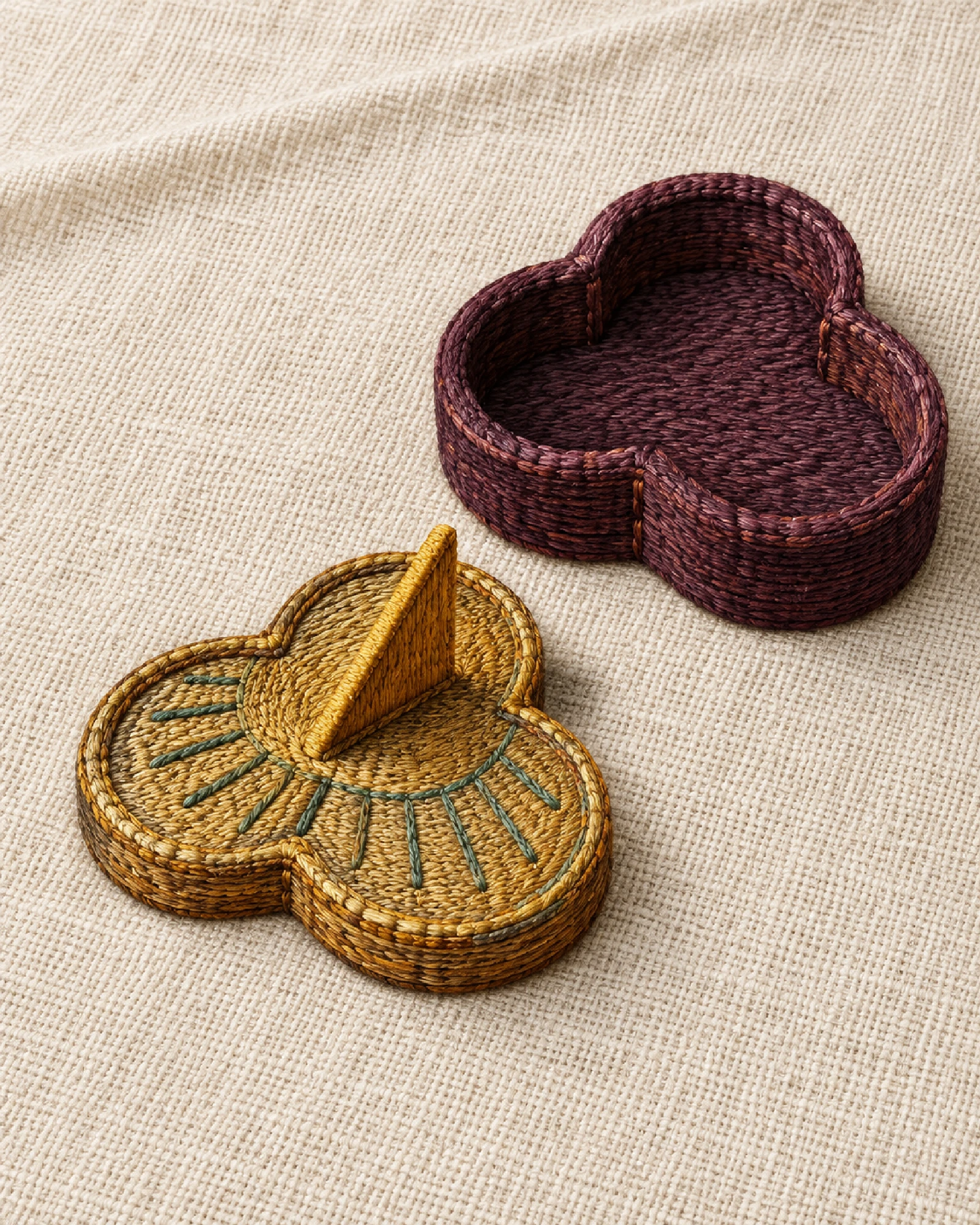
A brass sundial with a three-lobed petal base sits beside its wooden lid in generous negative space. Raised thread and changing stitch directions give the small product tangible depth.
Remix this referencePetal Sundial and Lid
- Form language
- Translate forms into supple appliqué-like shapes and compact relief volumes; permit slight handmade irregularity without losing construction.
- Contour
- Use softly raised couched-thread borders with occasional exposed stitch ends; internal edges remain finer than outer boundaries.
- Mark-making
- Lay visibly individual stitches in changing curved runs, mixing short scattered stitches with longer satin bands.
- Surface rendering
- Build padded thread relief over a visible woven ground; neighboring thread tones and overlapping stitch lengths create gradual transitions.
Priority
Make actual-looking stitch paths and raised thread relief define the embroidered illustration.
What to avoid & what to check
Exact prompt for this example
MODULE OWNERSHIP
subject: Subject count, type, stable proportions and landmarks, resting face geometry, hair shape, physical materials, garment construction and permanent marks. No emotion, movement, color assignment or rendering recipe.
expression: Facial soft-tissue displacement and pupil direction, muscle coordination, regional intensity, asymmetry and onset/peak/release. No head/body pose, stable appearance, skin color or rendering.
gesture: Head/neck/body/limb orientation, joint movement, support, contact and pose-caused occlusion using existing anatomy. No eye/pupil movement, emotion, identity, props inventory or camera.
props: Prop count, type, construction, physical material and scale relative to the subject. Holding/contact belongs to gesture, position to composition, color to palette.
scene: Environment elements, terrain, backdrop/floor presence and structural detail. No canvas positions, camera, lighting, assigned colors or render texture.
camera: Projection, focal-length impression, camera elevation/yaw/roll, viewing distance and crop. No actor pose, world placement, lighting or canvas aspect ratio.
composition: Normalized 0-100% canvas positions, scale in frame, depth/overlap, focal hierarchy and margins. No joint pose, camera projection, rendering, subject/prop inventory or emotion.
palette: Color anchors, hue/saturation/value ranges, colors assigned to parts and approximate color coverage. No illumination direction, shading algorithm, physical material or layout.
lighting: Light-source direction/softness/intensity, ambient illumination, physical shadow direction/length and highlight position. Absence of directional illumination is allowed. No shading technique, palette or material changes.
style: Reusable form abstraction, contour weight/taper/edge quality, medium and mark scale/density/direction, surface rendering and tonal transition technique. No fixed subject proportions, anatomy, identity, expression, pose, palette, light-source direction, camera or layout.
output: Image count, aspect ratio, size, file/alpha requirements and global lettering/logo/watermark restrictions. No background scenery, crop, style, identity or pose.

SUBJECT
inventory: One original tabletop sundial made from brass, small enough to fit comfortably in a palm.
geometry: A low three-lobed petal base carries a triangular gnomon and a curved sequence of shallow time grooves.
resting-face: No face is present.
appearance: The brass base has rounded rims and a solid fin set into its center; time marks are incised grooves.

PRIORITY


AVOID


CHECK


PROPS
inventory: One wooden carrying lid sized to enclose the sundial.
construction: A shallow walnut shell follows the base's three-lobed outline, with a hollow underside deep enough for the fin.

PRIORITY


AVOID


CHECK


SCENE
inventory: A fabric sheet covers a plain tabletop and continues as the backdrop; no additional setting elements.
structure: The support surface is level, with one shallow fold in the otherwise continuous fabric.

PRIORITY


AVOID


CHECK


CAMERA
projection: Use near-orthographic perspective with a long focal-length impression that preserves the base's recognizable outline.
viewpoint: View from an oblique overhead position, high enough to read the grooves and low enough to reveal the fin's height.
crop: Include the entire sundial and lid with a generous field of surrounding fabric.

PRIORITY


AVOID


CHECK


COMPOSITION
placement: Place the sundial below and left of center; the lid sits farther up and right, forming an unequal diagonal pair.
depth: The fin overlaps part of the groove arc; the separate lid remains behind the sundial in the visual depth order.
spacing: The sundial leads attention and the lid supports it; leave the upper left broadly open and a clear gap between the pair.

PRIORITY


AVOID


CHECK


PALETTE
colors: Use flax cream, antique ochre, deep plum, and muted sea green, with a small brighter saffron accent.
assignment: Assign cream to fabric, ochre to the base, saffron to the fin, plum to the lid, and sea green to the grooves.
balance: Cream provides the broad color field; the warm product and dark lid form compact accents with sparse green details.

PRIORITY


AVOID


CHECK


LIGHTING
sources: A broad, moderately soft light enters from the upper left, with gentle ambient fill.
shadows: The fin and raised edges cast short shadows toward the lower right; contact shadows stay soft but visible.
highlights: Restrained highlights catch the upper-left-facing edges of the base, fin, and lid.

PRIORITY


AVOID


CHECK


STYLE GUIDE
form-language: Translate forms into supple appliqué-like shapes and compact relief volumes; permit slight handmade irregularity without losing construction.
contour: Use softly raised couched-thread borders with occasional exposed stitch ends; internal edges remain finer than outer boundaries.
mark-making: Lay visibly individual stitches in changing curved runs, mixing short scattered stitches with longer satin bands.
surface-rendering: Build padded thread relief over a visible woven ground; neighboring thread tones and overlapping stitch lengths create gradual transitions.

PRIORITY
Make actual-looking stitch paths and raised thread relief define the embroidered illustration.

AVOID


CHECK


OUTPUT
format: Deliver one finished image, 4:5 aspect ratio, 1600 × 2000 pixels, opaque PNG.
restrictions: No lettering, numerals, logos, signatures, or watermarks.

PRIORITY


AVOID


CHECK


FINAL INTEGRATION
subject + props + style: The textile translation should preserve the distinction between the functional product and its fitted accessory.
composition + lighting + style: Within the open arrangement, let restrained highlights from the upper left catch raised thread ridges so the relief reads without extra decoration.
Model information comes from image provenance. The same prompt may produce a different result.