Text to imageIllustrationStyle guide
One Toy Block · Consistent Isometric Projection
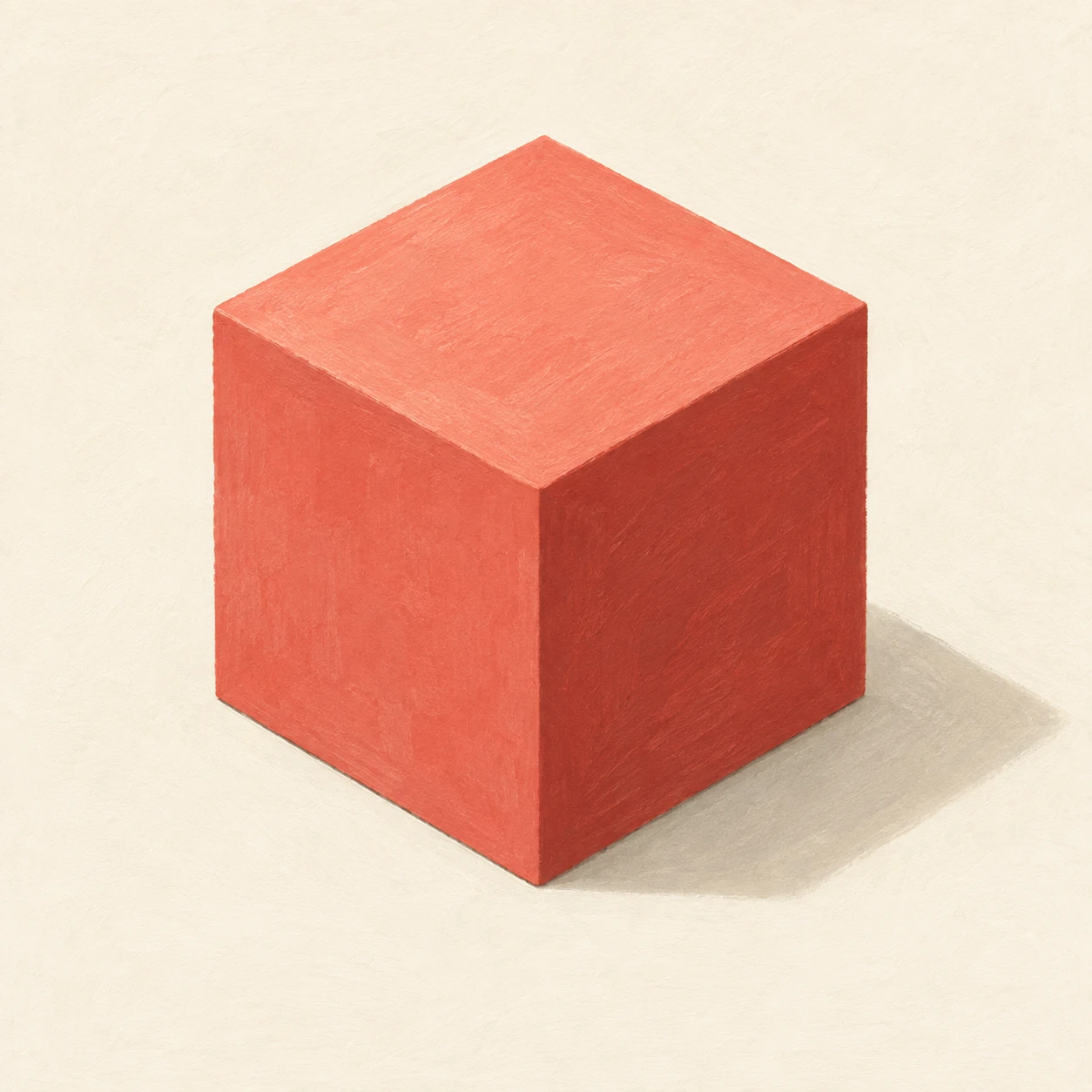
An illustration that makes a toy block’s solid structure clear through three consistent families of parallel edges.
One Toy Block · Consistent Isometric Projection
- Shape & line
- Construct the cube from three consistent edge directions: vertical, rising toward image-left, and rising toward image-right. Keep edges within each family parallel and opposing edges equal in apparent length, so the cube retains a stable isometric structure without convergence toward vanishing points.
- Color & light
- Use a muted coral base color with three flat value steps: the top is lightest, the image-left face is a middle value, and the image-right face is darkest. Suggest light from the upper image-left with a restrained ground shadow extending from the block’s base toward the lower image-right.
- Texture & material
- Render the block as matte painted wood using opaque gouache-like fills and faint, broad brush variation within each face. Keep the paint variation quieter than the differences between faces, and preserve crisp face boundaries so the surface treatment supports the geometric construction.
- Composition
- Center the block slightly above the canvas midpoint, leaving enough space below and to image-right for its complete cast shadow. Place it on a warm ivory ground without a horizon line, and keep the surrounding field uniform so all three edge directions remain easy to compare.
Priority
Prioritize consistent parallel edge families and clearly separated face values.
What to avoid & what to check
Avoid perspective convergence, rounded silhouettes, and gradients that obscure the three planar faces.
Check that each edge family stays parallel and the three visible faces meet cleanly at the front corner.
Exact prompt for this example
SUBJECT
Illustrate one solid, unmarked cubic toy block with its top, image-left face, and image-right face visible. All three faces belong to the same continuous cube and meet at one clearly readable front corner.

COMPOSITION
Use an elevated three-quarter isometric view, with the front vertical corner near the image center. Show the entire block on a plain ground with generous surrounding space; keep its top and both side faces clearly distinguishable.

STYLE GUIDE
1. Shape & line
Construct the cube from three consistent edge directions: vertical, rising toward image-left, and rising toward image-right. Keep edges within each family parallel and opposing edges equal in apparent length, so the cube retains a stable isometric structure without convergence toward vanishing points.

2. Color & light
Use a muted coral base color with three flat value steps: the top is lightest, the image-left face is a middle value, and the image-right face is darkest. Suggest light from the upper image-left with a restrained ground shadow extending from the block’s base toward the lower image-right.

3. Texture & material
Render the block as matte painted wood using opaque gouache-like fills and faint, broad brush variation within each face. Keep the paint variation quieter than the differences between faces, and preserve crisp face boundaries so the surface treatment supports the geometric construction.

4. Composition
Center the block slightly above the canvas midpoint, leaving enough space below and to image-right for its complete cast shadow. Place it on a warm ivory ground without a horizon line, and keep the surrounding field uniform so all three edge directions remain easy to compare.

PRIORITY
Preserve the requested identity, count, action, composition and output settings. Apply the style rules within those constraints; a style reference must not replace the subject or layout. Within the style: Prioritize consistent parallel edge families and clearly separated face values.

AVOID
Avoid perspective convergence, rounded silhouettes, and gradients that obscure the three planar faces.

OUTPUT
Create one square illustration. Include no lettering, numerals, captions, logos, or watermarks.

SELF-CHECK
Check that each edge family stays parallel and the three visible faces meet cleanly at the front corner.
Model information comes from image provenance. The same prompt may produce a different result.