Text to imageProductStyle guide
Canvas Slip-On · Layered Watercolor Glazes
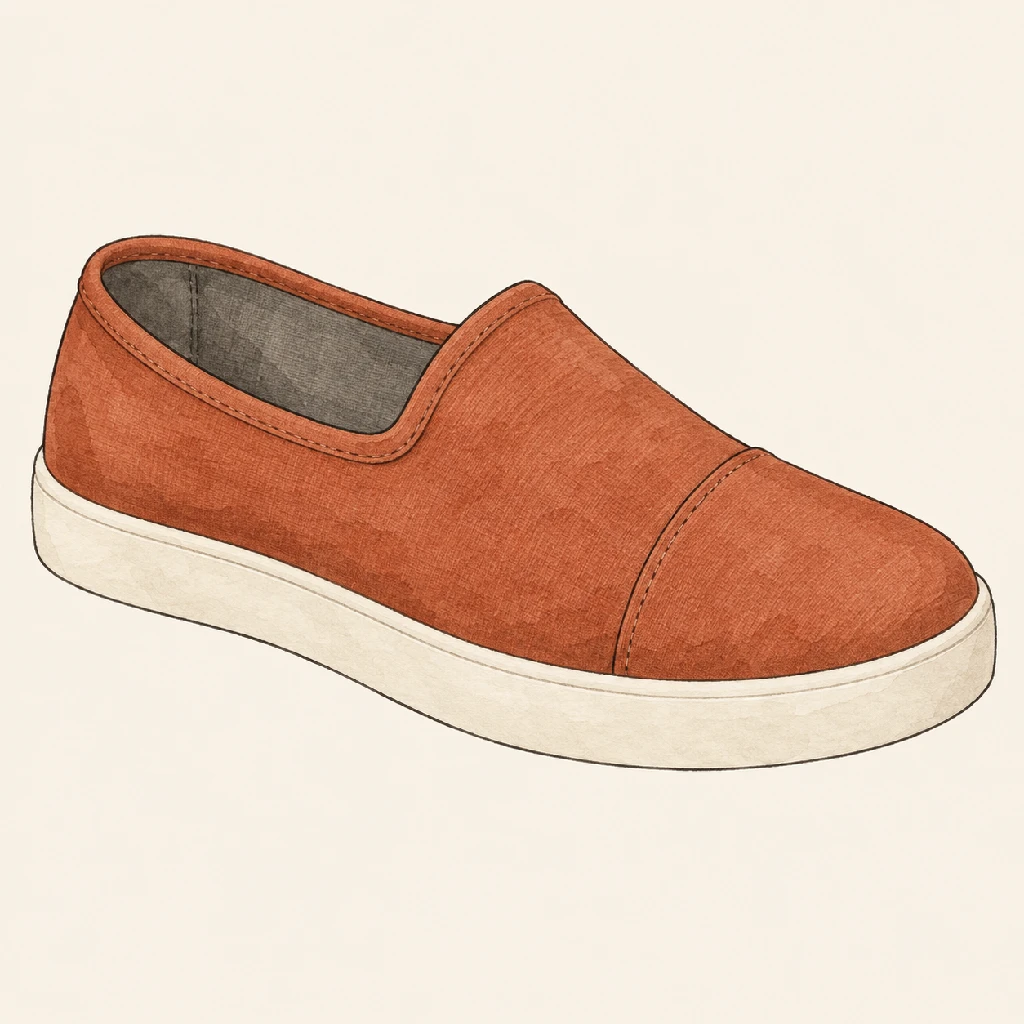
A slip-on product illustration exposing its rounded toe, open collar and rubber sole to demonstrate overlapping transparent watercolor layers.
Canvas Slip-On · Layered Watercolor Glazes
- Form language
- Use a simplified ink-and-watercolor illustration that retains complete silhouettes, openings and major construction divisions. Keep broad convex curves and genuine corners; omit incidental details below 1.5–2.5% of each connected form's longest bounding-box dimension. Avoid faceting continuous surfaces or adding decorative subdivisions.
- Contour
- Use ink contours with exterior widths of 0.25–0.45% and interior widths of 0.12–0.22% of the connected form's longest dimension. Keep continuous curved joins and round caps; taper exposed line ends to half their starting width over 2–4% of that dimension. Add no doubled outlines, heavy enclosing bands or fuzzy ink halos.
- Mark-making
- Use transparent watercolor on fine-grained paper. Each major enclosed surface receives one broad base wash and one inset overlapping glaze, using strokes 8–15% of its longest dimension. Wash strokes merge within each layer rather than forming repeated stripes. Openings and unfilled fields remain clean; add no splatter, hatching or opaque paint flecks.
- Surface rendering
- Use continuous, unquantized interpolation inside transparent washes. The inset glaze produces a visibly deeper overlapping region with a soft boundary 0.5–1.5% of its surface's longest dimension; interior transitions span 5–12%. Preserve paper grain through both layers without granular clumps. Exclude flat tone steps, wet blooms and opaque gradient overlays.
Priority
Make transparent layer overlap visible within continuous washes.
What to avoid & what to check
Avoid opaque paint patches, stepped tones and uncontrolled blooms.
Each major surface shows a base wash and a deeper inset glaze.
Exact prompt for this example
MODULE OWNERSHIP
subject: Subject count, type, stable proportions and landmarks, resting face geometry, hair shape, physical materials, garment construction and permanent marks. No emotion, movement, color assignment or rendering recipe.
expression: Facial soft-tissue displacement and pupil direction, muscle coordination, regional intensity, asymmetry and onset/peak/release. No head/body pose, stable appearance, skin color or rendering.
gesture: Head/neck/body/limb orientation, joint movement, support, contact and pose-caused occlusion using existing anatomy. No eye/pupil movement, emotion, identity, props inventory or camera.
props: Prop count, type, construction, physical material and scale relative to the subject. Holding/contact belongs to gesture, position to composition, color to palette.
scene: Environment elements, terrain, backdrop/floor presence and structural detail. No canvas positions, camera, lighting, assigned colors or render texture.
camera: Projection, focal-length impression, camera elevation/yaw/roll, viewing distance and crop. No actor pose, world placement, lighting or canvas aspect ratio.
composition: Normalized 0-100% canvas positions, scale in frame, depth/overlap, focal hierarchy and margins. No joint pose, camera projection, rendering, subject/prop inventory or emotion.
palette: Color anchors, hue/saturation/value ranges, colors assigned to parts and approximate color coverage. No illumination direction, shading algorithm, physical material or layout.
lighting: Light-source direction/softness/intensity, ambient illumination, physical shadow direction/length and highlight position. Absence of directional illumination is allowed. No shading technique, palette or material changes.
style: Reusable form abstraction, contour weight/taper/edge quality, medium and mark scale/density/direction, surface rendering and tonal transition technique. No fixed subject proportions, anatomy, identity, expression, pose, palette, light-source direction, camera or layout.
output: Image count, aspect ratio, size, file/alpha requirements and global lettering/logo/watermark restrictions. No background scenery, crop, style, identity or pose.

SUBJECT
inventory: Include exactly one canvas slip-on shoe, identified as the shoe. Its four distinguishing anchors are a rounded closed toe, continuous vamp, open heel collar and thick continuous outsole. Include no second shoe, laces or identifying marks.
geometry: Let L be heel-to-toe length. Width is 0.34–0.40L and maximum collar height above the outsole is 0.30–0.36L. The outsole is 0.08–0.12L thick. The collar opening extends 0.24–0.30L forward from the heel and is 0.18–0.24L wide; the toe ends in one broad convex cap without a pointed tip.
appearance: Use a woven canvas upper, a fabric-bound collar and one continuous rubber outsole. Include one transverse seam joining the toe cap to the vamp, 0.22–0.28L behind the toe toward the heel, where L is heel-to-toe length; all other upper surfaces are uninterrupted. The collar reveals a fabric lining. Fasteners, decorative patches and permanent marks are absent.

PRIORITY
Retain the open collar and continuous rounded shoe construction.

AVOID
Avoid laces, extra footwear and permanent decorative patches.

CHECK
One recognizable slip-on retains all four structural anchors.

GESTURE
head: The shoe has no head or neck and therefore no head-joint control targets. Do not assign head yaw, pitch or roll; its existing construction is oriented as one rigid object without articulated deformation.
torso: Define world +X as right, +Y as up and +Z as forward. The shoe's intrinsic +X runs heel to toe, +Y runs outsole to collar and +Z points outward from its broad outer side. Align these axes to the world at yaw, pitch and roll 0°±5°. There are no torso or pelvis joints.
limbs: No limb joints or finger groups exist on this product. Keep the upper, collar and outsole rigidly related, with no bending, twisting, compression or independently displaced component; limb articulation has no applicable target.
contact: Present the rigid product without physical support or contact. No surface bears its weight, and the outsole touches no floor or supporting object. No load-induced deformation or attached support is represented.

PRIORITY
Preserve one rigid orientation without support contact.

AVOID
Avoid articulated deformation and invented supporting contact.

CHECK
The complete product remains rigid and physically unsupported.

PROPS
inventory: The prop inventory is empty: include exactly zero accessories, tools, containers or other supplementary objects. The geometric motif requires no separate demonstration equipment.
construction: With zero props, there is no prop construction target. Do not introduce a backing plate, mounting hardware, supporting stand or attached component that would require additional construction.

PRIORITY
Keep the supplementary object inventory empty.

AVOID
Avoid mounting hardware and demonstration accessories.

CHECK
No separate accessory or support object is present.

SCENE
inventory: Include one plain illustrated backdrop field and no floor. Exclude buildings, terrain, furniture, vegetation, decorative motifs, lighting fixtures and environmental objects; the backdrop is the complete environment inventory.
structure: The backdrop is one uninterrupted plane without a horizon, architectural divisions, surface joints or repeated elements. It has no represented depth or structural relief and introduces no additional boundaries.

PRIORITY
Maintain one structurally uninterrupted backdrop.

AVOID
Avoid floor divisions and environmental decoration.

CHECK
The backdrop contains no horizon or structural subdivisions.

CAMERA
projection: Use orthographic projection with no focal-length perspective or depth-dependent size change. Preserve the product's relative dimensions while allowing geometric foreshortening from the specified viewpoint; include no lens distortion.
viewpoint: View from world +Z, moving 20°±5° toward +X and elevating 15°±5° above the world XZ plane. Aim at the product's geometric center with roll 0°±3° relative to world +Y. Viewing distance has no magnification effect in this projection.
crop: Show the complete product silhouette, including the heel, toe, collar rim and outsole. Retain the visible collar aperture and broad outer side without clipping their boundaries; permit intrinsic occlusion of the far side and internal lining.

PRIORITY
Expose the outer side, rounded toe and collar opening together.

AVOID
Avoid perspective distortion and clipped product extremities.

CHECK
The complete shoe and its visible collar aperture remain in view.

COMPOSITION
placement: Center the existing motif at (50%,50%), within ±5 percentage points, using top-left normalized coordinates. Its full visible span targets 80% of the shorter canvas side, allowed 70–90%; derive both bounds by uniform scaling of its existing proportions. The backdrop covers x=0–100%, y=0–100%.
depth: Use one borderless panel. The existing motif is the sole focal element over the backdrop. The collar aperture shows the existing lining; backdrop visibility is limited to genuine through-openings. Permit intrinsic self-occlusion but no independently placed obstruction or additional foreground layer.
spacing: Keep the complete visible motif inside x=5–95%, y=5–95%. Uniform-scale containment overrides nominal fill when proportions or center offsets cannot fit. Derive all margins from the resulting bounds; retain the single focal element without additional spacing targets.

PRIORITY
Prioritize complete containment over the nominal fill target.

AVOID
Avoid independent width and height scaling or decorative borders.

CHECK
The complete visible bounds remain inside the 5% inset on every edge.
The collar aperture reveals existing lining rather than backdrop.

PALETTE
colors: Use four anchors: canvas #B75E43, ivory #F4EBDD, lining #7B756C and dark ink #40372E. Permit continuous mixtures among these anchors for every tonal variation and boundary blend. Introduce no blue, green, violet or additional independent hue family.
assignment: Assign the upper, toe cap and collar binding to #B75E43; the outsole and backdrop to #F4EBDD; and all visible lining to #7B756C. Contours, seam marks and the deepest interior regions use #40372E. Unpainted reserves inherit the ivory anchor; all other variations use permitted mixtures.
balance: Coverage follows the actual assigned-region areas and totals 100%, with mixtures counted under their contributing roles. Preserve the four roles without separately colored trim, grain or accents; no fixed canvas occupancy is imposed on any color.

PRIORITY
Keep canvas, outsole, lining and ink roles distinguishable.

AVOID
Avoid independent accent colors and unassigned wash mixtures.

CHECK
Every painted region, reserve and contour inherits an anchor role.

LIGHTING
sources: Use deliberately unlit flat artwork with zero physical light sources. Illumination has no directional or depth variation; no key light, fill light or ambient intensity gradient is represented.
shadows: Directional cast shadows and contact shadows are absent. No region receives a physical shadow offset, reach or penumbra, and no detached shadow shape suggests elevation above a support surface.
highlights: Physical highlights are absent across the entire motif and backdrop. Include no specular point, reflective streak, rim illumination or luminous hotspot; no region gains brightness from a represented light source.

PRIORITY
Keep physical illumination uniformly absent.

AVOID
Avoid cast shadows, rim light and reflective hotspots.

CHECK
No directional shadow or physical highlight is visible.

STYLE GUIDE
form-language: Use a simplified ink-and-watercolor illustration that retains complete silhouettes, openings and major construction divisions. Keep broad convex curves and genuine corners; omit incidental details below 1.5–2.5% of each connected form's longest bounding-box dimension. Avoid faceting continuous surfaces or adding decorative subdivisions.
contour: Use ink contours with exterior widths of 0.25–0.45% and interior widths of 0.12–0.22% of the connected form's longest dimension. Keep continuous curved joins and round caps; taper exposed line ends to half their starting width over 2–4% of that dimension. Add no doubled outlines, heavy enclosing bands or fuzzy ink halos.
mark-making: Use transparent watercolor on fine-grained paper. Each major enclosed surface receives one broad base wash and one inset overlapping glaze, using strokes 8–15% of its longest dimension. Wash strokes merge within each layer rather than forming repeated stripes. Openings and unfilled fields remain clean; add no splatter, hatching or opaque paint flecks.
surface-rendering: Use continuous, unquantized interpolation inside transparent washes. The inset glaze produces a visibly deeper overlapping region with a soft boundary 0.5–1.5% of its surface's longest dimension; interior transitions span 5–12%. Preserve paper grain through both layers without granular clumps. Exclude flat tone steps, wet blooms and opaque gradient overlays.

PRIORITY
Make transparent layer overlap visible within continuous washes.

AVOID
Avoid opaque paint patches, stepped tones and uncontrolled blooms.

CHECK
Each major surface shows a base wash and a deeper inset glaze.

OUTPUT
format: Deliver exactly one raster image as a PNG file, 1024×1024 pixels with a 1:1 aspect ratio. Use an opaque image with no alpha channel or transparent pixels; provide no additional image variants.
restrictions: Include no lettering, dialogue, captions, sound-effect characters, logos, signatures or watermarks. Deliver the image without interface controls, metadata labels or an accompanying embedded reference sheet.

PRIORITY
Deliver one opaque PNG at the specified dimensions.

AVOID
Avoid embedded lettering and additional image variants.

CHECK
One 1024×1024 opaque PNG contains no lettering or watermark.

FINAL INTEGRATION
subject + gesture + camera: The heel-to-toe axis follows world +X. The elevated view from the outer side reveals the toe and collar opening while preserving the product's rigid, unsupported presentation.
palette + style: Use the permitted anchor mixtures for transparent base washes, deeper glaze overlaps and softened boundaries. Unpainted reserves retain the assigned ivory role, and ink contours retain the dark role.
lighting + style: Glaze overlap supplies illustrated tonal variation under the deliberately unlit treatment. It introduces no physical cast shadow, contact shadow or specular highlight.
Model information comes from image provenance. The same prompt may produce a different result.