Text to imageProductStyle guide
A Pocket Magnifier in Its Swivel Case
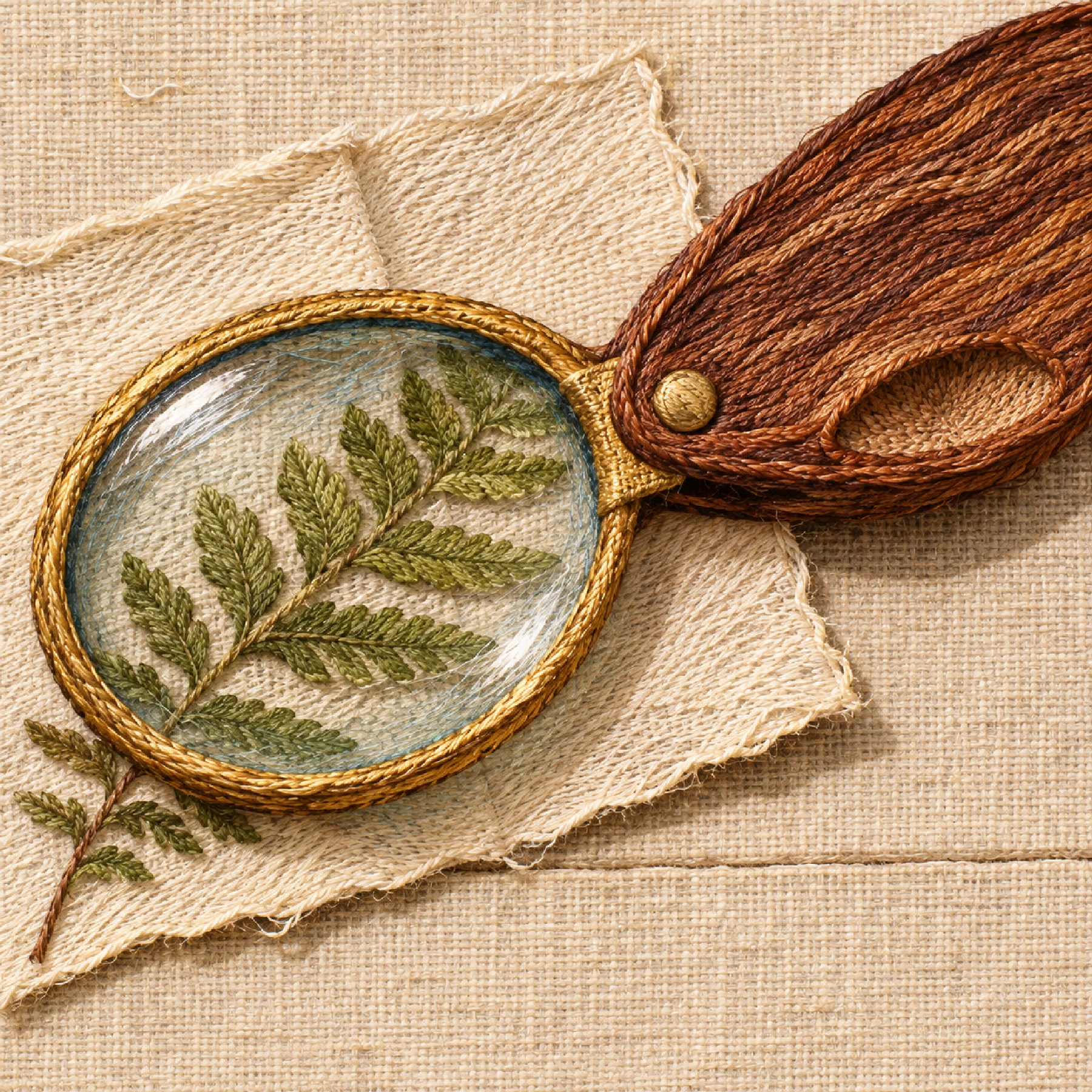
A magnifier opened from its walnut case enlarges a small fern fragment. Raised embroidery and open stitching distinguish metal, transparent glass and wood in an intimate product illustration.
Remix this referenceA Pocket Magnifier in Its Swivel Case
- Form language
- Translate forms into nested fabric-like islands with gently irregular boundaries; simplify tiny details while preserving useful structural breaks.
- Contour
- Build edges from couched cords that thicken at turns and loosen into occasional gaps, with natural variation in their paths.
- Mark-making
- Use raised satin stitches for compact planes, wandering long stitches for grain and sparse open stitches for transparent passages.
- Surface rendering
- Create tonal transitions by interleaving thread shades and changing stitch density; retain visible overlaps, loose ends and exposed ground.
Priority
Make tactile embroidery and raised thread relief the defining medium.
What to avoid & what to check
Exact prompt for this example
MODULE OWNERSHIP
subject: Subject count, type, stable proportions and landmarks, resting face geometry, hair shape, physical materials, garment construction and permanent marks. No emotion, movement, color assignment or rendering recipe.
expression: Facial soft-tissue displacement and pupil direction, muscle coordination, regional intensity, asymmetry and onset/peak/release. No head/body pose, stable appearance, skin color or rendering.
gesture: Head/neck/body/limb orientation, joint movement, support, contact and pose-caused occlusion using existing anatomy. No eye/pupil movement, emotion, identity, props inventory or camera.
props: Prop count, type, construction, physical material and scale relative to the subject. Holding/contact belongs to gesture, position to composition, color to palette.
scene: Environment elements, terrain, backdrop/floor presence and structural detail. No canvas positions, camera, lighting, assigned colors or render texture.
camera: Projection, focal-length impression, camera elevation/yaw/roll, viewing distance and crop. No actor pose, world placement, lighting or canvas aspect ratio.
composition: Normalized 0-100% canvas positions, scale in frame, depth/overlap, focal hierarchy and margins. No joint pose, camera projection, rendering, subject/prop inventory or emotion.
palette: Color anchors, hue/saturation/value ranges, colors assigned to parts and approximate color coverage. No illumination direction, shading algorithm, physical material or layout.
lighting: Light-source direction/softness/intensity, ambient illumination, physical shadow direction/length and highlight position. Absence of directional illumination is allowed. No shading technique, palette or material changes.
style: Reusable form abstraction, contour weight/taper/edge quality, medium and mark scale/density/direction, surface rendering and tonal transition technique. No fixed subject proportions, anatomy, identity, expression, pose, palette, light-source direction, camera or layout.
output: Image count, aspect ratio, size, file/alpha requirements and global lettering/logo/watermark restrictions. No background scenery, crop, style, identity or pose.

SUBJECT
inventory: One original folding pocket magnifier with an integral protective swivel case.
geometry: An oval lens pivots from a teardrop sleeve; an exposed hinge joins the nesting outlines.
resting-face: No face or facial landmarks.
appearance: A brass rim holds optical glass; the carved walnut sleeve has a shallow thumb recess and a flush pivot pin.

PRIORITY


AVOID


CHECK


PROPS
inventory: One folded paper slip larger than the lens and one dried fern fragment small enough to fit beneath its aperture.
construction: The paper has a soft crease and deckled edge; the fern retains its thin stem and papery leaflets.

PRIORITY


AVOID


CHECK


SCENE
inventory: A plain worktable surface forms the entire setting, with no visible wall or horizon.
structure: A shallow board joint is the only environmental structural detail.

PRIORITY


AVOID


CHECK


CAMERA
projection: Use restrained perspective with a short telephoto macro impression.
viewpoint: Look obliquely downward from close range, with no camera roll.
crop: Use an intimate detail crop that preserves the complete lens and hinge while trimming the sleeve's far tip.

PRIORITY


AVOID


CHECK


COMPOSITION
placement: Set the lens left of center and let the open sleeve extend diagonally toward the upper-right edge.
depth: The lens overlaps the fern and folded paper; a slightly enlarged leaf segment continues visibly through the glass.
spacing: Make the lens aperture the primary focus, the hinge secondary; leave quiet table space along the lower edge.

PRIORITY


AVOID


CHECK


PALETTE
colors: Use linen ivory, chestnut brown, antique gold and deep petrol, with a restrained moss-green accent.
assignment: Assign ivory to table and paper, chestnut to the sleeve, gold to the rim, petrol to glass edges and moss to the fern.
balance: Keep ivory dominant, brown substantial and the gold, petrol and green areas comparatively small.

PRIORITY


AVOID


CHECK


LIGHTING
sources: A broad soft source grazes the surface from the upper left, supported by gentle ambient fill.
shadows: Short, soft shadows fall toward the lower right beneath the product and raised thread relief.
highlights: A narrow highlight follows the upper-left rim, with a softer glint along the glass edge.

PRIORITY


AVOID


CHECK


STYLE GUIDE
form-language: Translate forms into nested fabric-like islands with gently irregular boundaries; simplify tiny details while preserving useful structural breaks.
contour: Build edges from couched cords that thicken at turns and loosen into occasional gaps, with natural variation in their paths.
mark-making: Use raised satin stitches for compact planes, wandering long stitches for grain and sparse open stitches for transparent passages.
surface-rendering: Create tonal transitions by interleaving thread shades and changing stitch density; retain visible overlaps, loose ends and exposed ground.

PRIORITY
Make tactile embroidery and raised thread relief the defining medium.

AVOID


CHECK


OUTPUT
format: One finished image, square 1:1, 1800 × 1800 pixels, opaque PNG; no lettering, logos or watermarks.
restrictions: Deliver one square 1:1 image at 1800 × 1800 pixels as an opaque PNG, without lettering, logos or watermarks.

PRIORITY


AVOID


CHECK


FINAL INTEGRATION
subject + style: The textile translation should preserve the product's understandable construction while allowing handmade irregularity.
Model information comes from image provenance. The same prompt may produce a different result.