Text to imageArt stylesStyle guide
Stretching a Sail in the Loft
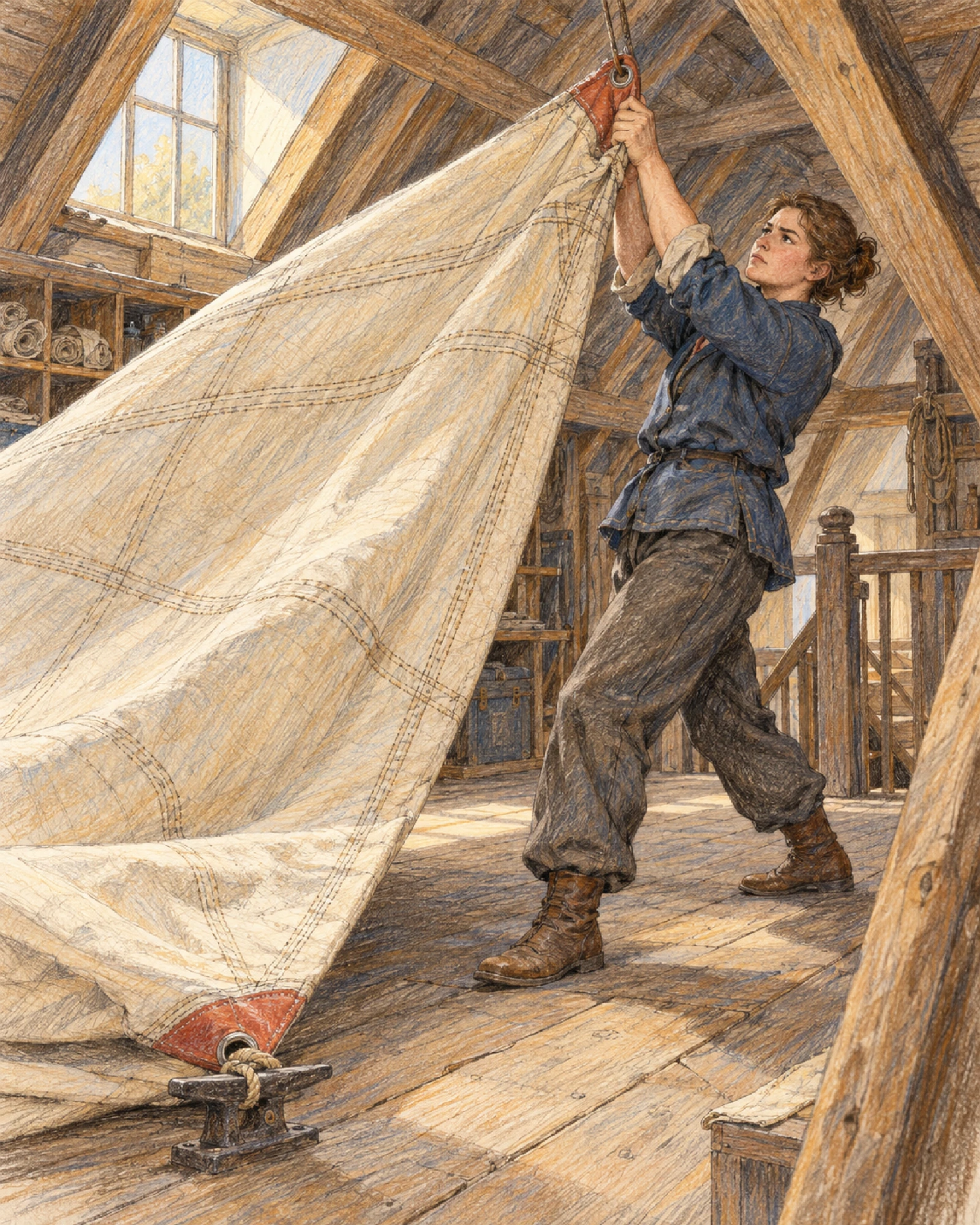
A sailmaker pulls a great sail corner upward. Rough pencil lines and scumbled colored pencil connect the sweeping cloth with the layered spaces of an attic workshop.
Remix this referenceStretching a Sail in the Loft
- Form language
- Reduce volumes to pliant wedges, bowed planes and blunt blocks; let incidental shapes vary within this loose construction.
- Contour
- Use searching graphite contours with doubled passages, broken edges and pressure-darkened turns; retain lighter exploratory lines.
- Mark-making
- Combine broad colored-pencil side strokes with wiry tip hatching; vary length and pressure as marks bend around local forms.
- Surface rendering
- Build tone through overlapping dry strokes and open paper gaps; let dark passages knot together and pale passages dissolve into rubbed edges.
Priority
Keep the rough pencil and colored-pencil sketchbook process visibly present in the finished drawing.
What to avoid & what to check
Exact prompt for this example
MODULE OWNERSHIP
subject: Subject count, type, stable proportions and landmarks, resting face geometry, hair shape, physical materials, garment construction and permanent marks. No emotion, movement, color assignment or rendering recipe.
expression: Facial soft-tissue displacement and pupil direction, muscle coordination, regional intensity, asymmetry and onset/peak/release. No head/body pose, stable appearance, skin color or rendering.
gesture: Head/neck/body/limb orientation, joint movement, support, contact and pose-caused occlusion using existing anatomy. No eye/pupil movement, emotion, identity, props inventory or camera.
props: Prop count, type, construction, physical material and scale relative to the subject. Holding/contact belongs to gesture, position to composition, color to palette.
scene: Environment elements, terrain, backdrop/floor presence and structural detail. No canvas positions, camera, lighting, assigned colors or render texture.
camera: Projection, focal-length impression, camera elevation/yaw/roll, viewing distance and crop. No actor pose, world placement, lighting or canvas aspect ratio.
composition: Normalized 0-100% canvas positions, scale in frame, depth/overlap, focal hierarchy and margins. No joint pose, camera projection, rendering, subject/prop inventory or emotion.
palette: Color anchors, hue/saturation/value ranges, colors assigned to parts and approximate color coverage. No illumination direction, shading algorithm, physical material or layout.
lighting: Light-source direction/softness/intensity, ambient illumination, physical shadow direction/length and highlight position. Absence of directional illumination is allowed. No shading technique, palette or material changes.
style: Reusable form abstraction, contour weight/taper/edge quality, medium and mark scale/density/direction, surface rendering and tonal transition technique. No fixed subject proportions, anatomy, identity, expression, pose, palette, light-source direction, camera or layout.
output: Image count, aspect ratio, size, file/alpha requirements and global lettering/logo/watermark restrictions. No background scenery, crop, style, identity or pose.

SUBJECT
inventory: One adult woman sailmaker, actor A.
geometry: Compact adult build with broad shoulders, substantial hands and an ordinary human silhouette.
resting-face: Broad forehead, straight nose bridge, blunt chin and a short, level mouth at rest.
appearance: Hair in a short tied bundle; a broad-collared canvas work jacket, loose trousers and leather ankle boots.

PRIORITY


AVOID


CHECK


EXPRESSION — ACTOR A
brows: Draw the inner brows slightly together without a deep furrow.
lids: Narrow the lids slightly, with mild tension in the lower lids.
cheeks: Keep the cheeks nearly at rest, with slight tension beside the mouth.
nose: Keep the nostrils relaxed and the nose unwrinkled.
mouth: Press the lips lightly together, with one corner a little tighter.
jaw: Keep the jaw closed with gentle tension rather than a hard clench.
gaze: Direct the pupils toward the reinforced sail corner between the hands.
coordination: Let brow and lid tension carry the effort while the lower face stays restrained.
timing: Hold a quiet apex of concentration, with no developing smile or wince.

PRIORITY


AVOID


CHECK


GESTURE
head: Lift the chin toward the raised hands and turn enough to reveal a readable three-quarter face.
torso: Lean the torso back in a gentle countercurve against the pull of the sail.
limbs: Raise both arms above shoulder height; bend the forward knee and brace the rear leg with both feet planted.
contact: Both hands grip one reinforced corner; another corner catches on the floor cleat as the sail lifts in a broad fold.

PRIORITY


AVOID


CHECK


PROPS
inventory: One triangular sail, considerably wider than A's outstretched arms.
construction: Heavy woven flax cloth with stitched reinforcing bands, thick corner patches and metal eyelets.

PRIORITY


AVOID


CHECK


SCENE
inventory: An attic sailmaking workshop with exposed rafters, a dormer window, built-in cubbies and an open stairwell.
structure: Uneven timber floorboards meet a low stair balustrade; a fixed floor cleat anchors the work area beneath the pitched roof.

PRIORITY


AVOID


CHECK


CAMERA
projection: Moderate wide-angle perspective with gently enlarged near forms and credible architectural recession.
viewpoint: Waist-height viewpoint, looking obliquely into the loft with a slight upward pitch and no roll.
crop: A room-wide view includes the complete figure; the sail and nearby architecture may continue beyond the edges.

PRIORITY


AVOID


CHECK


COMPOSITION
placement: Set A in the right third at about half the image height; the sail sweeps from lower left toward upper center.
depth: A cropped near beam overlaps the sail edge; the figure occupies middle depth, with stairs and roof bays receding behind.
spacing: Make the joined hands and lifted corner the first read, then the sweeping fold; leave a generous opening above the sail.

PRIORITY


AVOID


CHECK


PALETTE
colors: Warm paper ivory, straw ochre, muted indigo, graphite gray and a small vermilion accent.
assignment: Ivory sail, ochre timber, indigo jacket, graphite trousers and boots; warm ochre skin and vermilion corner patches.
balance: Let pale neutrals dominate, with restrained indigo weight and brief vermilion interruptions.

PRIORITY


AVOID


CHECK


LIGHTING
sources: Broad, soft daylight enters from the upper left through the dormer, with subdued ambient fill throughout the loft.
shadows: Soft shadows extend rightward across the floor; deeper shade gathers beneath the sail fold and roof beams.
highlights: Broad highlights follow the window-facing sail ridge and the upper edges of the hands.

PRIORITY


AVOID


CHECK


STYLE GUIDE
form-language: Reduce volumes to pliant wedges, bowed planes and blunt blocks; let incidental shapes vary within this loose construction.
contour: Use searching graphite contours with doubled passages, broken edges and pressure-darkened turns; retain lighter exploratory lines.
mark-making: Combine broad colored-pencil side strokes with wiry tip hatching; vary length and pressure as marks bend around local forms.
surface-rendering: Build tone through overlapping dry strokes and open paper gaps; let dark passages knot together and pale passages dissolve into rubbed edges.

PRIORITY
Keep the rough pencil and colored-pencil sketchbook process visibly present in the finished drawing.

AVOID


CHECK


OUTPUT
format: One finished image, 4:5 portrait, 1600 × 2000 pixels, opaque PNG.
restrictions: No lettering, logos or watermarks.

PRIORITY


AVOID


CHECK
Model information comes from image provenance. The same prompt may produce a different result.