Text to imageAnimationStyle guide
A Mural Fragment in Her Palm
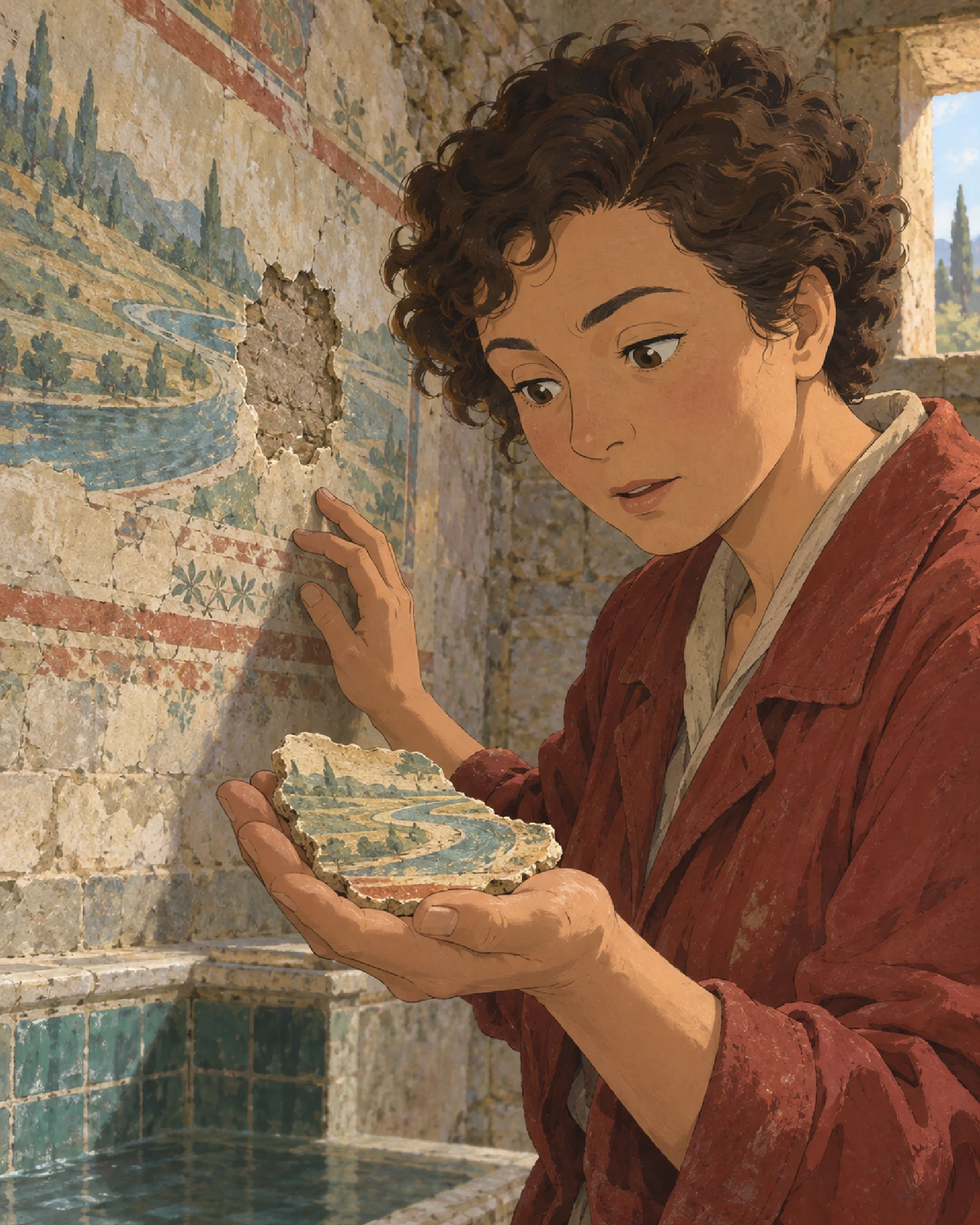
A mural conservator catches a fallen plaster fragment in an old bathhouse. An intimate painted scene connects the little river in her palm with the gap it left behind.
Remix this referenceA Mural Fragment in Her Palm
- Form language
- Build broad interlocking painted planes first; simplify small forms into selective patches while allowing coherent local variation.
- Contour
- Alternate firm and softened paint boundaries, with occasional lost edges and only brief tapered contour accents.
- Mark-making
- Overlap medium-width brush traces along each plane; use sparse broken dry-brush strokes with naturally varied pressure.
- Surface rendering
- Let shallow paper-and-pigment grain show through uneven opaque layers, blending tonal passages without polishing away brush variation.
Priority
Rendering medium: 2D hand-painted animated-film background illustration; formal rendering reference: Studio Ghibli · 2020s · The Boy and the Heron (2023), background art
What to avoid & what to check
Exact prompt for this example
MODULE OWNERSHIP
subject: Subject count, type, stable proportions and landmarks, resting face geometry, hair shape, physical materials, garment construction and permanent marks. No emotion, movement, color assignment or rendering recipe.
expression: Facial soft-tissue displacement and pupil direction, muscle coordination, regional intensity, asymmetry and onset/peak/release. No head/body pose, stable appearance, skin color or rendering.
gesture: Head/neck/body/limb orientation, joint movement, support, contact and pose-caused occlusion using existing anatomy. No eye/pupil movement, emotion, identity, props inventory or camera.
props: Prop count, type, construction, physical material and scale relative to the subject. Holding/contact belongs to gesture, position to composition, color to palette.
scene: Environment elements, terrain, backdrop/floor presence and structural detail. No canvas positions, camera, lighting, assigned colors or render texture.
camera: Projection, focal-length impression, camera elevation/yaw/roll, viewing distance and crop. No actor pose, world placement, lighting or canvas aspect ratio.
composition: Normalized 0-100% canvas positions, scale in frame, depth/overlap, focal hierarchy and margins. No joint pose, camera projection, rendering, subject/prop inventory or emotion.
palette: Color anchors, hue/saturation/value ranges, colors assigned to parts and approximate color coverage. No illumination direction, shading algorithm, physical material or layout.
lighting: Light-source direction/softness/intensity, ambient illumination, physical shadow direction/length and highlight position. Absence of directional illumination is allowed. No shading technique, palette or material changes.
style: Reusable form abstraction, contour weight/taper/edge quality, medium and mark scale/density/direction, surface rendering and tonal transition technique. No fixed subject proportions, anatomy, identity, expression, pose, palette, light-source direction, camera or layout.
output: Image count, aspect ratio, size, file/alpha requirements and global lettering/logo/watermark restrictions. No background scenery, crop, style, identity or pose.

SUBJECT
inventory: One middle-aged human mural conservator, actor A.
geometry: An elongated oval face, broad cheekbones, a substantial nose and sturdy hands with square fingertips.
resting-face: Straight brows, deep-set eyes, a broad upper lip and a softly rounded chin define her resting features.
appearance: Short clustered curls and a woven cotton work jacket with a turned collar and roomy sleeves; no permanent marks.

PRIORITY


AVOID


CHECK


EXPRESSION — ACTOR A
brows: Both brows lift slightly, with the nearer brow leading.
lids: Upper lids open a little; lower lids remain relaxed.
cheeks: Cheeks stay loose without a smile-driven lift.
nose: Nostrils remain relaxed, with no wrinkling at the bridge.
mouth: Lips part narrowly; the corners remain almost level.
jaw: The jaw releases just enough to separate the lips.
gaze: Both pupils turn down toward the river fragment.
coordination: The questioning brow and opening lids lead a quieter mouth response.
timing: Catch the onset of recognition, before the expression becomes a smile.

PRIORITY


AVOID


CHECK


GESTURE
head: Her neck bends gently forward and her chin lowers toward the cupped hand.
torso: Her upper body turns away from the wall while remaining slightly inclined toward it.
limbs: One elbow folds to bring the open palm beneath her face; the other arm remains loosely raised toward the wall.
contact: The fragment rests across the cupped palm; the raised fingertips hover clear of the damaged plaster.

PRIORITY


AVOID


CHECK


PROPS
inventory: One fallen mural fragment, roughly the length of her palm.
construction: A shallow curved lime-plaster flake with a broken rim and a painted river bend continuing across its face.

PRIORITY


AVOID


CHECK


SCENE
inventory: An old bathhouse interior with a river mural, a deep window reveal and the upper edge of a tiled basin.
structure: A fresh irregular loss interrupts the mural's river bend; older plaster losses expose the masonry beneath.

PRIORITY


AVOID


CHECK


CAMERA
projection: Natural perspective with a normal-to-short-telephoto focal-length impression.
viewpoint: A close three-quarter view from face height, pitched gently downward to reveal the palm.
crop: An intimate crop through the crown, upper arms and lower forearms, retaining the full face and palm.

PRIORITY


AVOID


CHECK


COMPOSITION
placement: The face occupies the right half; the palm and fragment sit below center, opposite the mural's missing patch.
depth: The palm overlaps the jacket in the foreground; the wall recedes behind, with its gap clearly separated from the hand.
spacing: The fragment leads, then the face, then the wall gap; an open interval links the two broken river sections.

PRIORITY


AVOID


CHECK


PALETTE
colors: Chalk ivory, weathered blue-green, muted brick red and warm umber, with restrained saturation.
assignment: Ivory plaster, blue-green river and basin tiles, brick-red jacket, warm brown skin and umber hair.
balance: Pale mineral tones dominate; the jacket supplies the broad warm accent and the river a smaller cool accent.

PRIORITY


AVOID


CHECK


LIGHTING
sources: Broad soft daylight enters from the upper left, supported by gentle ambient room light.
shadows: Soft shadows fall down and right; the fragment casts a short contact shadow across the palm.
highlights: Broad highlights touch the upper cheek, fingertips and the fragment's exposed rim.

PRIORITY


AVOID


CHECK


STYLE GUIDE
form-language: Build broad interlocking painted planes first; simplify small forms into selective patches while allowing coherent local variation.
contour: Alternate firm and softened paint boundaries, with occasional lost edges and only brief tapered contour accents.
mark-making: Overlap medium-width brush traces along each plane; use sparse broken dry-brush strokes with naturally varied pressure.
surface-rendering: Let shallow paper-and-pigment grain show through uneven opaque layers, blending tonal passages without polishing away brush variation.

PRIORITY
Rendering medium: 2D hand-painted animated-film background illustration; formal rendering reference: Studio Ghibli · 2020s · The Boy and the Heron (2023), background art

AVOID


CHECK


OUTPUT
format: One finished image, portrait 4:5, 1600 × 2000 pixels, opaque PNG.
restrictions: No lettering, captions, logos or watermarks.

PRIORITY


AVOID


CHECK


FINAL INTEGRATION
props + scene + composition: Make the painted river legible across the separated surfaces so their relationship carries the small narrative.
expression + gesture + style: Preserve the readable pause in the performance while allowing the painted edges to remain lively.
Art direction
스튜디오 지브리 / Studio Ghibli · 2020s · 그대들은 어떻게 살 것인가(2023)의 배경 미술 / The Boy and the Heron (2023), background art ↗- Establish broad form planes before describing smaller surface variations with painted patches
- Use hard and soft painted boundaries rather than strong continuous outlines
- Overlapping brush traces following the plane direction with sparse dry-brush marks
- Shallow paper-and-pigment texture, uneven painted planes and blended tonal transitions
Model information comes from image provenance. The same prompt may produce a different result.