Text to imageArt stylesStyle guide
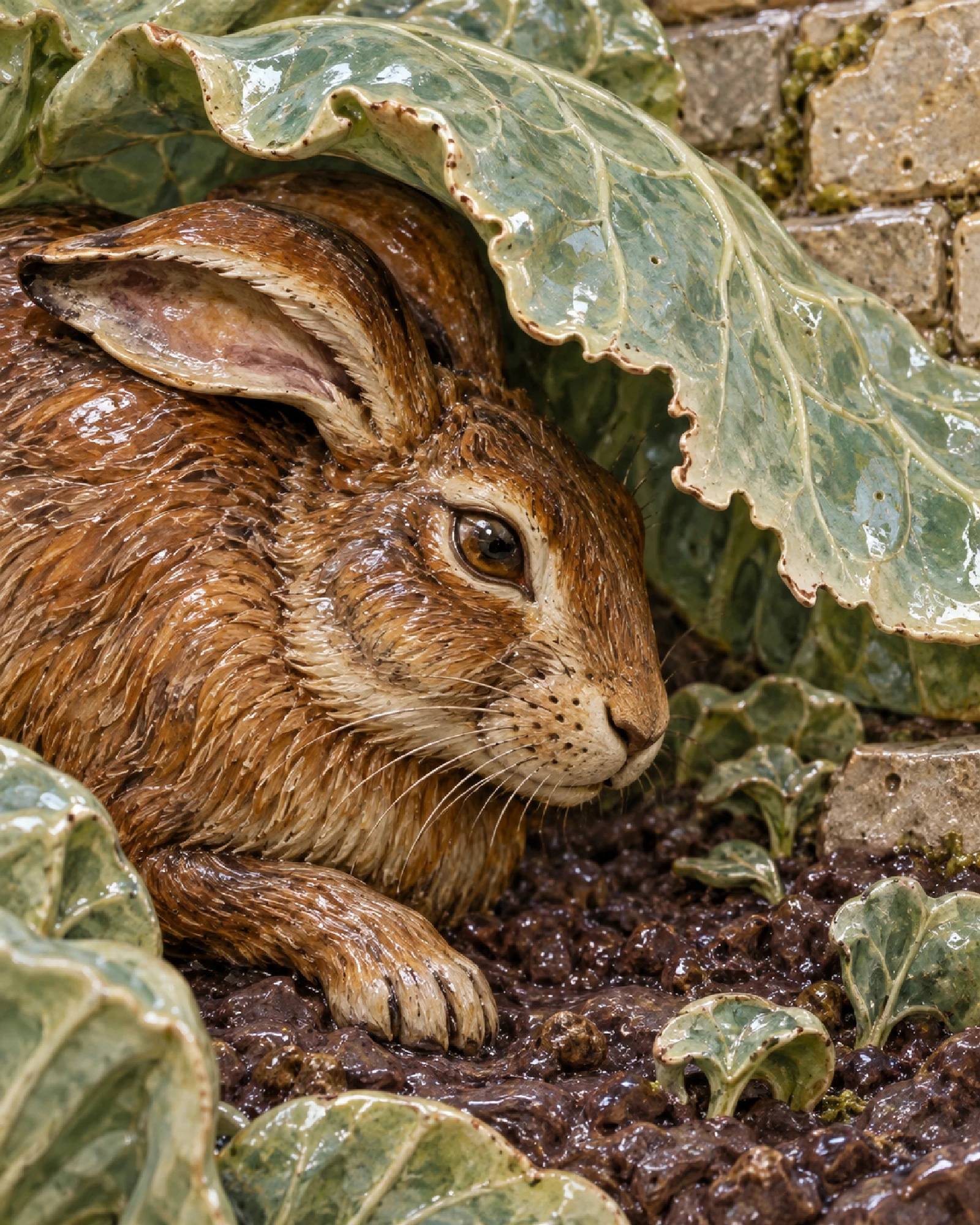
Hare Beneath a Cabbage Leaf
An intimate ceramic relief illustration of a hare lowering its head beneath a torn cabbage leaf. Swelling forms and glaze pooled in recesses give this small garden shelter a rich tactile presence.
Remix this referenceHare Beneath a Cabbage Leaf
- Form language
- Translate forms into shallow ceramic relief: rounded swelling planes, compressed recesses and gently rolled rims.
- Contour
- Let modeled edges carry the contour, broad on outer rims and thinner at incisions, with softly irregular hand-shaped joins.
- Mark-making
- Use sparse curved incisions and short pressed strokes that follow local form; vary pressure and spacing naturally.
- Surface rendering
- Model glaze as translucent pooling in recesses and milkier coats on raised planes, with uneven glossy transitions and occasional pinholes.
Priority
Make the modeled glaze and shallow ceramic relief visibly define the illustration.
What to avoid & what to check
Exact prompt for this example
MODULE OWNERSHIP
subject: Subject count, type, stable proportions and landmarks, resting face geometry, hair shape, physical materials, garment construction and permanent marks. No emotion, movement, color assignment or rendering recipe.
expression: Facial soft-tissue displacement and pupil direction, muscle coordination, regional intensity, asymmetry and onset/peak/release. No head/body pose, stable appearance, skin color or rendering.
gesture: Head/neck/body/limb orientation, joint movement, support, contact and pose-caused occlusion using existing anatomy. No eye/pupil movement, emotion, identity, props inventory or camera.
props: Prop count, type, construction, physical material and scale relative to the subject. Holding/contact belongs to gesture, position to composition, color to palette.
scene: Environment elements, terrain, backdrop/floor presence and structural detail. No canvas positions, camera, lighting, assigned colors or render texture.
camera: Projection, focal-length impression, camera elevation/yaw/roll, viewing distance and crop. No actor pose, world placement, lighting or canvas aspect ratio.
composition: Normalized 0-100% canvas positions, scale in frame, depth/overlap, focal hierarchy and margins. No joint pose, camera projection, rendering, subject/prop inventory or emotion.
palette: Color anchors, hue/saturation/value ranges, colors assigned to parts and approximate color coverage. No illumination direction, shading algorithm, physical material or layout.
lighting: Light-source direction/softness/intensity, ambient illumination, physical shadow direction/length and highlight position. Absence of directional illumination is allowed. No shading technique, palette or material changes.
style: Reusable form abstraction, contour weight/taper/edge quality, medium and mark scale/density/direction, surface rendering and tonal transition technique. No fixed subject proportions, anatomy, identity, expression, pose, palette, light-source direction, camera or layout.
output: Image count, aspect ratio, size, file/alpha requirements and global lettering/logo/watermark restrictions. No background scenery, crop, style, identity or pose.

SUBJECT
inventory: One adult wild hare, actor A; retain an animal's anatomy without clothing or accessories.
geometry: Recognizable hare construction: long tapered ears, a narrow muzzle, deep shoulders and slender forepaws.
resting-face: Lateral almond-shaped eyes, a small divided upper lip and compact nose define the resting face.
appearance: Short dense fur, longer cheek whiskers and fine inner-ear hair; individual fur details may vary naturally.

PRIORITY


AVOID


CHECK


EXPRESSION — ACTOR A
brows: No distinct brow displacement is visible.
lids: The visible eyelids remain softly open, without a pronounced squint.
cheeks: Cheek tissue stays relaxed, without a lifted smile shape.
nose: The nose remains unwrinkled, with no exaggerated nostril flare.
mouth: Lips meet gently without corner pulling.
jaw: The jaw rests closed without visible tension.
gaze: The visible pupil points toward the torn leaf edge.
coordination: Keep the eye attention subtle and the lower face quiet.
timing: Capture the held resting instant at the expression's apex.

PRIORITY


AVOID


CHECK


GESTURE
head: A lowers its head beneath the leaf; one ear folds backward while the other remains partly raised.
torso: The shoulders settle into a compact crouch with the neck gently extended.
limbs: The visible forepaw bends beneath the chest and supports the crouch; unseen limbs need no prescription.
contact: The forepaw rests on the garden soil; the folded ear lightly touches the leaf's underside.

PRIORITY


AVOID


CHECK


PROPS
inventory: No separate props.
construction: No prop construction applies.

PRIORITY


AVOID


CHECK


SCENE
inventory: A damp kitchen garden with rooted cabbage foliage, exposed soil and an old masonry terrace wall.
structure: A broad leaf has a torn opening and curled rim; shallow soil hollows and uneven wall joints suggest age.

PRIORITY


AVOID


CHECK


CAMERA
projection: Use restrained perspective with a short-telephoto impression and little near-to-far exaggeration.
viewpoint: Look from hare-eye height in a shallow three-quarter view, with no camera roll.
crop: An intimate close crop includes the head, shoulder and one forepaw, cutting through foliage and the torso.

PRIORITY


AVOID


CHECK


COMPOSITION
placement: The face anchors the lower-left area; the sweeping leaf occupies the upper-right, with a narrow wall passage beyond.
depth: The leaf overlaps the ear while leaving the eye clear; face first, leaf rim second, wall last.
spacing: Leave a small breathing pocket between muzzle and torn edge; let broad foliage run beyond the frame.

PRIORITY


AVOID


CHECK


PALETTE
colors: Use warm chestnut, pale celadon, muted aubergine and oatmeal, with a small near-black accent.
assignment: Chestnut belongs to the hare, celadon to leaves, aubergine to soil, oatmeal to masonry and near-black to the eye.
balance: Chestnut and celadon dominate; quieter low-saturation surroundings support their warm-cool exchange.

PRIORITY


AVOID


CHECK


LIGHTING
sources: Broad soft daylight arrives from the upper left, with gentle ambient fill beneath the leaf.
shadows: The leaf casts a soft shadow across the shoulder; smaller relief shadows fall toward the lower right.
highlights: Highlights gather along the upper-left leaf rim, ear ridge and cheek crest, remaining broad and restrained.

PRIORITY


AVOID


CHECK


STYLE GUIDE
form-language: Translate forms into shallow ceramic relief: rounded swelling planes, compressed recesses and gently rolled rims.
contour: Let modeled edges carry the contour, broad on outer rims and thinner at incisions, with softly irregular hand-shaped joins.
mark-making: Use sparse curved incisions and short pressed strokes that follow local form; vary pressure and spacing naturally.
surface-rendering: Model glaze as translucent pooling in recesses and milkier coats on raised planes, with uneven glossy transitions and occasional pinholes.

PRIORITY
Make the modeled glaze and shallow ceramic relief visibly define the illustration.

AVOID


CHECK


OUTPUT
format: One finished image, portrait 4:5 aspect ratio, 1600 × 2000 pixels, opaque PNG.
restrictions: No lettering, logos or watermarks.

PRIORITY


AVOID


CHECK


FINAL INTEGRATION
style + lighting: Let illumination reveal the modeled surface without replacing the glaze treatment with photographic realism.
gesture + composition: Keep the sheltering contact readable within the close overlapping arrangement.
Model information comes from image provenance. The same prompt may produce a different result.