Text to imageIllustrationStyle guide
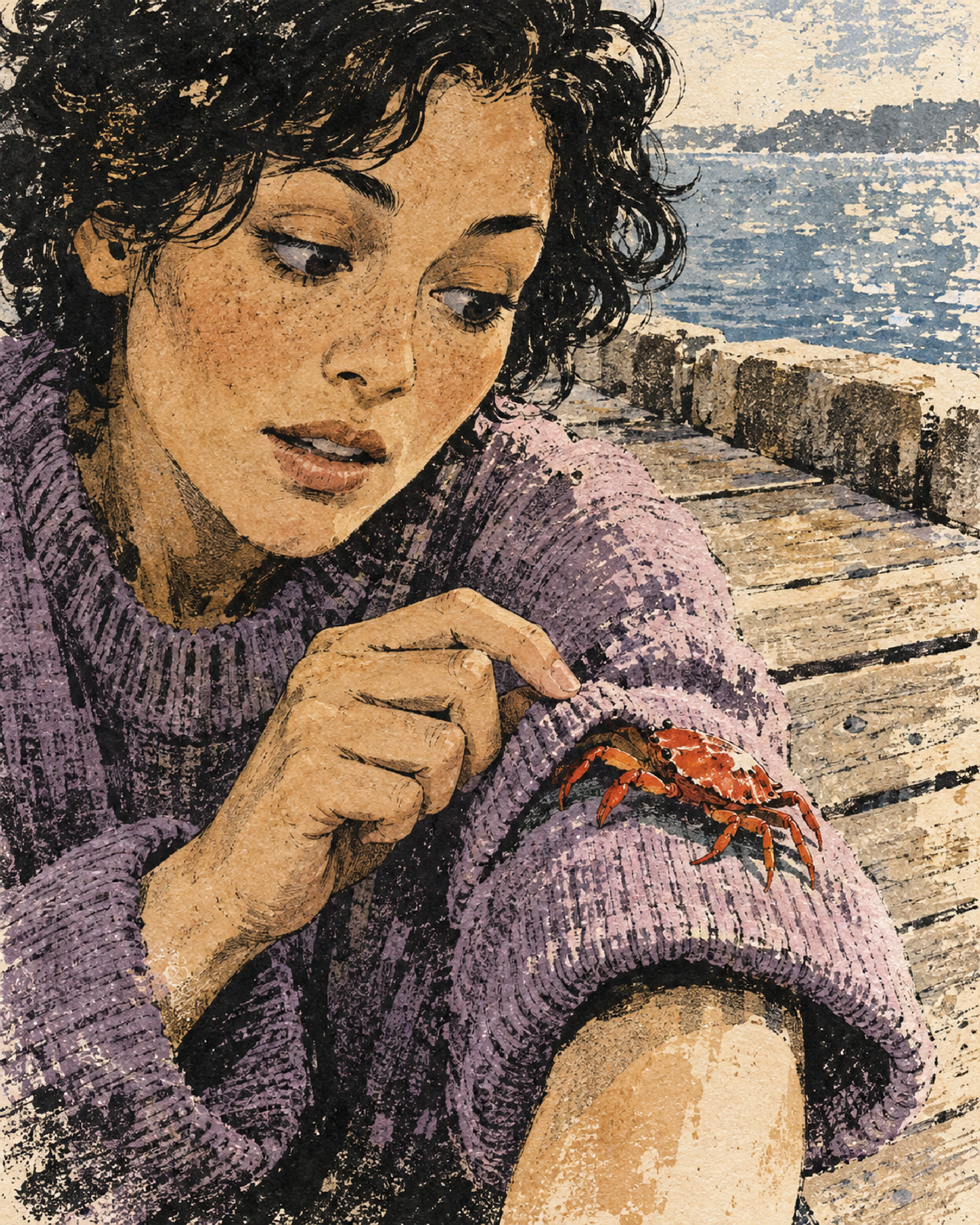
Crab in Her Cuff
A tightly cropped woman discovers a small crab inside her folded cuff. Ragged brush ink and imperfect print layers turn the small encounter into a bold poster illustration.
Remix this referenceCrab in Her Cuff
- Form language
- Reduce forms into interlocking organic masses interrupted by wiry accents; let secondary details vary within this vocabulary.
- Contour
- Alternate fine nib lines with swollen brush edges; allow contours to break, feather and occasionally merge into adjacent masses.
- Mark-making
- Use dragged ink strokes, quick scratch marks and imperfectly registered print passes; vary marks naturally rather than repeating a texture stamp.
- Surface rendering
- Build tone with porous ink deposits and broken halftone patches; a thin wash bridges selected transitions while exposed paper stays active.
Priority
Make the experimental ink-and-print process visibly present in the finished illustration.
What to avoid & what to check
Exact prompt for this example
MODULE OWNERSHIP
subject: Subject count, type, stable proportions and landmarks, resting face geometry, hair shape, physical materials, garment construction and permanent marks. No emotion, movement, color assignment or rendering recipe.
expression: Facial soft-tissue displacement and pupil direction, muscle coordination, regional intensity, asymmetry and onset/peak/release. No head/body pose, stable appearance, skin color or rendering.
gesture: Head/neck/body/limb orientation, joint movement, support, contact and pose-caused occlusion using existing anatomy. No eye/pupil movement, emotion, identity, props inventory or camera.
props: Prop count, type, construction, physical material and scale relative to the subject. Holding/contact belongs to gesture, position to composition, color to palette.
scene: Environment elements, terrain, backdrop/floor presence and structural detail. No canvas positions, camera, lighting, assigned colors or render texture.
camera: Projection, focal-length impression, camera elevation/yaw/roll, viewing distance and crop. No actor pose, world placement, lighting or canvas aspect ratio.
composition: Normalized 0-100% canvas positions, scale in frame, depth/overlap, focal hierarchy and margins. No joint pose, camera projection, rendering, subject/prop inventory or emotion.
palette: Color anchors, hue/saturation/value ranges, colors assigned to parts and approximate color coverage. No illumination direction, shading algorithm, physical material or layout.
lighting: Light-source direction/softness/intensity, ambient illumination, physical shadow direction/length and highlight position. Absence of directional illumination is allowed. No shading technique, palette or material changes.
style: Reusable form abstraction, contour weight/taper/edge quality, medium and mark scale/density/direction, surface rendering and tonal transition technique. No fixed subject proportions, anatomy, identity, expression, pose, palette, light-source direction, camera or layout.
output: Image count, aspect ratio, size, file/alpha requirements and global lettering/logo/watermark restrictions. No background scenery, crop, style, identity or pose.

SUBJECT
inventory: One adult woman, actor A, and one small shore crab.
geometry: A has broad cheekbones and a rounded chin; the crab has a flattened shell and slender jointed legs.
resting-face: A has straight brows, broad upper lids and a softly defined upper lip; the crab needs no facial detail.
appearance: Short loose curls and a thick rib-knit sweater with a generous folded cuff; the crab has a hard chitin shell.

PRIORITY


AVOID


CHECK


EXPRESSION — ACTOR A
brows: Both brows rise slightly, with the nearer brow a little higher.
lids: Upper lids lift gently; lower lids remain loose.
cheeks: Cheeks remain relaxed without a smile-driven lift.
nose: Nostrils stay relaxed and the bridge remains unwrinkled.
mouth: Lips part narrowly, with neither corner pulled upward.
jaw: The jaw releases just enough to separate the lips.
gaze: Both pupils look down toward the crab.
coordination: The lifted brows and lids lead; the mouth responds more faintly.
timing: Catch the onset of recognition before the expression becomes a smile.

PRIORITY


AVOID


CHECK


GESTURE
head: A inclines her head and neck toward her raised forearm.
torso: Her upper body leans forward slightly, shoulders softly rounded.
limbs: One bent arm crosses her body palm-up; the opposite thumb and forefinger lift the cuff edge.
contact: The crab braces its legs across the fabric fold; her fingers touch only the cuff.

PRIORITY


AVOID


CHECK


PROPS
inventory: No separate props.
construction: No prop construction applies.

PRIORITY


AVOID


CHECK


SCENE
inventory: A timber quay beside open harbor water, with a low stone curb.
structure: Broad plank joints and the simple curb establish the quay; no buildings are needed.

PRIORITY


AVOID


CHECK


CAMERA
projection: Perspective with a short-telephoto impression and gentle depth compression.
viewpoint: An intimate three-quarter view from slightly above, with level roll.
crop: Crop through the crown, outer shoulder and forearms while retaining the face and cuff encounter.

PRIORITY


AVOID


CHECK


COMPOSITION
placement: The face fills the upper-left half; the cuff encounter sits roughly 65% across and 65% down.
depth: The sleeve overlaps the lower face; the quay recedes behind, with water opening along the right.
spacing: The crab is the first focal point, the face second; preserve breathing room beside their diagonal connection.

PRIORITY


AVOID


CHECK


PALETTE
colors: Bone, soot black, dusty lilac, muted ochre and a sharp vermilion accent.
assignment: Bone for water and paper reserves, black for hair, lilac for knitwear, ochre for skin, vermilion for the crab.
balance: Pale reserves dominate; black and lilac carry broad masses, while vermilion remains a small concentrated accent.

PRIORITY


AVOID


CHECK


LIGHTING
sources: Broad soft daylight arrives from the upper right with generous ambient fill.
shadows: Short soft shadows fall toward the lower left, most visible beneath the cuff fold.
highlights: Quiet highlights touch the upper-right shell edge and the raised finger ridges.

PRIORITY


AVOID


CHECK


STYLE GUIDE
form-language: Reduce forms into interlocking organic masses interrupted by wiry accents; let secondary details vary within this vocabulary.
contour: Alternate fine nib lines with swollen brush edges; allow contours to break, feather and occasionally merge into adjacent masses.
mark-making: Use dragged ink strokes, quick scratch marks and imperfectly registered print passes; vary marks naturally rather than repeating a texture stamp.
surface-rendering: Build tone with porous ink deposits and broken halftone patches; a thin wash bridges selected transitions while exposed paper stays active.

PRIORITY
Make the experimental ink-and-print process visibly present in the finished illustration.

AVOID


CHECK


OUTPUT
format: One portrait 4:5 image, 2400 × 3000 pixels, opaque PNG.
restrictions: No lettering, logos or watermarks.

PRIORITY


AVOID


CHECK


FINAL INTEGRATION
composition + style: Let irregular print edges support the focal hierarchy without obscuring the small encounter.
Model information comes from image provenance. The same prompt may produce a different result.