Text to imageAnimationStyle guide
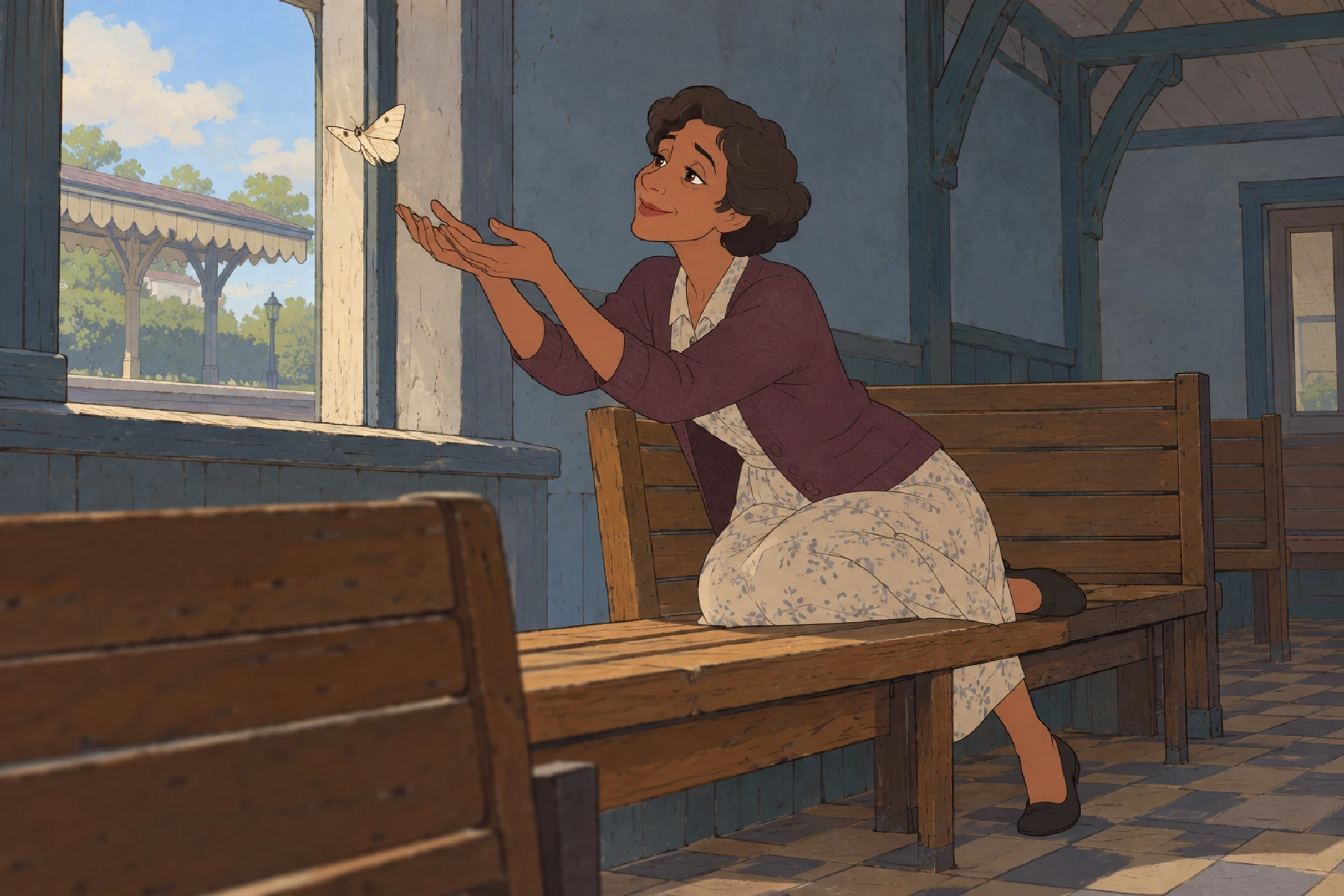
A Moth at the Waiting-Room Window
In an old station waiting room, a woman opens her hands to release a moth through a window. Layered benches and window frames carry the affectionate irregularity of xerographic pencil lines.
Remix this referenceA Moth at the Waiting-Room Window
- Form language
- Build legible masses from broad curves interrupted by selective angular planes; simplify minor shapes without making every edge regular.
- Contour
- Use dry, sketch-like contours with slight weight fluctuations and tapered breaks, retaining the lively drag of transferred pencil.
- Mark-making
- Leave selective short doubled contours and broken pencil strokes; let incidental marks vary naturally within a sparse drawing vocabulary.
- Surface rendering
- Use flat cel fills with few tonal steps and slight line-to-fill misregistration; broader passages may retain thin, uneven gouache scumbles.
Priority
Rendering medium: hand-drawn 2D xerographic cel-animation illustration; formal rendering reference: Walt Disney Studios · 1960s · One Hundred and One Dalmatians (1961)
What to avoid & what to check
Exact prompt for this example
MODULE OWNERSHIP
subject: Subject count, type, stable proportions and landmarks, resting face geometry, hair shape, physical materials, garment construction and permanent marks. No emotion, movement, color assignment or rendering recipe.
expression: Facial soft-tissue displacement and pupil direction, muscle coordination, regional intensity, asymmetry and onset/peak/release. No head/body pose, stable appearance, skin color or rendering.
gesture: Head/neck/body/limb orientation, joint movement, support, contact and pose-caused occlusion using existing anatomy. No eye/pupil movement, emotion, identity, props inventory or camera.
props: Prop count, type, construction, physical material and scale relative to the subject. Holding/contact belongs to gesture, position to composition, color to palette.
scene: Environment elements, terrain, backdrop/floor presence and structural detail. No canvas positions, camera, lighting, assigned colors or render texture.
camera: Projection, focal-length impression, camera elevation/yaw/roll, viewing distance and crop. No actor pose, world placement, lighting or canvas aspect ratio.
composition: Normalized 0-100% canvas positions, scale in frame, depth/overlap, focal hierarchy and margins. No joint pose, camera projection, rendering, subject/prop inventory or emotion.
palette: Color anchors, hue/saturation/value ranges, colors assigned to parts and approximate color coverage. No illumination direction, shading algorithm, physical material or layout.
lighting: Light-source direction/softness/intensity, ambient illumination, physical shadow direction/length and highlight position. Absence of directional illumination is allowed. No shading technique, palette or material changes.
style: Reusable form abstraction, contour weight/taper/edge quality, medium and mark scale/density/direction, surface rendering and tonal transition technique. No fixed subject proportions, anatomy, identity, expression, pose, palette, light-source direction, camera or layout.
output: Image count, aspect ratio, size, file/alpha requirements and global lettering/logo/watermark restrictions. No background scenery, crop, style, identity or pose.

SUBJECT
inventory: A is one middle-aged woman; one small moth completes the living subjects.
geometry: A has a sturdy build and an elongated face; the palm-sized moth has broad triangular forewings.
resting-face: A has narrow almond-shaped eyes, pronounced cheekbones, a broad nose tip and a small mouth.
appearance: A has short swept-back waves, a wool cardigan over a cotton dress and flat shoes; the moth has powder-scaled wings.

PRIORITY


AVOID


CHECK


EXPRESSION — ACTOR A
brows: The inner brows settle from a slight lift.
lids: Upper lids soften while the lower lids rise gently.
cheeks: A faint cheek lift lingers beside the mouth.
nose: The nose stays relaxed, without wrinkling or nostril flare.
mouth: Closed lips retain a small smile, slightly higher on the visible side.
jaw: The jaw releases without opening the mouth.
gaze: Both pupils follow the moth.
coordination: The soft lids and lingering mouth corners share the same quiet affection.
timing: Capture the release after a fuller smile; the near mouth corner relaxes last.

PRIORITY


AVOID


CHECK


GESTURE
head: A extends her neck slightly toward her hands, keeping her face in a readable three-quarter turn.
torso: Her torso leans across the bench back with a gentle twist toward the window.
limbs: One knee rests on the bench and the other foot stays grounded; both arms extend into opening, cupped palms.
contact: Her knee bears against the seat; the moth lifts clear of her fingertips with its wings spread.

PRIORITY


AVOID


CHECK


PROPS
inventory: No separate props.
construction: No prop construction applies.

PRIORITY


AVOID


CHECK


SCENE
inventory: An old rural station waiting room has timber benches, plaster walls, a tiled floor and an open window.
structure: Deep window reveals and exposed roof braces enclose the room; a hedge and platform canopy are visible outside.

PRIORITY


AVOID


CHECK


CAMERA
projection: Use moderate wide-angle perspective with gentle convergence and restrained edge distortion.
viewpoint: Look diagonally across the room from seated eye height, with a level camera and no roll.
crop: Frame the complete figure and window opening, allowing nearby bench ends to enter the crop.

PRIORITY


AVOID


CHECK


COMPOSITION
placement: A occupies about 40% of canvas width; her hands and the moth lead toward the upper-left window's open space, with the moth just beyond her fingertips.
depth: A cropped bench overlaps the lower foreground; A occupies the middle layer, with the platform beyond the window.
spacing: Give A about half the frame height; make hands and moth the first read, face second, with breathing room around both.

PRIORITY


AVOID


CHECK


PALETTE
colors: Use smoky blue, oatmeal cream, muted plum and weathered ochre, with charcoal accents.
assignment: Blue belongs to walls, ochre to timber, plum to the cardigan, cream to dress and moth; A has warm brown skin.
balance: Broad subdued blue and ochre fields dominate; plum is a smaller accent, and the moth carries the palest cream.

PRIORITY


AVOID


CHECK


LIGHTING
sources: Broad soft daylight enters from the upper left through the window, supported by dim room ambience.
shadows: Bench and figure shadows extend softly toward the lower right; the window recess stays deeper in shade.
highlights: Keep restrained highlights on the window-facing cheek, fingertips and upper wing edges.

PRIORITY


AVOID


CHECK


STYLE GUIDE
form-language: Build legible masses from broad curves interrupted by selective angular planes; simplify minor shapes without making every edge regular.
contour: Use dry, sketch-like contours with slight weight fluctuations and tapered breaks, retaining the lively drag of transferred pencil.
mark-making: Leave selective short doubled contours and broken pencil strokes; let incidental marks vary naturally within a sparse drawing vocabulary.
surface-rendering: Use flat cel fills with few tonal steps and slight line-to-fill misregistration; broader passages may retain thin, uneven gouache scumbles.

PRIORITY
Rendering medium: hand-drawn 2D xerographic cel-animation illustration; formal rendering reference: Walt Disney Studios · 1960s · One Hundred and One Dalmatians (1961)

AVOID


CHECK


OUTPUT
format: One finished image, landscape 3:2, 1800 × 1200 pixels, opaque PNG.
restrictions: No lettering, logos or watermarks.

PRIORITY


AVOID


CHECK


FINAL INTEGRATION
expression + gesture + composition: Let facial acting and bodily action support the same moment while composition preserves their readability.
style + palette + lighting: Translate the assigned colors and illumination into the chosen tonal language while retaining drawing irregularities.
Art direction
디즈니 / Walt Disney Studios · 1960s · 101마리 달마시안(1961) / One Hundred and One Dalmatians (1961) ↗- Use legible form masses with selective angular simplification
- Sketch-like contours with small weight irregularities instead of polished ink uniformity
- Retain selective short doubled contour traces and broken pencil-like marks
- Flat fills with few tonal levels and slight line-to-fill edge misregistration
Model information comes from image provenance. The same prompt may produce a different result.