Text to imageCalligraphyStyle guide
Brush Lettering Inside a Grain Elevator
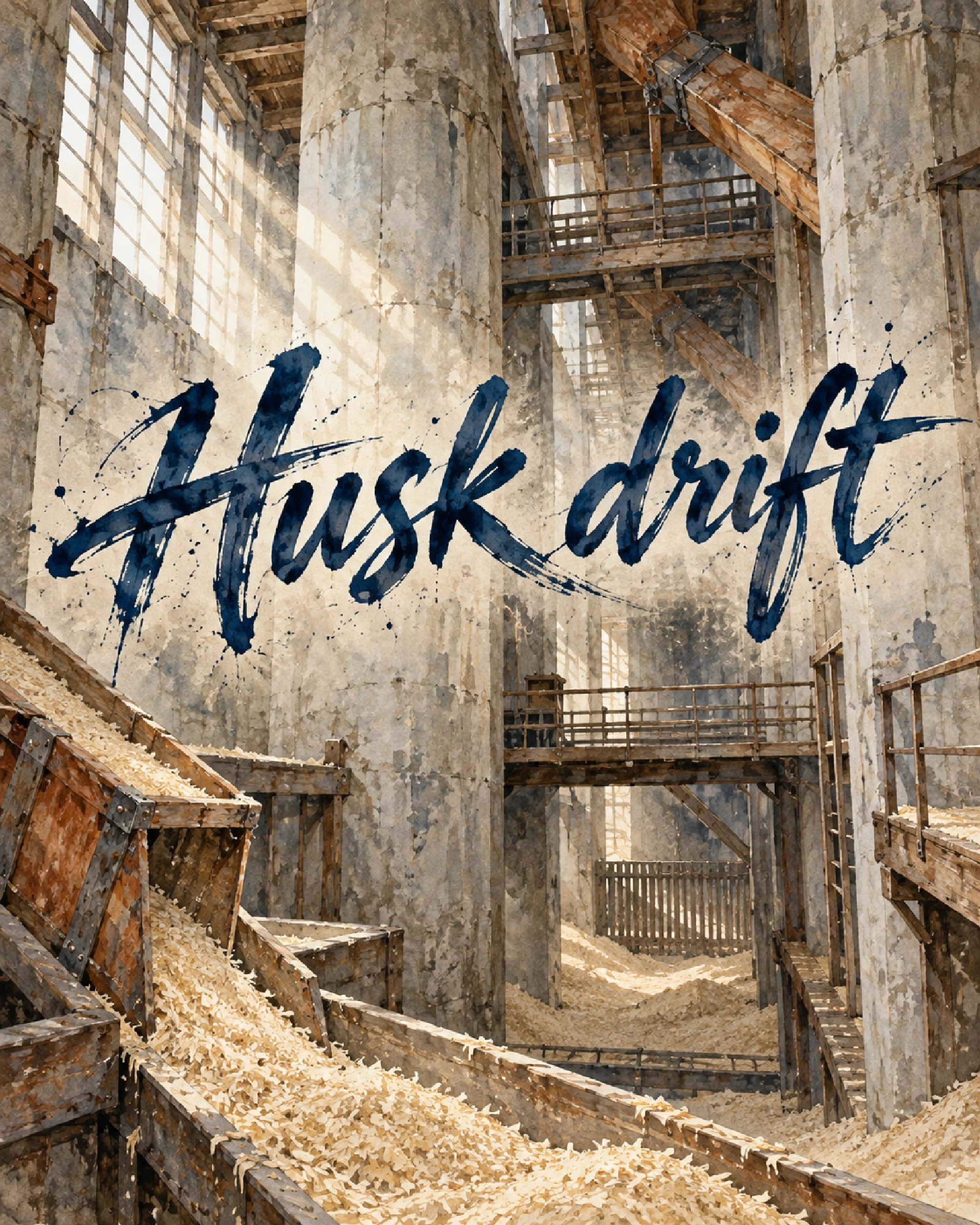
Expressive brush lettering crosses the deep interior of an empty grain elevator. Saturated strokes and broken bristle trails answer the old grain chutes and light drifts of husks.
Remix this referenceBrush Lettering Inside a Grain Elevator
- Form language
- Simplify architecture into interrupted planes and hollow blocks; let secondary structural details vary within that language.
- Contour
- Give brush edges swelling pressure changes, split bristle margins and lifted tapers; keep surrounding contours discontinuous.
- Mark-making
- Alternate loaded brush pulls with quick dry passages; use sparse, shorter directional marks to suggest architectural wear.
- Surface rendering
- Allow ink pools, absorbent feathering and exposed paper within strokes; build the setting through translucent washes with uneven edges.
Priority
Gestural brush calligraphy with expressive ink variation.
What to avoid & what to check
Exact prompt for this example
MODULE OWNERSHIP
subject: Subject count, type, stable proportions and landmarks, resting face geometry, hair shape, physical materials, garment construction and permanent marks. No emotion, movement, color assignment or rendering recipe.
expression: Facial soft-tissue displacement and pupil direction, muscle coordination, regional intensity, asymmetry and onset/peak/release. No head/body pose, stable appearance, skin color or rendering.
gesture: Head/neck/body/limb orientation, joint movement, support, contact and pose-caused occlusion using existing anatomy. No eye/pupil movement, emotion, identity, props inventory or camera.
props: Prop count, type, construction, physical material and scale relative to the subject. Holding/contact belongs to gesture, position to composition, color to palette.
scene: Environment elements, terrain, backdrop/floor presence and structural detail. No canvas positions, camera, lighting, assigned colors or render texture.
camera: Projection, focal-length impression, camera elevation/yaw/roll, viewing distance and crop. No actor pose, world placement, lighting or canvas aspect ratio.
composition: Normalized 0-100% canvas positions, scale in frame, depth/overlap, focal hierarchy and margins. No joint pose, camera projection, rendering, subject/prop inventory or emotion.
palette: Color anchors, hue/saturation/value ranges, colors assigned to parts and approximate color coverage. No illumination direction, shading algorithm, physical material or layout.
lighting: Light-source direction/softness/intensity, ambient illumination, physical shadow direction/length and highlight position. Absence of directional illumination is allowed. No shading technique, palette or material changes.
style: Reusable form abstraction, contour weight/taper/edge quality, medium and mark scale/density/direction, surface rendering and tonal transition technique. No fixed subject proportions, anatomy, identity, expression, pose, palette, light-source direction, camera or layout.
output: Image count, aspect ratio, size, file/alpha requirements and global lettering/logo/watermark restrictions. No background scenery, crop, style, identity or pose.

SUBJECT
inventory: One calligraphic inscription; no human or animal subjects.
geometry: Write "Husk drift" in recognizable joined Latin letters, with open counters and a distinct word gap.
resting-face: No face or facial geometry applies.
appearance: The inscription consists of deposited ink, without a separate sculptural body or mounting hardware.

PRIORITY


AVOID


CHECK


PROPS
inventory: No separate props.
construction: No prop construction applies.

PRIORITY


AVOID


CHECK


SCENE
inventory: An empty grain-elevator interior contains concrete shafts, timber grain chutes, fixed catwalks and loose husks.
structure: Open shaft mouths interrupt successive floors; slatted windows and a partly buried lower landing complete the enclosure.

PRIORITY


AVOID


CHECK


CAMERA
projection: Moderate wide-angle perspective gives the interior depth without exaggerated edge stretching.
viewpoint: Look lengthwise through the shafts from lower-catwalk height, with a slight upward view and level roll.
crop: Use a broad interior view that crops a nearby chute and other structural fragments at the frame edges.

PRIORITY


AVOID


CHECK


COMPOSITION
placement: The inscription spans the open middle on a gently rising line; its broad opening leads toward the shorter final word.
depth: A nearby chute overlaps distant landings; the inscription remains a graphic foreground layer over the architectural depth.
spacing: Make lettering the first read, leave breathing room around its terminals, and gather denser architecture below it.

PRIORITY


AVOID


CHECK


PALETTE
colors: Use deep indigo, oat cream, muted rust and smoke gray as the small color family.
assignment: Assign indigo to lettering, oat cream to husks, rust to timber accents and smoke gray to concrete.
balance: Keep the setting mostly pale and restrained; reserve the deepest values for the inscription and a few recesses.

PRIORITY


AVOID


CHECK


LIGHTING
sources: Soft daylight enters from high windows on the left, supported by weak ambient light within the shafts.
shadows: Architectural shadows fall broadly toward the right; the graphic inscription casts no environmental shadow.
highlights: Window-facing chute rims and landing edges receive subdued highlights.

PRIORITY


AVOID


CHECK


STYLE GUIDE
form-language: Simplify architecture into interrupted planes and hollow blocks; let secondary structural details vary within that language.
contour: Give brush edges swelling pressure changes, split bristle margins and lifted tapers; keep surrounding contours discontinuous.
mark-making: Alternate loaded brush pulls with quick dry passages; use sparse, shorter directional marks to suggest architectural wear.
surface-rendering: Allow ink pools, absorbent feathering and exposed paper within strokes; build the setting through translucent washes with uneven edges.

PRIORITY
Gestural brush calligraphy with expressive ink variation.

AVOID


CHECK


OUTPUT
format: One opaque PNG, 1600 × 2000 pixels, 4:5 aspect ratio. Allow primary lettering; forbid additional text, logos and watermarks.
restrictions: Deliver one opaque PNG at 1600 × 2000 pixels in a 4:5 aspect ratio. Allow primary lettering; forbid additional text, logos and watermarks.

PRIORITY


AVOID


CHECK


FINAL INTEGRATION
subject + output: The subject inscription is the primary lettering permitted by output: "Husk drift".
Model information comes from image provenance. The same prompt may produce a different result.