Text to imageIllustrationStyle guide
A Hare Beneath the Garden Gate
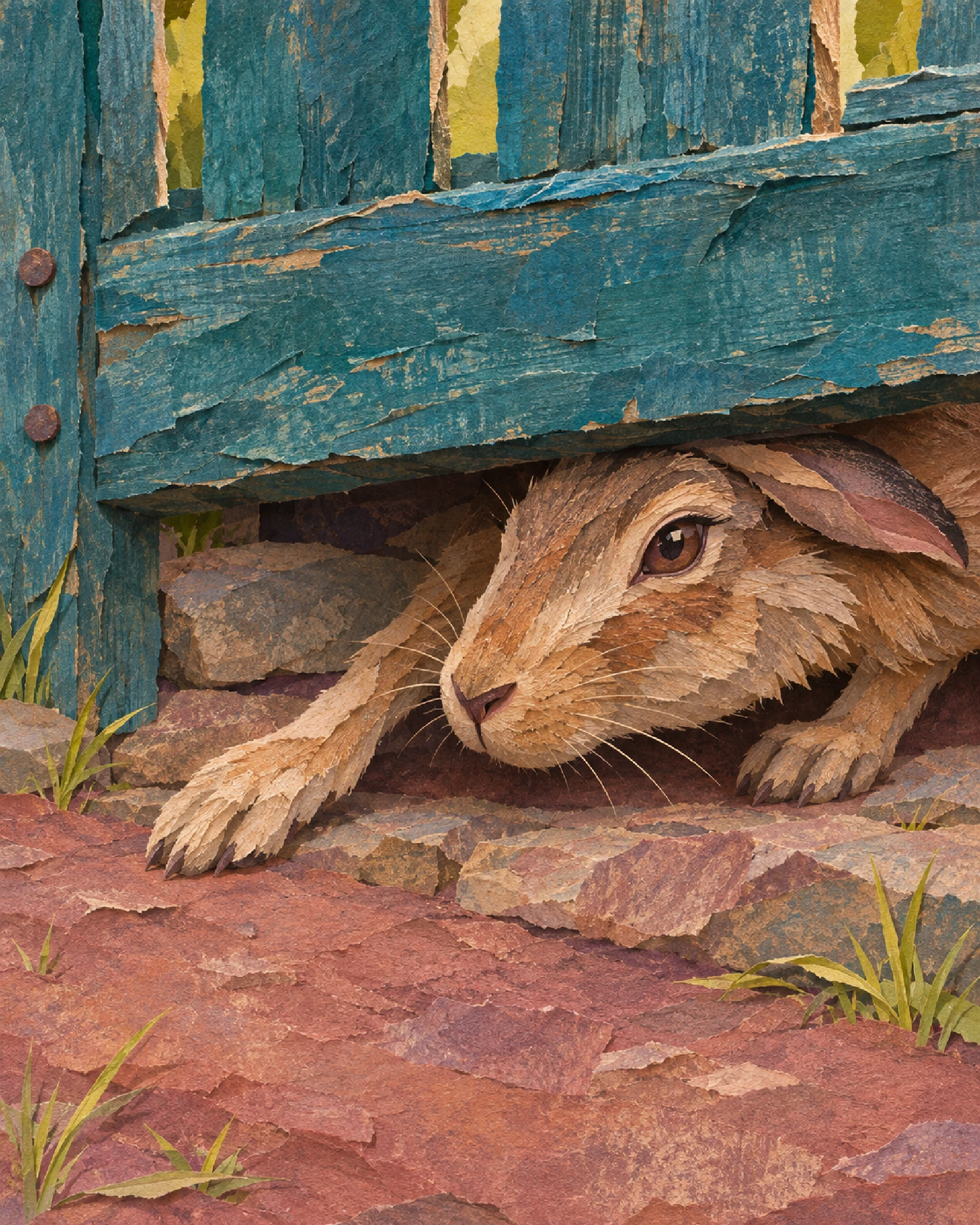
A hare eases its face and forepaws beneath a garden gate. Expressive cropping and overlapping paper edges turn a small passage into an absorbing encounter.
Remix this referenceA Hare Beneath the Garden Gate
- Form language
- Build forms from interlocking cut-paper masses, using broad shapes interrupted by a few slender fragments; allow local irregularity.
- Contour
- Alternate decisive scissor-cut edges with softly torn edges; overlapping silhouettes provide definition without continuous drawn outlines.
- Mark-making
- Use gouache-stained papers with broken dry-brush sweeps and occasional pencil scratches; vary marks naturally across neighboring pieces.
- Surface rendering
- Show tactile overlaps, slight edge lift and exposed paper fibers; build tonal changes through layered patches and uneven translucent stains.
Priority
The finished image must visibly read as layered cut-paper collage with tactile overlaps.
What to avoid & what to check
Exact prompt for this example
MODULE OWNERSHIP
subject: Subject count, type, stable proportions and landmarks, resting face geometry, hair shape, physical materials, garment construction and permanent marks. No emotion, movement, color assignment or rendering recipe.
expression: Facial soft-tissue displacement and pupil direction, muscle coordination, regional intensity, asymmetry and onset/peak/release. No head/body pose, stable appearance, skin color or rendering.
gesture: Head/neck/body/limb orientation, joint movement, support, contact and pose-caused occlusion using existing anatomy. No eye/pupil movement, emotion, identity, props inventory or camera.
props: Prop count, type, construction, physical material and scale relative to the subject. Holding/contact belongs to gesture, position to composition, color to palette.
scene: Environment elements, terrain, backdrop/floor presence and structural detail. No canvas positions, camera, lighting, assigned colors or render texture.
camera: Projection, focal-length impression, camera elevation/yaw/roll, viewing distance and crop. No actor pose, world placement, lighting or canvas aspect ratio.
composition: Normalized 0-100% canvas positions, scale in frame, depth/overlap, focal hierarchy and margins. No joint pose, camera projection, rendering, subject/prop inventory or emotion.
palette: Color anchors, hue/saturation/value ranges, colors assigned to parts and approximate color coverage. No illumination direction, shading algorithm, physical material or layout.
lighting: Light-source direction/softness/intensity, ambient illumination, physical shadow direction/length and highlight position. Absence of directional illumination is allowed. No shading technique, palette or material changes.
style: Reusable form abstraction, contour weight/taper/edge quality, medium and mark scale/density/direction, surface rendering and tonal transition technique. No fixed subject proportions, anatomy, identity, expression, pose, palette, light-source direction, camera or layout.
output: Image count, aspect ratio, size, file/alpha requirements and global lettering/logo/watermark restrictions. No background scenery, crop, style, identity or pose.

SUBJECT
inventory: A is one adult hare with a natural fur coat; no clothing or accessories.
geometry: Long narrow ears, an elongated muzzle, high-set lateral eyes and slender forepaws establish a recognizable hare.
resting-face: A small divided upper lip, compact whisker pads and an almond-shaped visible eye define the resting face; no human-like eyebrows.
appearance: Short facial fur meets longer cheek tufts; the ears have sparse inner fur and the muzzle carries fine whiskers.

PRIORITY


AVOID


CHECK


EXPRESSION — ACTOR A
brows: Keep the brow region relaxed, without visible lifting or tightening.
lids: The visible upper lid lifts slightly as attention sharpens.
cheeks: Whisker pads remain relaxed, without a smile-like lift.
nose: The nostrils open subtly in a tentative sniff.
mouth: The small lip division stays closed and unstrained.
jaw: The jaw remains gently closed.
gaze: Direct the visible pupil toward the open garden beyond the gap.
coordination: Let the slight lid lift and nostril opening carry the curiosity; the lower face stays quiet.
timing: Catch the onset of inspection, before the eye opens fully.

PRIORITY


AVOID


CHECK


GESTURE
head: Lower the head beneath the bottom rail; one ear folds backward against the neck to clear the opening.
torso: The shoulders sink into a low forward stretch while the body continues behind the gate.
limbs: One forepaw reaches leftward beyond the threshold while the other braces closer beneath the chest.
contact: Both forepaws bear on the earth; the folded ear brushes the rail, which conceals the upper shoulders.

PRIORITY


AVOID


CHECK


PROPS
inventory: No separate props.
construction: No prop construction applies.

PRIORITY


AVOID


CHECK


SCENE
inventory: A weathered plank garden gate, an uneven stone threshold, bare earth and a few grass blades.
structure: A broad bottom rail bridges the opening above the worn threshold; the garden beyond remains sparsely described.

PRIORITY


AVOID


CHECK


CAMERA
projection: Use restrained perspective with a short-telephoto impression.
viewpoint: Look from ground level, slightly oblique to the gate, with no camera roll.
crop: Frame an intimate close-up, cutting through the gate and excluding the hare's hindquarters.

PRIORITY


AVOID


CHECK


COMPOSITION
placement: The gate dominates the upper field; the hare's face occupies the lower right and the exposed forepaw sits in the lower middle.
depth: Read the exposed eye first, then the muzzle and paw; the rail overlaps the hare and the threshold recedes behind it.
spacing: Leave a generous wedge of open ground at lower left against the compressed opening around the face.

PRIORITY


AVOID


CHECK


PALETTE
colors: Anchor the image in petrol blue, warm oatmeal, clay rose and deep aubergine, with a small yellow-green accent.
assignment: Give the gate petrol blue, fur oatmeal and muted umber, earth clay rose, dark features aubergine and grass yellow-green.
balance: Let the blue field dominate, with warm pale fur as the main value contrast and accents used sparingly.

PRIORITY


AVOID


CHECK


LIGHTING
sources: Broad soft daylight enters from upper right, with subdued ambient light inside the gap.
shadows: Short soft shadows fall down-left; the clearance beneath the rail holds the deepest shadow.
highlights: Keep highlights restrained on the upper muzzle and exposed eye.

PRIORITY


AVOID


CHECK


STYLE GUIDE
form-language: Build forms from interlocking cut-paper masses, using broad shapes interrupted by a few slender fragments; allow local irregularity.
contour: Alternate decisive scissor-cut edges with softly torn edges; overlapping silhouettes provide definition without continuous drawn outlines.
mark-making: Use gouache-stained papers with broken dry-brush sweeps and occasional pencil scratches; vary marks naturally across neighboring pieces.
surface-rendering: Show tactile overlaps, slight edge lift and exposed paper fibers; build tonal changes through layered patches and uneven translucent stains.

PRIORITY
The finished image must visibly read as layered cut-paper collage with tactile overlaps.

AVOID


CHECK


OUTPUT
format: One finished illustration, portrait 4:5, 1600 × 2000 pixels, opaque PNG.
restrictions: No lettering, logos or watermarks.

PRIORITY


AVOID


CHECK


FINAL INTEGRATION
gesture + composition: Let the overlap make the passage legible while preserving enough visible contact to understand the movement.
style + expression: Simplify the facial pieces without losing the small changes that convey attention.
Model information comes from image provenance. The same prompt may produce a different result.