Text to imageArt stylesStyle guide
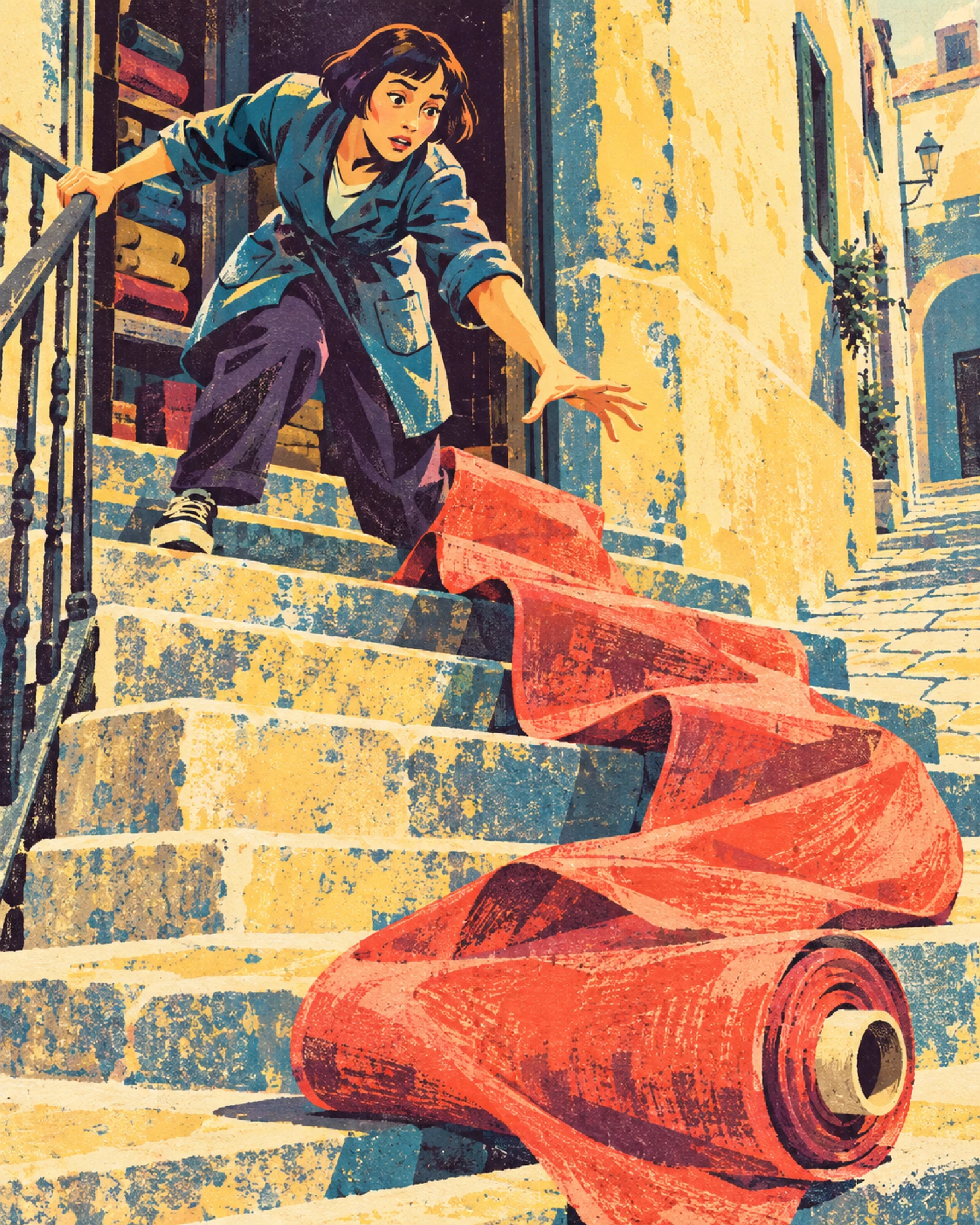
Cloth Unrolling Down the Steps
A textile seller reaches after a bolt of cloth unrolling down the shop steps. Broad ink shapes, rough print edges, and overprinted planes link the cloth’s tumbling curves with the repeated stairs in a lively screenprinted illustration.
Remix this referenceCloth Unrolling Down the Steps
- Form language
- Compress forms into interlocking arcs, blunt wedges, and broad stepped bands; vary their cadence so repetition feels energetic rather than mechanical.
- Contour
- Let adjoining ink shapes define most edges; use occasional thick, abruptly tapered contour fragments with subtly ragged stencil boundaries.
- Mark-making
- Use sparse, broad squeegee scuffs and irregular mesh skips within selected ink passages; their size and direction may vary naturally.
- Surface rendering
- Build tones through opaque screenprinted layers and translucent overprints, allowing slight registration slips and exposed paper to interrupt solid passages.
Priority
Make the screenprint’s decisive shape rhythms and visible ink overlaps unmistakable.
What to avoid & what to check
Exact prompt for this example
MODULE OWNERSHIP
subject: Subject count, type, stable proportions and landmarks, resting face geometry, hair shape, physical materials, garment construction and permanent marks. No emotion, movement, color assignment or rendering recipe.
expression: Facial soft-tissue displacement and pupil direction, muscle coordination, regional intensity, asymmetry and onset/peak/release. No head/body pose, stable appearance, skin color or rendering.
gesture: Head/neck/body/limb orientation, joint movement, support, contact and pose-caused occlusion using existing anatomy. No eye/pupil movement, emotion, identity, props inventory or camera.
props: Prop count, type, construction, physical material and scale relative to the subject. Holding/contact belongs to gesture, position to composition, color to palette.
scene: Environment elements, terrain, backdrop/floor presence and structural detail. No canvas positions, camera, lighting, assigned colors or render texture.
camera: Projection, focal-length impression, camera elevation/yaw/roll, viewing distance and crop. No actor pose, world placement, lighting or canvas aspect ratio.
composition: Normalized 0-100% canvas positions, scale in frame, depth/overlap, focal hierarchy and margins. No joint pose, camera projection, rendering, subject/prop inventory or emotion.
palette: Color anchors, hue/saturation/value ranges, colors assigned to parts and approximate color coverage. No illumination direction, shading algorithm, physical material or layout.
lighting: Light-source direction/softness/intensity, ambient illumination, physical shadow direction/length and highlight position. Absence of directional illumination is allowed. No shading technique, palette or material changes.
style: Reusable form abstraction, contour weight/taper/edge quality, medium and mark scale/density/direction, surface rendering and tonal transition technique. No fixed subject proportions, anatomy, identity, expression, pose, palette, light-source direction, camera or layout.
output: Image count, aspect ratio, size, file/alpha requirements and global lettering/logo/watermark restrictions. No background scenery, crop, style, identity or pose.

SUBJECT
inventory: One adult textile seller, actor A.
geometry: A wiry build with narrow shoulders, long forearms, and broad hands.
resting-face: A long nose, rounded chin, straight brows, and a narrow resting mouth.
appearance: A blunt bob, a cotton work smock with patch pockets, loose trousers, and canvas shoes.

PRIORITY


AVOID


CHECK


EXPRESSION — ACTOR A
brows: Both brows lift, with the nearer brow rising slightly first.
lids: Upper lids lift; lower lids remain lightly taut.
cheeks: Cheeks remain low without a smile crease.
nose: The nose stays relaxed without wrinkling or flaring.
mouth: Lips part into a small, uneven opening.
jaw: The jaw drops slightly without stretching the mouth.
gaze: Pupils track the escaping cloth roll.
coordination: The alert upper face leads the smaller mouth reaction.
timing: Catch the onset, just as recognition interrupts an ordinary working expression.

PRIORITY


AVOID


CHECK


GESTURE
head: A turns the head down the steps, neck extending with the reach.
torso: The torso pitches forward and twists slightly toward the descending cloth.
limbs: One arm reaches with spread fingers; the other braces behind, while bent legs span adjacent steps.
contact: The rear palm grips the railing; both shoes bear weight, and the reaching hand has not caught the cloth.

PRIORITY


AVOID


CHECK


PROPS
inventory: One partially unrolled bolt of cloth, its rolled core about as wide as A’s torso.
construction: Supple woven fabric winds around a hollow cardboard tube, with an uninterrupted loose length.

PRIORITY


AVOID


CHECK


SCENE
inventory: An outdoor textile-shop entrance, a short stone staircase, a simple railing, and a paved lane.
structure: The recessed doorway opens directly onto broad, worn steps; plaster walls enclose the narrow lane.

PRIORITY


AVOID


CHECK


CAMERA
projection: Perspective with a moderately wide lens impression and restrained foreshortening.
viewpoint: Look obliquely down the staircase from slightly above standing eye level, with no camera roll.
crop: A full-figure environmental view includes the descending fabric and a fragment of the shop entrance.

PRIORITY


AVOID


CHECK


COMPOSITION
placement: A occupies the upper-left third; the large cloth curl and the gap before the reaching hand form the main focus below.
depth: The loose cloth crosses successive stair edges and overlaps A’s lower silhouette before curling into the foreground.
spacing: Keep a clear pocket around the hand and roll; let architecture extend beyond the edges and leave breathing room above A.

PRIORITY


AVOID


CHECK


PALETTE
colors: Use chili coral, deep aubergine, muted petrol blue, and pale butter yellow, with restrained warm skin tones.
assignment: Coral belongs to the cloth, petrol blue to the workwear, butter yellow to masonry, and aubergine to the deepest accents.
balance: Pale architectural color covers most of the image; the concentrated coral passage carries the strongest saturation.

PRIORITY


AVOID


CHECK


LIGHTING
sources: Broad daylight enters from upper left, with soft ambient light reaching the doorway.
shadows: Short, softly edged shadows fall down and right across the steps; the doorway remains more deeply shaded.
highlights: Broad highlights touch the upper cloth folds and the upper-left planes of the face and hands.

PRIORITY


AVOID


CHECK


STYLE GUIDE
form-language: Compress forms into interlocking arcs, blunt wedges, and broad stepped bands; vary their cadence so repetition feels energetic rather than mechanical.
contour: Let adjoining ink shapes define most edges; use occasional thick, abruptly tapered contour fragments with subtly ragged stencil boundaries.
mark-making: Use sparse, broad squeegee scuffs and irregular mesh skips within selected ink passages; their size and direction may vary naturally.
surface-rendering: Build tones through opaque screenprinted layers and translucent overprints, allowing slight registration slips and exposed paper to interrupt solid passages.

PRIORITY
Make the screenprint’s decisive shape rhythms and visible ink overlaps unmistakable.

AVOID


CHECK


OUTPUT
format: Produce one finished image, portrait 4:5, 1600 × 2000 pixels, as an opaque PNG.
restrictions: No lettering, logos, signatures, or watermarks.

PRIORITY


AVOID


CHECK
Model information comes from image provenance. The same prompt may produce a different result.