Text to imageArt stylesStyle guide
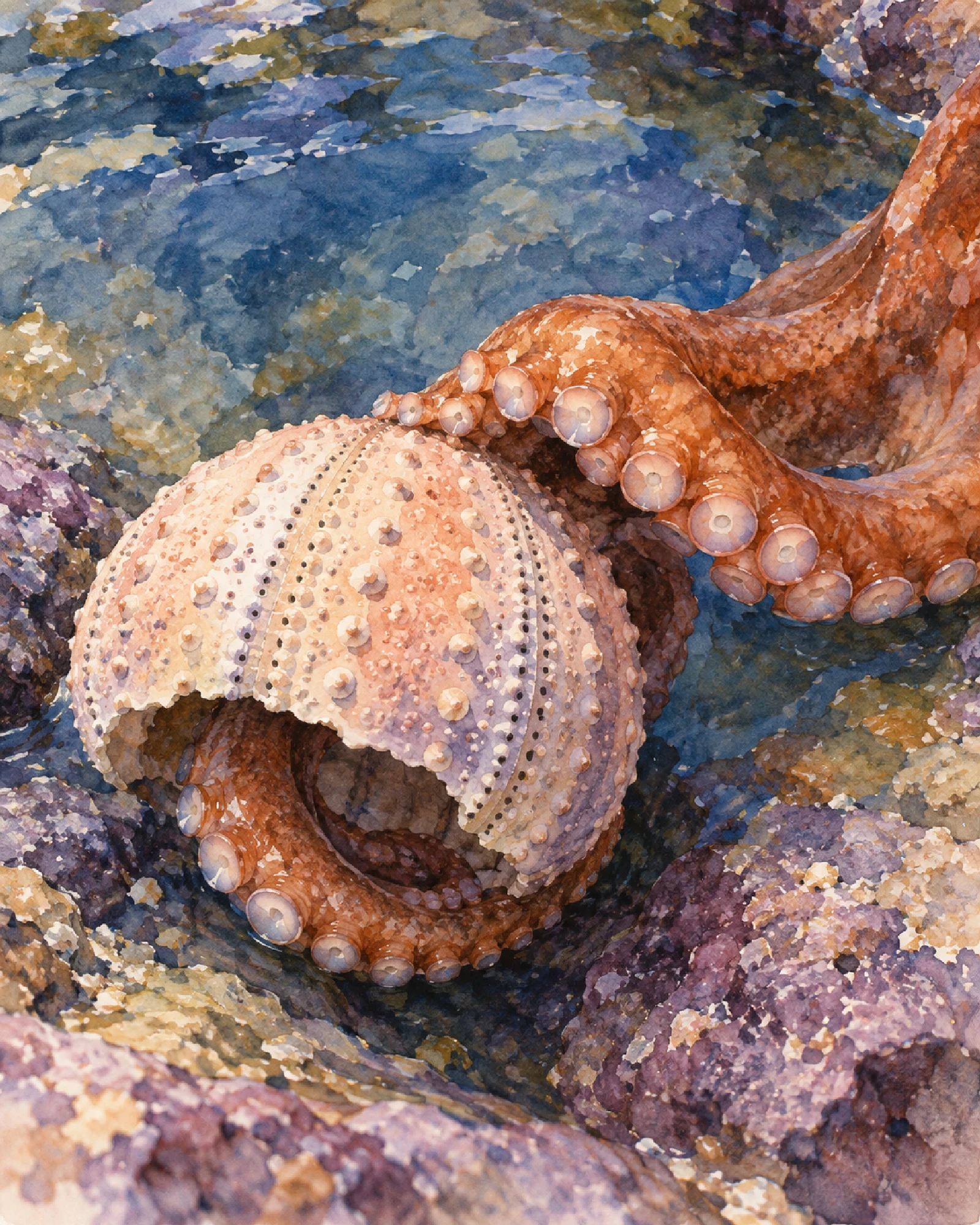
An Octopus Turning an Urchin Shell
An octopus turns an empty urchin shell in a shallow rock pool. Blooming watercolor and broken edges bring the soft underwater contact into intimate view.
Remix this referenceAn Octopus Turning an Urchin Shell
- Form language
- Simplify forms into elastic ribbons and interrupted domes, retaining observed irregularities; incidental shapes may vary naturally.
- Contour
- Alternate crisp brush-edge fragments, feathered bleeds, and boundaries lost into adjacent washes.
- Mark-making
- Place broad wet strokes beside sparse dry-brush skips, allowing backruns and pigment blooms to interrupt quiet passages.
- Surface rendering
- Build transparent watercolor layers with pooled pigment and lifted pale passages; expose paper unevenly rather than texturing every surface alike.
Priority
Expressive watercolor blooms and broken edges remain visibly active.
What to avoid & what to check
Exact prompt for this example
MODULE OWNERSHIP
subject: Subject count, type, stable proportions and landmarks, resting face geometry, hair shape, physical materials, garment construction and permanent marks. No emotion, movement, color assignment or rendering recipe.
expression: Facial soft-tissue displacement and pupil direction, muscle coordination, regional intensity, asymmetry and onset/peak/release. No head/body pose, stable appearance, skin color or rendering.
gesture: Head/neck/body/limb orientation, joint movement, support, contact and pose-caused occlusion using existing anatomy. No eye/pupil movement, emotion, identity, props inventory or camera.
props: Prop count, type, construction, physical material and scale relative to the subject. Holding/contact belongs to gesture, position to composition, color to palette.
scene: Environment elements, terrain, backdrop/floor presence and structural detail. No canvas positions, camera, lighting, assigned colors or render texture.
camera: Projection, focal-length impression, camera elevation/yaw/roll, viewing distance and crop. No actor pose, world placement, lighting or canvas aspect ratio.
composition: Normalized 0-100% canvas positions, scale in frame, depth/overlap, focal hierarchy and margins. No joint pose, camera projection, rendering, subject/prop inventory or emotion.
palette: Color anchors, hue/saturation/value ranges, colors assigned to parts and approximate color coverage. No illumination direction, shading algorithm, physical material or layout.
lighting: Light-source direction/softness/intensity, ambient illumination, physical shadow direction/length and highlight position. Absence of directional illumination is allowed. No shading technique, palette or material changes.
style: Reusable form abstraction, contour weight/taper/edge quality, medium and mark scale/density/direction, surface rendering and tonal transition technique. No fixed subject proportions, anatomy, identity, expression, pose, palette, light-source direction, camera or layout.
output: Image count, aspect ratio, size, file/alpha requirements and global lettering/logo/watermark restrictions. No background scenery, crop, style, identity or pose.

SUBJECT
inventory: One common octopus, actor A.
geometry: Tapering arms have paired rows of rounded suckers; their thickness varies naturally.
resting-face: No resting facial geometry is specified.
appearance: Soft skin has fine papillae and occasional folds; no garments or permanent markings.

PRIORITY


AVOID


CHECK


EXPRESSION — ACTOR A
brows: No visible brow channel; leave it unprescribed.
lids: No lid displacement is prescribed.
cheeks: No visible cheek channel; leave it unprescribed.
nose: No applicable nose channel; do not invent nasal acting.
mouth: No mouth displacement is prescribed.
jaw: No visible jaw channel; leave it unprescribed.
gaze: No gaze direction is prescribed.
coordination: No visible facial coordination applies; retain the neutral designation.
timing: The neutral apex is only a binding state; no visible facial transition applies.

PRIORITY


AVOID


CHECK


GESTURE
head: No head action is prescribed.
torso: No mantle action is prescribed.
limbs: One arm curls beneath the shell while another folds over its rim, beginning a gentle turn.
contact: A few suckers adhere to the shell; the supporting arm keeps it clear of the rock.

PRIORITY


AVOID


CHECK


PROPS
inventory: One empty sea-urchin shell, slightly wider than the thickest visible arm.
construction: A brittle mineral dome with radial pores, tiny bumps, and an irregular open underside.

PRIORITY


AVOID


CHECK


SCENE
inventory: A shallow tide pool with submerged rock and a little waterborne grit.
structure: A worn rock hollow forms the pool floor, with a shallow lip breaking the continuous water.

PRIORITY


AVOID


CHECK


CAMERA
projection: Natural close-focus perspective with a modest macro-lens impression.
viewpoint: Look obliquely downward from just above the pool rim, with no roll.
crop: An intimate detail excludes the head and mantle, cutting through continuing arms tightly at the right.

PRIORITY


AVOID


CHECK


COMPOSITION
placement: The shell sits below and left of center; an arm enters from the upper right toward the contact.
depth: The shell overlaps its supporting curl; the second arm crosses its rim above the recessed pool floor. The mouth remains concealed.
spacing: The shell and gripping curl lead the focal hierarchy, with broad open water above them.

PRIORITY


AVOID


CHECK


PALETTE
colors: Burnt sienna, muted ultramarine, chalky peach, and mineral violet.
assignment: Sienna for the arms, peach for the shell, ultramarine for the water, and violet for the rock.
balance: Cool subdued colors dominate; the smaller warm forms carry the strongest saturation.

PRIORITY


AVOID


CHECK


LIGHTING
sources: Broad soft daylight arrives from the upper left, with generous ambient light through the water.
shadows: Short softened shadows fall toward the lower right beneath the shell and overlapping arms.
highlights: Small highlights touch upper-left shell ridges and exposed sucker lips.

PRIORITY


AVOID


CHECK


STYLE GUIDE
form-language: Simplify forms into elastic ribbons and interrupted domes, retaining observed irregularities; incidental shapes may vary naturally.
contour: Alternate crisp brush-edge fragments, feathered bleeds, and boundaries lost into adjacent washes.
mark-making: Place broad wet strokes beside sparse dry-brush skips, allowing backruns and pigment blooms to interrupt quiet passages.
surface-rendering: Build transparent watercolor layers with pooled pigment and lifted pale passages; expose paper unevenly rather than texturing every surface alike.

PRIORITY
Expressive watercolor blooms and broken edges remain visibly active.

AVOID


CHECK


OUTPUT
format: One finished image, portrait 4:5, 1600 × 2000 pixels, opaque PNG.
restrictions: No lettering, logos, signatures, or watermarks.

PRIORITY


AVOID


CHECK


FINAL INTEGRATION
gesture + composition + style: Keep the contact legible while allowing surrounding boundaries to dissolve into the medium.
Model information comes from image provenance. The same prompt may produce a different result.