Text to imageIllustrationStyle guide
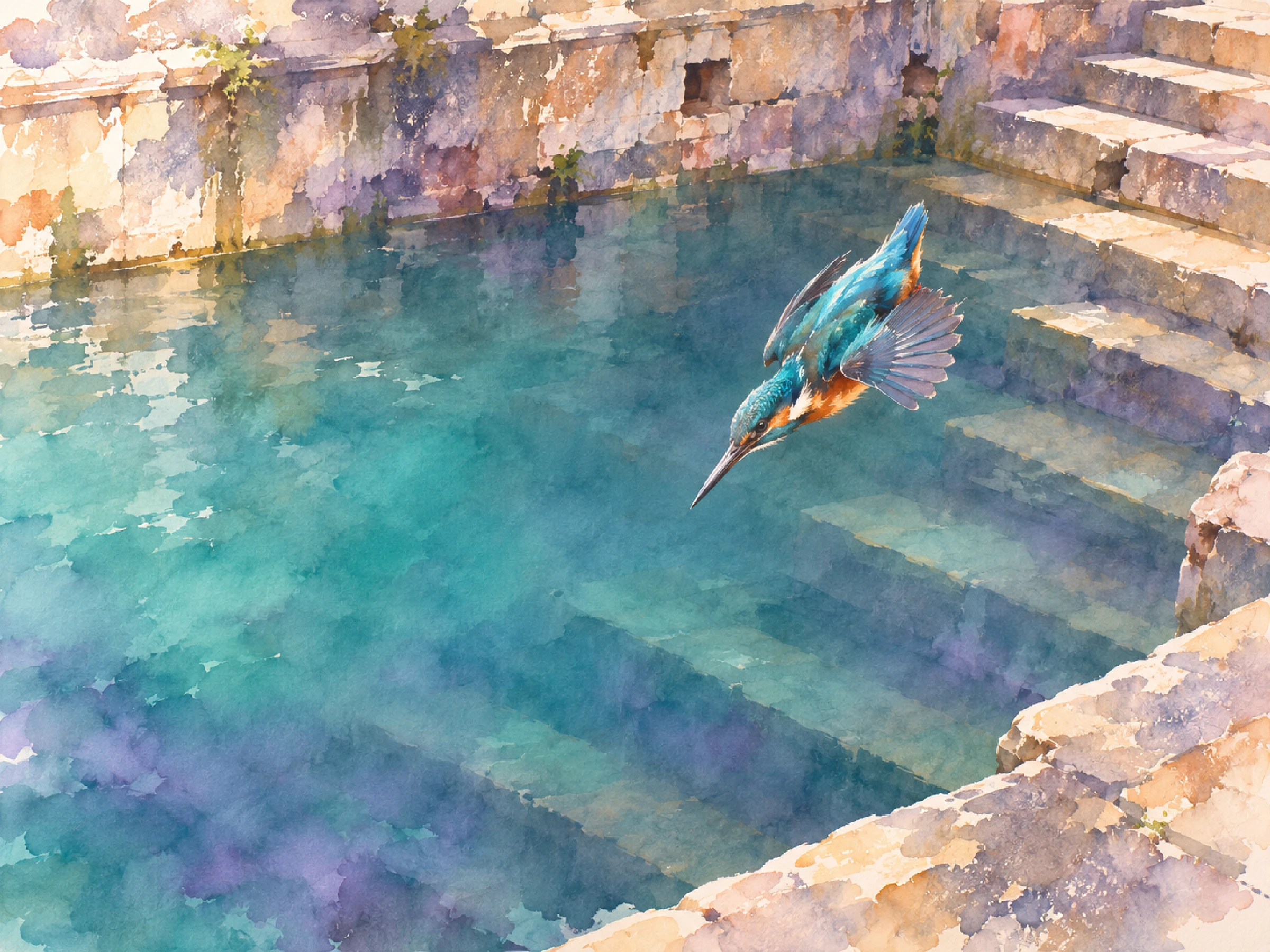
A Kingfisher Diving Above Submerged Steps
A kingfisher plunges beside the submerged stairs of an old stone stepwell. Spreading watercolor blooms and broken edges connect quiet water with a brief burst of movement.
Remix this referenceA Kingfisher Diving Above Submerged Steps
- Form language
- Simplify forms into broad interlocking masses, retaining a few decisive small landmarks; incidental shapes may vary naturally.
- Contour
- Alternate crisp brush edges, feathered bleeds and missing contour stretches rather than uniformly enclosing every shape.
- Mark-making
- Use broad wet strokes interrupted by sparse dry-brush skips and quick tapered touches, with freely varying pressure and spacing.
- Surface rendering
- Transparent watercolor washes mingle into blooms and pigment pools; selective glazing deepens tones while exposed paper preserves luminosity.
Priority
Make watercolor blooms and broken edges visibly shape the image.
What to avoid & what to check
Exact prompt for this example
MODULE OWNERSHIP
subject: Subject count, type, stable proportions and landmarks, resting face geometry, hair shape, physical materials, garment construction and permanent marks. No emotion, movement, color assignment or rendering recipe.
expression: Facial soft-tissue displacement and pupil direction, muscle coordination, regional intensity, asymmetry and onset/peak/release. No head/body pose, stable appearance, skin color or rendering.
gesture: Head/neck/body/limb orientation, joint movement, support, contact and pose-caused occlusion using existing anatomy. No eye/pupil movement, emotion, identity, props inventory or camera.
props: Prop count, type, construction, physical material and scale relative to the subject. Holding/contact belongs to gesture, position to composition, color to palette.
scene: Environment elements, terrain, backdrop/floor presence and structural detail. No canvas positions, camera, lighting, assigned colors or render texture.
camera: Projection, focal-length impression, camera elevation/yaw/roll, viewing distance and crop. No actor pose, world placement, lighting or canvas aspect ratio.
composition: Normalized 0-100% canvas positions, scale in frame, depth/overlap, focal hierarchy and margins. No joint pose, camera projection, rendering, subject/prop inventory or emotion.
palette: Color anchors, hue/saturation/value ranges, colors assigned to parts and approximate color coverage. No illumination direction, shading algorithm, physical material or layout.
lighting: Light-source direction/softness/intensity, ambient illumination, physical shadow direction/length and highlight position. Absence of directional illumination is allowed. No shading technique, palette or material changes.
style: Reusable form abstraction, contour weight/taper/edge quality, medium and mark scale/density/direction, surface rendering and tonal transition technique. No fixed subject proportions, anatomy, identity, expression, pose, palette, light-source direction, camera or layout.
output: Image count, aspect ratio, size, file/alpha requirements and global lettering/logo/watermark restrictions. No background scenery, crop, style, identity or pose.

SUBJECT
inventory: One kingfisher, actor A; no other animals or people.
geometry: A compact bird with a broad crown, long straight bill, short neck and short tail.
resting-face: Small round eyes sit beside the bill base; the bill halves meet along a straight line at rest.
appearance: Short overlapping body feathers and longer flight feathers; no accessories or scars.

PRIORITY


AVOID


CHECK


EXPRESSION — ACTOR A
brows: No independent brow displacement.
lids: The visible eyelids remain open without a blink or exaggerated narrowing.
cheeks: No cheek lift, compression or puffing.
nose: No visible nasal soft-tissue action.
mouth: The bill remains closed with no gape.
jaw: The lower jaw stays at rest without opening or a strained clamp.
gaze: The visible pupil aims at the intended water-entry point.
coordination: Coordinate the open eye and closed bill without humanlike facial contractions.
timing: At the captured dive instant, hold this neutral facial state steady.

PRIORITY


AVOID


CHECK


GESTURE
head: A extends its neck slightly, directing its bill down toward the water.
torso: The body follows the bill in a steep descending dive, with the tail trailing upward.
limbs: The wings draw inward unevenly, leaving one flight-feather fan briefly open.
contact: The bird remains airborne just before entry, without touching the water or stone.

PRIORITY


AVOID


CHECK


PROPS
inventory: No separate props.
construction: No prop construction applies.

PRIORITY


AVOID


CHECK


SCENE
inventory: An open stone stepwell containing deep water, descending stairs and a worn retaining wall.
structure: Broad masonry steps continue beneath the water; softened corners and occasional gaps suggest age.

PRIORITY


AVOID


CHECK


CAMERA
projection: Natural perspective with a moderately wide focal-length impression.
viewpoint: Look obliquely down into the well from above its rim, with no camera roll.
crop: A broad environmental view keeps the entire bird visible while cropping the surrounding masonry.

PRIORITY


AVOID


CHECK


COMPOSITION
placement: Place the small bird right of center; let the stairs enter from the right and open water spread leftward.
depth: The bird is the first focal point; submerged stair bands provide a quieter second reading below it.
spacing: Keep generous open water around the dive; stagger the stair bands for a spacious, uneven rhythm.

PRIORITY


AVOID


CHECK


PALETTE
colors: Use mineral turquoise, smoky violet, warm limestone and a small burnt-orange accent.
assignment: Turquoise belongs to water and the bird's back; orange marks its breast, limestone the stairs, violet the depths.
balance: Pale, restrained water colors dominate; concentrated bird colors provide the smallest vivid accent.

PRIORITY


AVOID


CHECK


LIGHTING
sources: Broad soft daylight enters from the upper left, with generous ambient illumination inside the well.
shadows: Step lips cast short, soft shadows toward the lower right; underwater shadows remain diffuse.
highlights: Light catches the upper bill edge, shoulder and a few exposed stair lips.

PRIORITY


AVOID


CHECK


STYLE GUIDE
form-language: Simplify forms into broad interlocking masses, retaining a few decisive small landmarks; incidental shapes may vary naturally.
contour: Alternate crisp brush edges, feathered bleeds and missing contour stretches rather than uniformly enclosing every shape.
mark-making: Use broad wet strokes interrupted by sparse dry-brush skips and quick tapered touches, with freely varying pressure and spacing.
surface-rendering: Transparent watercolor washes mingle into blooms and pigment pools; selective glazing deepens tones while exposed paper preserves luminosity.

PRIORITY
Make watercolor blooms and broken edges visibly shape the image.

AVOID


CHECK


OUTPUT
format: One finished image, landscape 4:3, 2400 × 1800 pixels, opaque PNG.
restrictions: No lettering, logos or watermarks.

PRIORITY


AVOID


CHECK
Model information comes from image provenance. The same prompt may produce a different result.