Text to imageCalligraphyStyle guide
Folded Light in Heavy Strokes
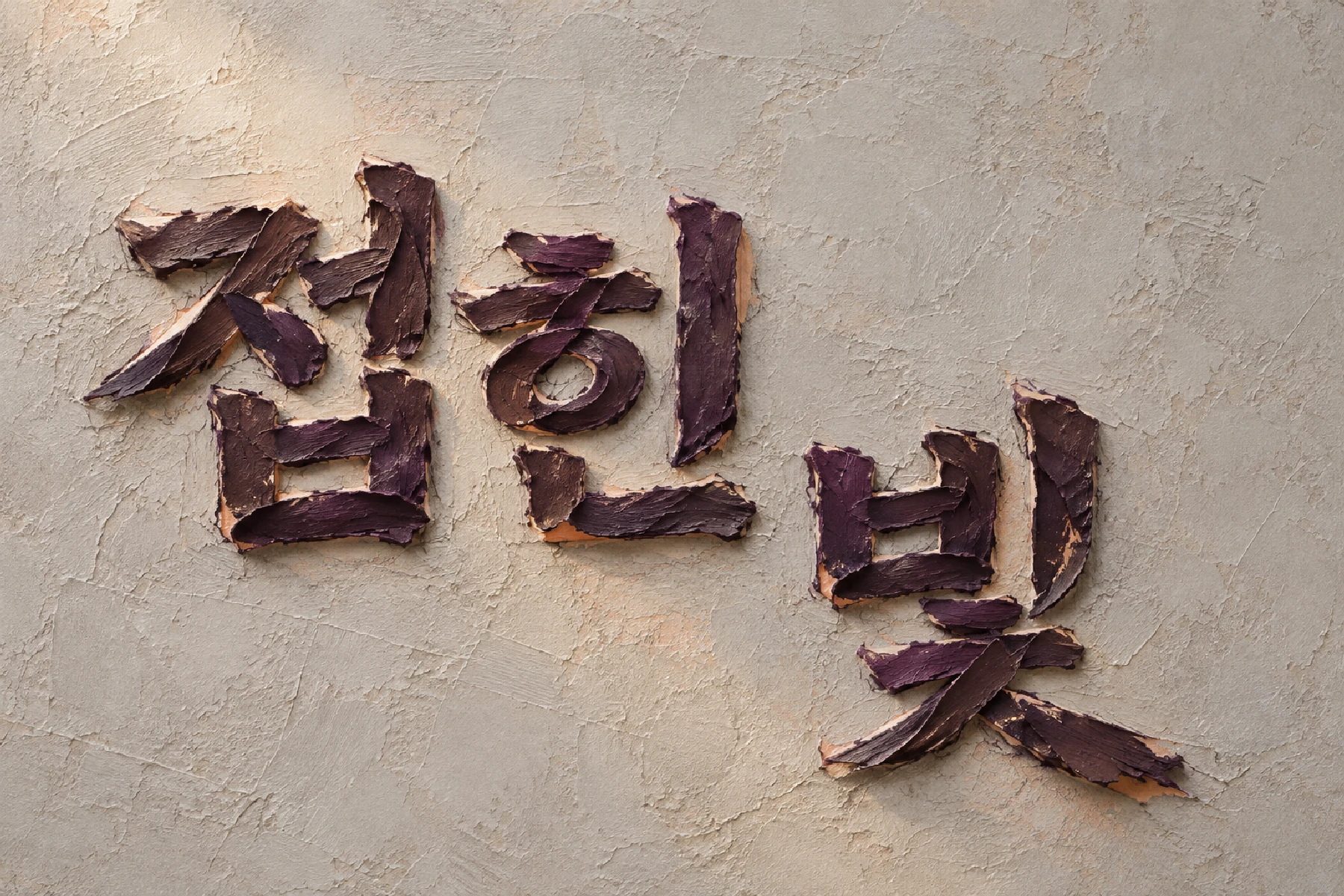
Heavy Hangul strokes rise in pigment relief and turn like folded planes. Asymmetric lettering and soft shadows give the spacious contemporary calligraphy a sculptural presence.
Remix this referenceFolded Light in Heavy Strokes
- Form language
- Use swelling masses interrupted by folded planar turns, with an expressive rhythm of expansion and compression.
- Contour
- Alternate firm knife-cut edges with soft dragged edges; taper selected endings abruptly rather than rounding every terminal.
- Mark-making
- Use broad painting-knife pulls with occasional narrow scrapes; let pressure changes create irregular ridges and interrupted tracks.
- Surface rendering
- Alternate dense impasto with rubbed thin passages; keep tonal transitions tactile and naturally uneven.
Priority
Emphasize bold sculptural forms with decisive planar turns.
What to avoid & what to check
Exact prompt for this example
MODULE OWNERSHIP
subject: Subject count, type, stable proportions and landmarks, resting face geometry, hair shape, physical materials, garment construction and permanent marks. No emotion, movement, color assignment or rendering recipe.
expression: Facial soft-tissue displacement and pupil direction, muscle coordination, regional intensity, asymmetry and onset/peak/release. No head/body pose, stable appearance, skin color or rendering.
gesture: Head/neck/body/limb orientation, joint movement, support, contact and pose-caused occlusion using existing anatomy. No eye/pupil movement, emotion, identity, props inventory or camera.
props: Prop count, type, construction, physical material and scale relative to the subject. Holding/contact belongs to gesture, position to composition, color to palette.
scene: Environment elements, terrain, backdrop/floor presence and structural detail. No canvas positions, camera, lighting, assigned colors or render texture.
camera: Projection, focal-length impression, camera elevation/yaw/roll, viewing distance and crop. No actor pose, world placement, lighting or canvas aspect ratio.
composition: Normalized 0-100% canvas positions, scale in frame, depth/overlap, focal hierarchy and margins. No joint pose, camera projection, rendering, subject/prop inventory or emotion.
palette: Color anchors, hue/saturation/value ranges, colors assigned to parts and approximate color coverage. No illumination direction, shading algorithm, physical material or layout.
lighting: Light-source direction/softness/intensity, ambient illumination, physical shadow direction/length and highlight position. Absence of directional illumination is allowed. No shading technique, palette or material changes.
style: Reusable form abstraction, contour weight/taper/edge quality, medium and mark scale/density/direction, surface rendering and tonal transition technique. No fixed subject proportions, anatomy, identity, expression, pose, palette, light-source direction, camera or layout.
output: Image count, aspect ratio, size, file/alpha requirements and global lettering/logo/watermark restrictions. No background scenery, crop, style, identity or pose.

SUBJECT
inventory: One original Hangul lettering relief; no people, animals or other figures.
geometry: The exact phrase is "접힌 빛". Preserve recognizable syllable blocks and open internal spaces between their components.
resting-face: No face is present.
appearance: The lettering consists of thick mineral-pigment paste with raised ridges, shallow troughs and occasional exposed substrate.

PRIORITY


AVOID


CHECK


PROPS
inventory: No separate props.
construction: No prop construction applies.

PRIORITY


AVOID


CHECK


SCENE
inventory: A continuous shallow wall surface supports the relief; no floor or surrounding room is visible.
structure: The wall has a broad, slightly recessed panel without a frame, joints or architectural ornament.

PRIORITY


AVOID


CHECK


CAMERA
projection: Use a restrained perspective with the compressed depth of a long-lens artwork photograph.
viewpoint: View almost straight toward the wall, slightly from its right side, with a level camera.
crop: Show the complete lettering and a generous surrounding expanse of wall.

PRIORITY


AVOID


CHECK


COMPOSITION
placement: Cluster the lettering left of center: the first word sits higher, while the second begins farther right and lower.
depth: Keep the lettering in one shallow layer against the wall, with clear gaps between neighboring syllables.
spacing: Make the lettering the dominant focus, with broad breathing room above and right and a generous outer margin.

PRIORITY


AVOID


CHECK


PALETTE
colors: Use deep aubergine, muted apricot and pale mineral gray as the principal color anchors.
assignment: Assign aubergine to the lettering, apricot to occasional exposed substrate, and mineral gray to the wall.
balance: Let the pale neutral dominate the image area; keep the dark lettering concentrated and the warm accent sparse.

PRIORITY


AVOID


CHECK


LIGHTING
sources: A broad soft source from the upper left grazes the relief, supported by gentle ambient light.
shadows: Raised strokes overlap their own short, soft cast shadows falling toward the lower right; shadows remain legible within shallow troughs.
highlights: Broad subdued highlights touch the upper-left ridges without sharp glare.

PRIORITY


AVOID


CHECK


STYLE GUIDE
form-language: Use swelling masses interrupted by folded planar turns, with an expressive rhythm of expansion and compression.
contour: Alternate firm knife-cut edges with soft dragged edges; taper selected endings abruptly rather than rounding every terminal.
mark-making: Use broad painting-knife pulls with occasional narrow scrapes; let pressure changes create irregular ridges and interrupted tracks.
surface-rendering: Alternate dense impasto with rubbed thin passages; keep tonal transitions tactile and naturally uneven.

PRIORITY
Emphasize bold sculptural forms with decisive planar turns.

AVOID


CHECK


OUTPUT
format: One finished image, landscape 3:2, 1800 × 1200 pixels, opaque PNG.
restrictions: Allow primary lettering; forbid additional text, logos and watermarks.

PRIORITY


AVOID


CHECK


FINAL INTEGRATION
subject + output: The sole permitted primary lettering is the phrase defined in subject.geometry: "접힌 빛".
Model information comes from image provenance. The same prompt may produce a different result.