Text to imageCharacterStyle guide
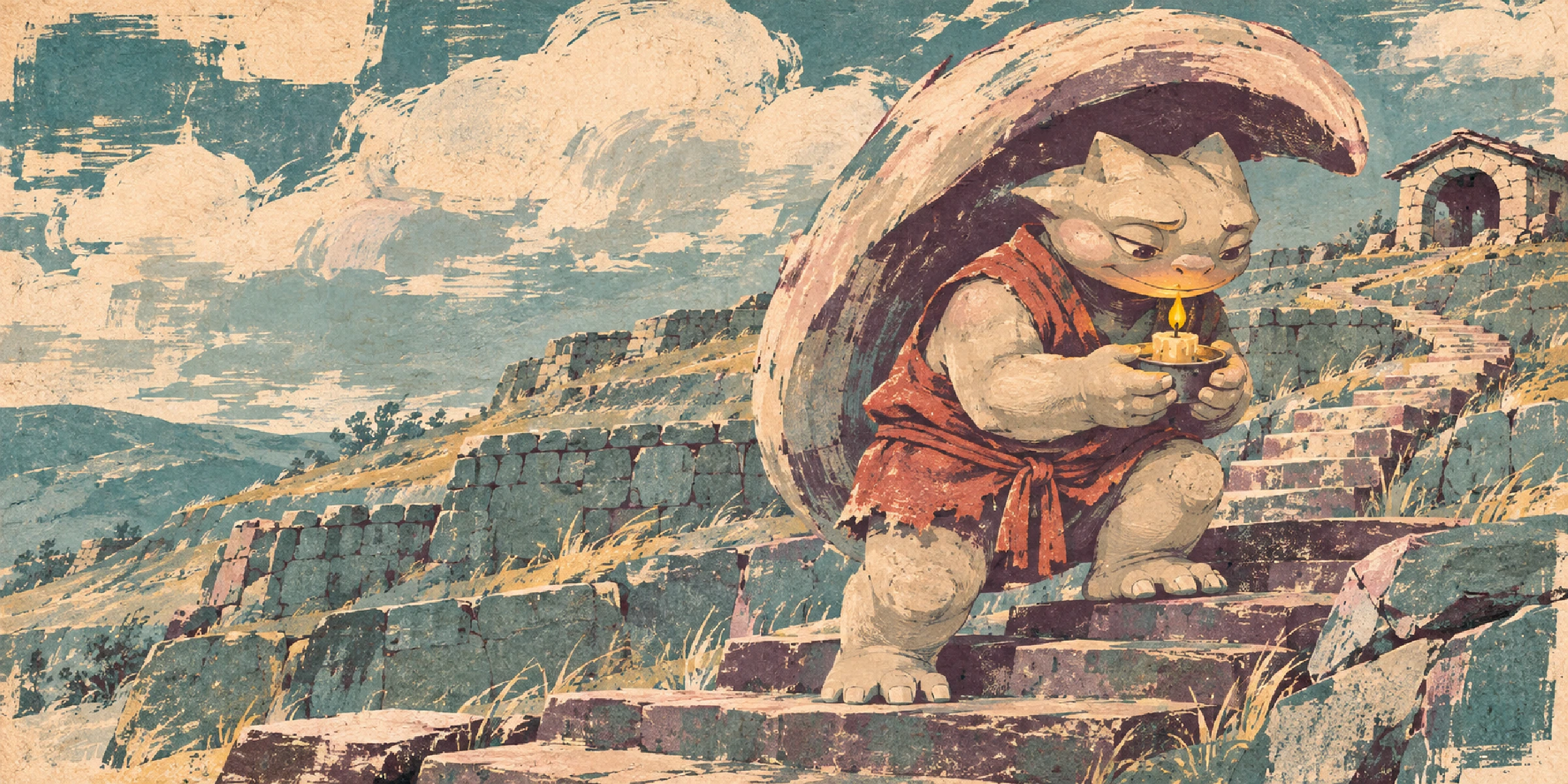
A Traveler Shielding a Candle with Its Tail
An unfamiliar traveler shields a candle with its broad tail on a hillside stair. Dragged ink and imperfect print layers open a winding journey toward a distant shelter.
Remix this referenceA Traveler Shielding a Candle with Its Tail
- Form language
- Compress forms into weighty silhouettes with angular cutout interruptions; let broad masses coexist with a few wiry internal fragments.
- Contour
- Brush contours swell into pooled edges, taper abruptly and disappear in dry gaps; avoid a uniformly enclosing outline.
- Mark-making
- Use dragged squeegee streaks, blunt brush scuffs and occasional loose reed-pen runs, with naturally changing pressure and spacing.
- Surface rendering
- Build tone from translucent overprints and ragged opaque blocks; uneven ink transfer exposes paper, with slight registration slips at selected edges.
Priority
Make the ink-and-print experimental poster treatment visibly physical through pressure, overlap and imperfect transfer.
What to avoid & what to check
Exact prompt for this example
MODULE OWNERSHIP
subject: Subject count, type, stable proportions and landmarks, resting face geometry, hair shape, physical materials, garment construction and permanent marks. No emotion, movement, color assignment or rendering recipe.
expression: Facial soft-tissue displacement and pupil direction, muscle coordination, regional intensity, asymmetry and onset/peak/release. No head/body pose, stable appearance, skin color or rendering.
gesture: Head/neck/body/limb orientation, joint movement, support, contact and pose-caused occlusion using existing anatomy. No eye/pupil movement, emotion, identity, props inventory or camera.
props: Prop count, type, construction, physical material and scale relative to the subject. Holding/contact belongs to gesture, position to composition, color to palette.
scene: Environment elements, terrain, backdrop/floor presence and structural detail. No canvas positions, camera, lighting, assigned colors or render texture.
camera: Projection, focal-length impression, camera elevation/yaw/roll, viewing distance and crop. No actor pose, world placement, lighting or canvas aspect ratio.
composition: Normalized 0-100% canvas positions, scale in frame, depth/overlap, focal hierarchy and margins. No joint pose, camera projection, rendering, subject/prop inventory or emotion.
palette: Color anchors, hue/saturation/value ranges, colors assigned to parts and approximate color coverage. No illumination direction, shading algorithm, physical material or layout.
lighting: Light-source direction/softness/intensity, ambient illumination, physical shadow direction/length and highlight position. Absence of directional illumination is allowed. No shading technique, palette or material changes.
style: Reusable form abstraction, contour weight/taper/edge quality, medium and mark scale/density/direction, surface rendering and tonal transition technique. No fixed subject proportions, anatomy, identity, expression, pose, palette, light-source direction, camera or layout.
output: Image count, aspect ratio, size, file/alpha requirements and global lettering/logo/watermark restrictions. No background scenery, crop, style, identity or pose.

SUBJECT
inventory: One original, clothed, terrestrial creature, actor A; no other figures.
geometry: A barrel-shaped torso, short sturdy legs, broad hands, a wedge-shaped crown and a long, wide, flexible tail with a blunt tip.
resting-face: A short flattened muzzle, widely spaced eyes, rounded cheek pads and a small mouth beneath a broad nose.
appearance: Supple hairless hide and a sleeveless wool wrap vest with an integral tie; minor folds and worn edges may vary naturally.

PRIORITY


AVOID


CHECK


EXPRESSION — ACTOR A
brows: Inner brow tissue draws slightly together, with one side a little lower.
lids: Upper lids lower slightly; lower lids remain gently firm.
cheeks: Cheek tissue stays mostly relaxed, with a faint lift beneath the eyes.
nose: Nostrils remain relaxed without a wrinkle across the nose.
mouth: Lips meet softly; one corner presses inward a little more.
jaw: The jaw remains closed without a clenched bulge.
gaze: Both pupils look downward toward the candle flame.
coordination: Gathered brows carry the effort while the relaxed lower face keeps it gentle.
timing: Hold the apex of quiet concentration, before any release.

PRIORITY


AVOID


CHECK


GESTURE
head: The neck inclines and the chin dips toward the hands, leaving the muzzle visible.
torso: The torso leans slightly uphill; the broad tail curls forward above the shoulders into a protective hood.
limbs: Pause mid-ascent with one foot on the higher step, the other supporting below, and elbows gathered near the ribs.
contact: Both palms cradle the candle cup; the tail shelters it without touching the flame or hiding the face.

PRIORITY


AVOID


CHECK


PROPS
inventory: One palm-sized candleholder assembly containing a short candle.
construction: A shallow tin cup with a rolled rim supports a thick wax stub and a single exposed wick.

PRIORITY


AVOID


CHECK


SCENE
inventory: An exposed hillside with a winding stone stair, abandoned retaining terraces, sparse grass and a small stone shelter.
structure: The stair crosses shallow gullies between broken terrace walls and reaches an arched shelter beneath a broad clouded sky.

PRIORITY


AVOID


CHECK


CAMERA
projection: Moderate wide-angle perspective with gentle distance recession and restrained edge distortion.
viewpoint: View from the downhill side at the creature's chest height, in a three-quarter view with a level horizon.
crop: A wide environmental full-body view includes the complete tail hood and enough distance to read the route.

PRIORITY


AVOID


CHECK


COMPOSITION
placement: A occupies the right third at roughly two-thirds image height; the stair enters at lower left and bends toward the distant upper-right shelter.
depth: The face and flame lead, the enclosing tail follows, and overlapping terrace bands carry attention into the distance.
spacing: Keep breathing room inside the tail arc and a generous open stretch across the left half; separate the silhouette from wall edges.

PRIORITY


AVOID


CHECK


PALETTE
colors: Chalk cream, deep plum, muted petrol teal, oxide red and a small sulfur-yellow accent.
assignment: Cream for hide and sky reserves, plum for dark accents, teal for terraces, oxide red for the vest and yellow for the flame.
balance: Cream and subdued teal dominate; the red garment forms a compact counterweight to the tiny, vivid flame.

PRIORITY


AVOID


CHECK


LIGHTING
sources: Soft sky light arrives broadly from upper left; the candle adds a small, weaker upward light beneath the face.
shadows: Diffuse shadows fall gently to the lower right; the tail hood leaves the face recessed but readable.
highlights: Broad highlights touch upper-left surfaces; small candle highlights catch the lower muzzle, fingers and cup rim.

PRIORITY


AVOID


CHECK


STYLE GUIDE
form-language: Compress forms into weighty silhouettes with angular cutout interruptions; let broad masses coexist with a few wiry internal fragments.
contour: Brush contours swell into pooled edges, taper abruptly and disappear in dry gaps; avoid a uniformly enclosing outline.
mark-making: Use dragged squeegee streaks, blunt brush scuffs and occasional loose reed-pen runs, with naturally changing pressure and spacing.
surface-rendering: Build tone from translucent overprints and ragged opaque blocks; uneven ink transfer exposes paper, with slight registration slips at selected edges.

PRIORITY
Make the ink-and-print experimental poster treatment visibly physical through pressure, overlap and imperfect transfer.

AVOID


CHECK


OUTPUT
format: One finished image, 2:1 landscape aspect ratio, 2400 × 1200 pixels, opaque PNG.
restrictions: No lettering, logos, signatures or watermarks.

PRIORITY


AVOID


CHECK
Model information comes from image provenance. The same prompt may produce a different result.