Text to imageProductStyle guide
Oval Paint Box with a Mixing Tile
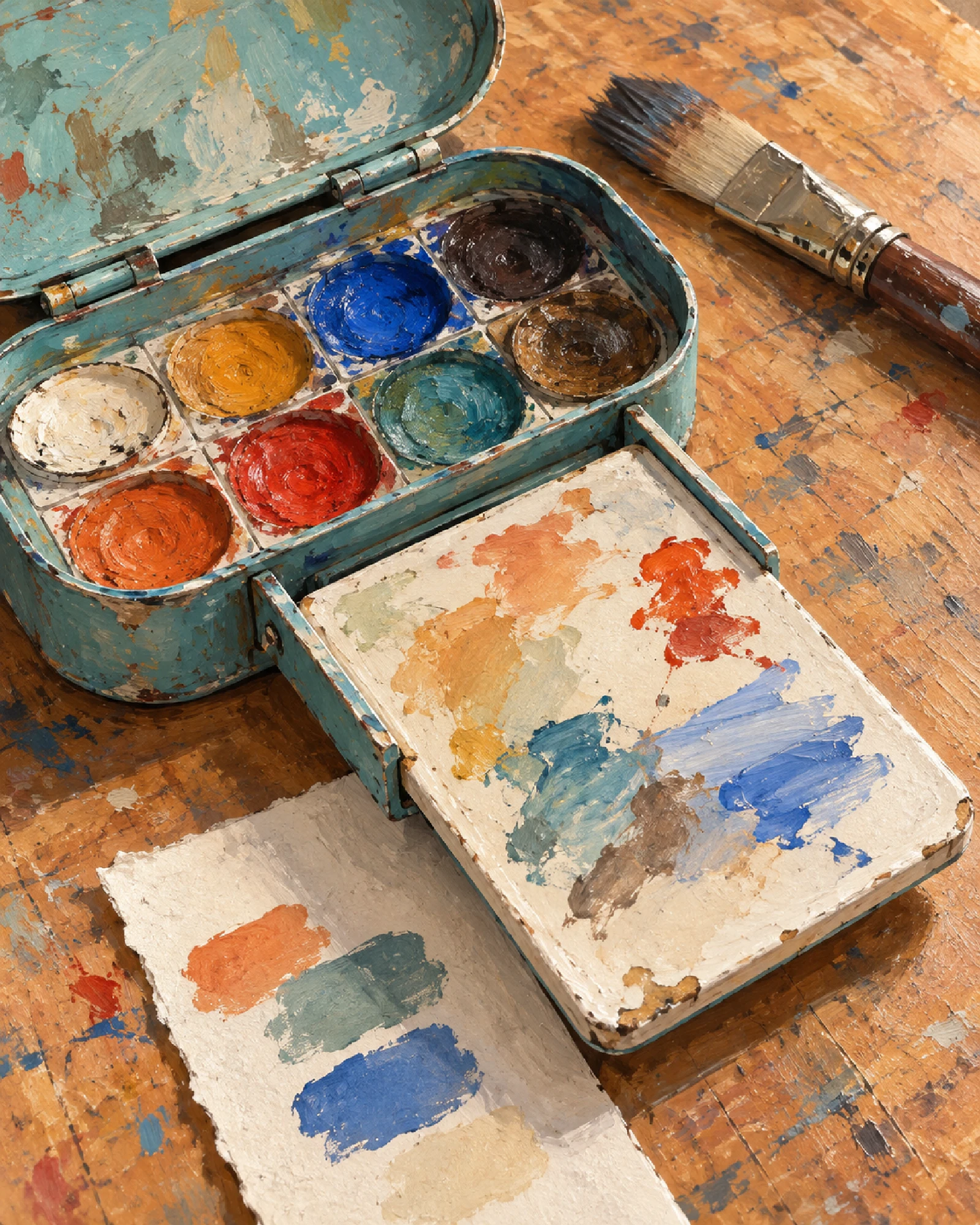
An intimate gouache study of a small oval paint box with an extended porcelain mixing tile. Opaque brushwork and residual paint give the working tool a tactile, personal presence.
Remix this referenceOval Paint Box with a Mixing Tile
- Form language
- Describe objects with slightly uneven blocks and rounded planar turns; let minor details vary within a coherent hand-painted vocabulary.
- Contour
- Build contours from adjoining brush shapes rather than a continuous outline; alternate firm edges with softly lost passages.
- Mark-making
- Use visible flat-brush sweeps, blunt dabs, and occasional dry skips; retain changes of stroke direction around curved forms.
- Surface rendering
- Layer opaque gouache patches with scumbled undercolor and chalky light strokes; step between tones without polishing every transition.
Priority
Preserve the loose gouache character through visible opaque brushwork and selective unfinished edges.
What to avoid & what to check
Exact prompt for this example
MODULE OWNERSHIP
subject: Subject count, type, stable proportions and landmarks, resting face geometry, hair shape, physical materials, garment construction and permanent marks. No emotion, movement, color assignment or rendering recipe.
expression: Facial soft-tissue displacement and pupil direction, muscle coordination, regional intensity, asymmetry and onset/peak/release. No head/body pose, stable appearance, skin color or rendering.
gesture: Head/neck/body/limb orientation, joint movement, support, contact and pose-caused occlusion using existing anatomy. No eye/pupil movement, emotion, identity, props inventory or camera.
props: Prop count, type, construction, physical material and scale relative to the subject. Holding/contact belongs to gesture, position to composition, color to palette.
scene: Environment elements, terrain, backdrop/floor presence and structural detail. No canvas positions, camera, lighting, assigned colors or render texture.
camera: Projection, focal-length impression, camera elevation/yaw/roll, viewing distance and crop. No actor pose, world placement, lighting or canvas aspect ratio.
composition: Normalized 0-100% canvas positions, scale in frame, depth/overlap, focal hierarchy and margins. No joint pose, camera projection, rendering, subject/prop inventory or emotion.
palette: Color anchors, hue/saturation/value ranges, colors assigned to parts and approximate color coverage. No illumination direction, shading algorithm, physical material or layout.
lighting: Light-source direction/softness/intensity, ambient illumination, physical shadow direction/length and highlight position. Absence of directional illumination is allowed. No shading technique, palette or material changes.
style: Reusable form abstraction, contour weight/taper/edge quality, medium and mark scale/density/direction, surface rendering and tonal transition technique. No fixed subject proportions, anatomy, identity, expression, pose, palette, light-source direction, camera or layout.
output: Image count, aspect ratio, size, file/alpha requirements and global lettering/logo/watermark restrictions. No background scenery, crop, style, identity or pose.

SUBJECT
inventory: One original pocket paint box with an integrated lid, pigment tray, and sliding mixing tile.
geometry: The shallow oval case has a long-edge hinge, rounded pigment wells, and a broad tile carried by side rails.
resting-face: No faces are present.
appearance: An enamel-coated metal shell surrounds pressed pigment cakes; the porcelain tile bears residual paint and small edge chips.

PRIORITY


AVOID


CHECK


GESTURE
head: No head-joint control targets apply.
torso: The case rests level, with its lid raised on the hinge and its mixing tile slid outward along the rails.
limbs: No limb-joint control targets apply.
contact: The tabletop supports the case, and the side rails support the mixing tile.

PRIORITY


AVOID


CHECK


PROPS
inventory: One broad paintbrush, slightly longer than the box, and one small sheet of swatch paper.
construction: The brush has a wooden handle, metal ferrule, and flattened bristle bundle; the paper has a softly torn edge.

PRIORITY


AVOID


CHECK


SCENE
inventory: A worn studio worktable provides the entire visible environment.
structure: The tabletop is a continuous wooden surface with shallow dents and old paint deposits; no room architecture is visible.

PRIORITY


AVOID


CHECK


CAMERA
projection: Use natural perspective with a normal-lens impression and little optical distortion.
viewpoint: Look down from a close, oblique overhead viewpoint, with no camera roll.
crop: Make an intimate detail crop that reveals the case interior and tile while clipping the far lid edge and brush handle.

PRIORITY


AVOID


CHECK


COMPOSITION
placement: The box runs diagonally through the left half; its tile occupies the lower-right portion of the frame.
depth: The lid overlaps the tray; the tile overlaps the swatch paper, while the brush makes a loose counter-diagonal.
spacing: Concentrate attention on the tile-to-case junction, leaving an irregular quiet patch of tabletop at the upper right.

PRIORITY


AVOID


CHECK


PALETTE
colors: Use dusty turquoise, warm cream, apricot, and deep umber, with small concentrated pigment accents.
assignment: Give the case turquoise, the tile and paper cream, the table apricot, and the brush handle umber.
balance: Keep most colors muted; reserve stronger vermilion and ultramarine for pigment cakes and a few mixed paint traces.

PRIORITY


AVOID


CHECK


LIGHTING
sources: Soft window light comes from the upper right, with gentle ambient fill across the work surface.
shadows: Short, soft shadows fall toward the lower left; the lid creates a deeper sheltered shadow inside the case.
highlights: Broad restrained highlights touch the upper-right rim and tile edge, with no dazzling specular points.

PRIORITY


AVOID


CHECK


STYLE GUIDE
form-language: Describe objects with slightly uneven blocks and rounded planar turns; let minor details vary within a coherent hand-painted vocabulary.
contour: Build contours from adjoining brush shapes rather than a continuous outline; alternate firm edges with softly lost passages.
mark-making: Use visible flat-brush sweeps, blunt dabs, and occasional dry skips; retain changes of stroke direction around curved forms.
surface-rendering: Layer opaque gouache patches with scumbled undercolor and chalky light strokes; step between tones without polishing every transition.

PRIORITY
Preserve the loose gouache character through visible opaque brushwork and selective unfinished edges.

AVOID


CHECK


OUTPUT
format: Produce one finished image, portrait 4:5, 1600 × 2000 pixels, as an opaque PNG.
restrictions: Include no lettering, labels, logos, signatures, or watermarks.

PRIORITY


AVOID


CHECK


FINAL INTEGRATION
subject + camera + composition: Keep the integrated parts understandable within the close framing while allowing the surrounding edges to remain incidental.
style + palette + lighting: Let brushwork interpret the established colors and illumination while preserving the distinction between adjacent surfaces.
Model information comes from image provenance. The same prompt may produce a different result.