Text to imageIllustrationStyle guide
One Scallop Shell · Radial Rib Spacing
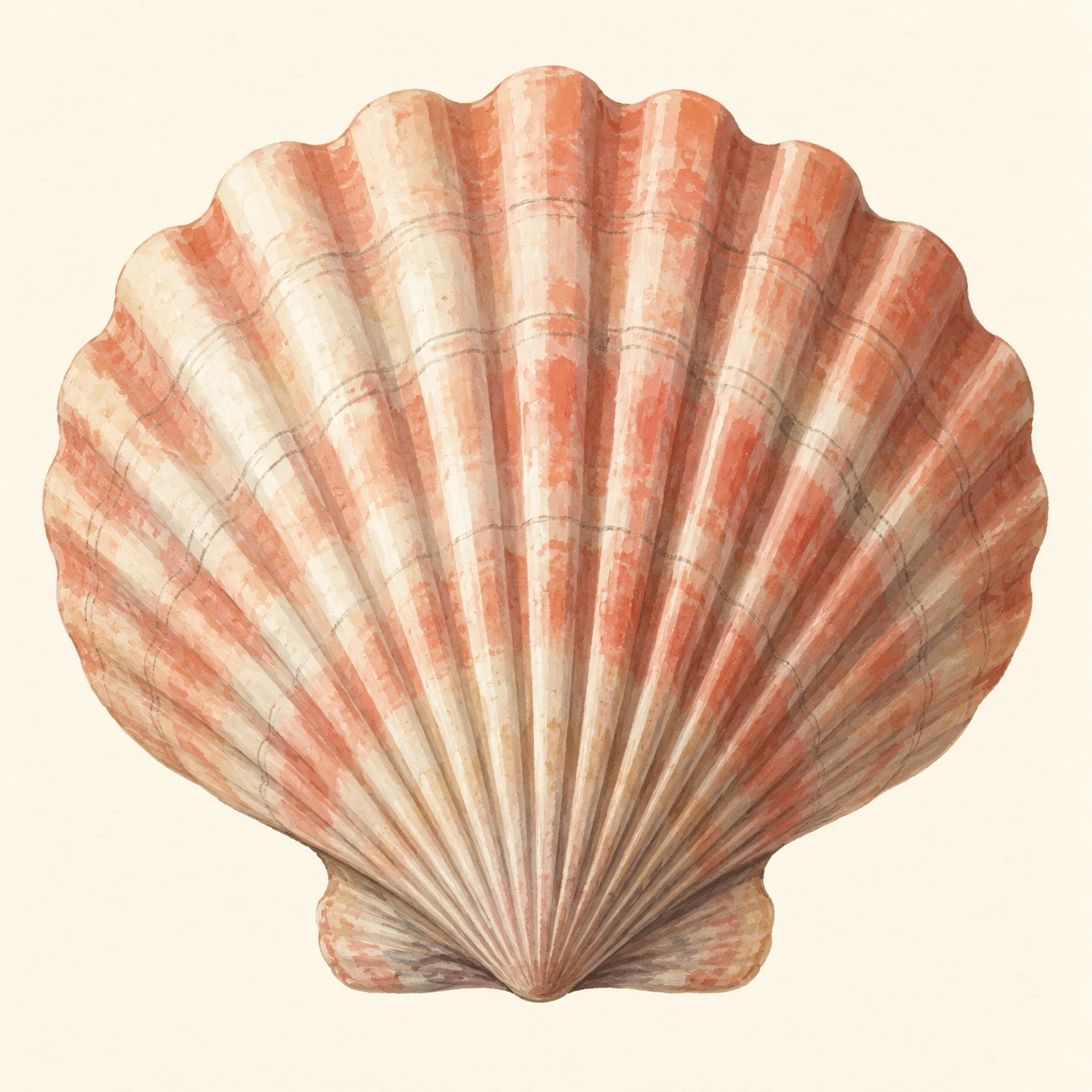
Describe a scallop shell’s fan-shaped structure through ribs and grooves that spread from a narrow hinge toward a broad rim.
One Scallop Shell · Radial Rib Spacing
- Shape & line
- Build the silhouette as a broad fan above a small hinge. Draw ribs that converge tightly at image-bottom center and separate progressively toward image-top; align each rounded rim lobe with a raised rib and each intervening notch with a groove.
- Color & light
- Use muted coral and cream under a light arriving from image-upper left. Give each raised rib a pale image-left flank and a darker image-right flank, keeping the grooves darker than the crests so the radial relief remains readable across the shell.
- Texture & material
- Lay down matte gouache in broad, quiet patches, then add a few thin pencil growth arcs crossing several ribs. Let these arcs curve around the dome and soften across bright crests; preserve the ribs as the dominant texture rather than filling every groove with marks.
- Composition
- Place the hinge below the image center and let the fan occupy most of the upper half. Keep the background uniform and the outer contour clear, so the eye can follow the widening rib intervals from the hinge to the rim without competing objects.
Priority
Prioritize continuous radial ribs whose spacing visibly widens toward the rim.
What to avoid & what to check
Avoid parallel ribs, disconnected rim lobes, and glossy plastic highlights.
Check that the ribs converge at the lower hinge and meet matching lobes along the upper rim.
Exact prompt for this example
SUBJECT
Draw exactly one empty scallop shell with its convex exterior facing the viewer. Its narrow hinge sits at image-bottom center, and its broad scalloped rim opens toward image-top. Raised ribs radiate continuously from the hinge to the rim.

COMPOSITION
Use a nearly frontal view with a slight tilt that reveals the shell’s shallow dome. Center the complete shell on a plain warm ivory background, leaving generous margins and keeping the hinge and every rim lobe visible.

STYLE GUIDE
1. Shape & line
Build the silhouette as a broad fan above a small hinge. Draw ribs that converge tightly at image-bottom center and separate progressively toward image-top; align each rounded rim lobe with a raised rib and each intervening notch with a groove.

2. Color & light
Use muted coral and cream under a light arriving from image-upper left. Give each raised rib a pale image-left flank and a darker image-right flank, keeping the grooves darker than the crests so the radial relief remains readable across the shell.

3. Texture & material
Lay down matte gouache in broad, quiet patches, then add a few thin pencil growth arcs crossing several ribs. Let these arcs curve around the dome and soften across bright crests; preserve the ribs as the dominant texture rather than filling every groove with marks.

4. Composition
Place the hinge below the image center and let the fan occupy most of the upper half. Keep the background uniform and the outer contour clear, so the eye can follow the widening rib intervals from the hinge to the rim without competing objects.

PRIORITY
Preserve the requested identity, count, action, composition and output settings. Apply the style rules within those constraints; a style reference must not replace the subject or layout. Within the style: Prioritize continuous radial ribs whose spacing visibly widens toward the rim.

AVOID
Avoid parallel ribs, disconnected rim lobes, and glossy plastic highlights.

OUTPUT
Produce one square editorial illustration in opaque gouache with fine pencil accents. Include no lettering, labels, border, or watermark.

SELF-CHECK
Check that the ribs converge at the lower hinge and meet matching lobes along the upper rim.
Model information comes from image provenance. The same prompt may produce a different result.